September 8, 2026
Bonus Content: Home Depot’s Real Growth Engine Isn’t the Housing Market
American Energy Is Powering a Trillion-Dollar Buildout.
In the 1800s, John D. Rockefeller refined oil into the world’s most valuable fuel. He did not invent demand. He positioned himself at the chokepoint of it.
Now, another company is creating its own “Rockefeller Moment” with the one commodity artificial intelligence cannot run without: electricity.
Global AI spending is projected at $2 trillion, and all of it depends on power that has not been built yet. The United States must more than triple its annual power capacity, from 25 gigawatts of data center demand in 2024 to more than 80 gigawatts by 2030 to meet this expected demand.
American PowerGen is developing a 22 gigawatt pipeline of natural gas power generation to serve exactly that demand. The company is leading efforts in Texas, where large new electricity users have already requested more than 430 gigawatts of new power – nearly 5x the state’s current peak capacity.
Land is secured across multiple ERCOT zones. Natural gas supply is arranged. ERCOT interconnection studies are completed. Air permits are submitted. 3 gigawatts of that pipeline begins construction in 2027.
The team behind it has 12 successful power plant exits: CEO Peter Perri III with 20+ years in power infrastructure, and CFO Vince Palmieri with 25+ years in infrastructure investing.
Become an American PowerGen shareholder before the Early Investor Bonus ends to lock in the $2.50 share price and receive up to 17% bonus shares.
Minimum investment: $1,000.
Home Depot’s Real Growth Engine Isn’t the Housing Market
The housing market is frozen. Mortgage rates are sitting near 6.7%, a multi-week climb that pushed the average 30-year fixed rate to its highest level since mid-2025. Existing homeowners are not selling. Would-be renovators are not spending. And yet Home Depot just posted one of its cleaner quarters in recent memory, because the company has been quietly rebuilding itself around customers who do not wait for rate cuts before picking up a nail gun.
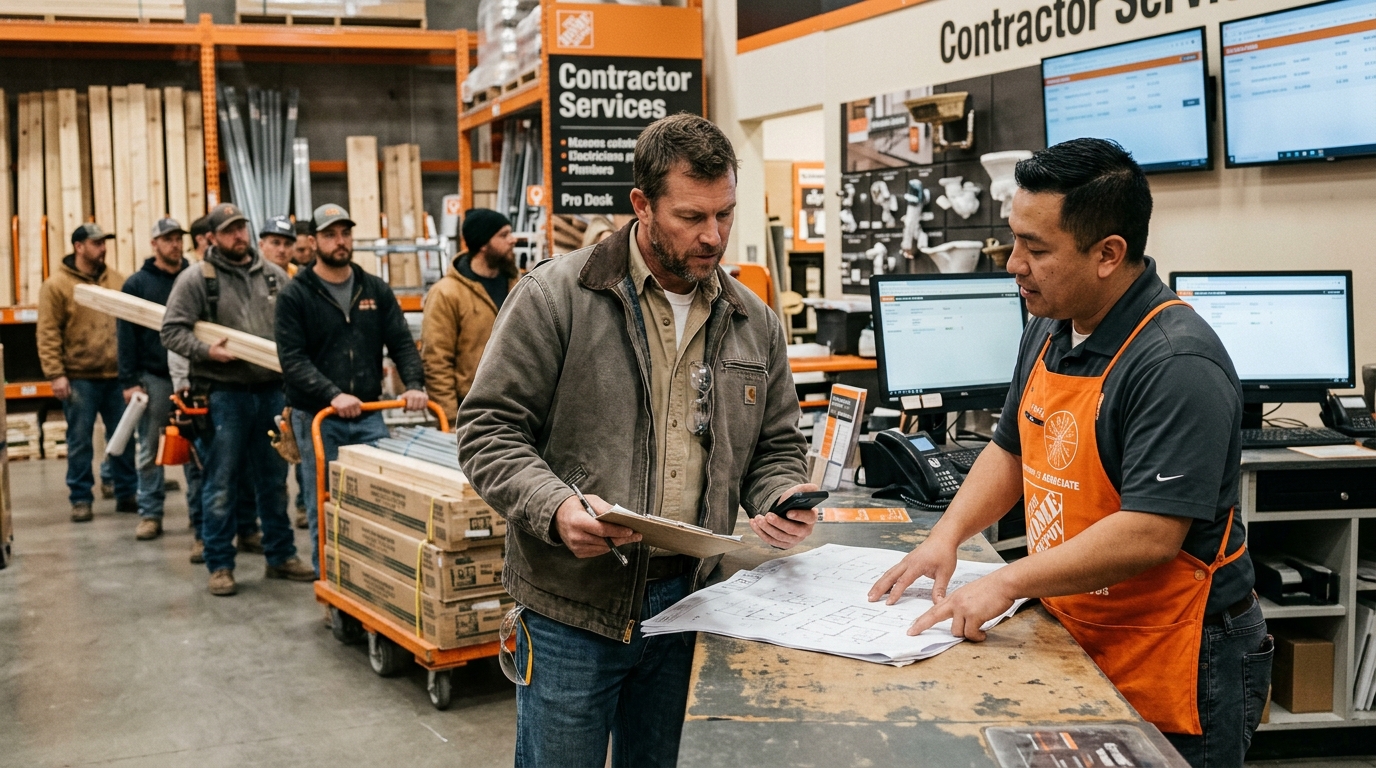
Second-quarter sales rose 5.7% to $47.9 billion, with net earnings up to about $4.8 billion. Comparable sales among the Pro customer outperformed DIY, and strength appeared across Pro-heavy categories including portable power, decking, dimensional lumber, pipe and fittings, fasteners, hand tools, and concrete. These are not the product lines of a homeowner adding a backsplash. They are the worksite staples of contractors with active job orders.
The distinction matters more than it looks. CFO Richard McPhail has described the backdrop as “frozen housing market conditions,” while also emphasizing that Home Depot is taking share and serving customers better. That share gain is the actual story. Pro operations represented more than $90 billion of Home Depot’s $164.7 billion in fiscal 2025 sales, and outperformed DIY in early fiscal 2026 with positive comparable sales.
What is driving contractor activity if housing is slow? The commercial side is picking up the slack. Total nonresidential building activity is forecast to grow 8.7% in 2026, an upgrade of more than five percentage points from the prior forecast, with year-to-date construction starts through June up 6.5% year-on-year. Much of that acceleration is tied to data center construction driven by AI investment, but the downstream effect is real: contractors are busy, and busy contractors buy supplies.
Home Depot has spent three years buying its way into that supply chain. The $18.25 billion acquisition of SRS Distribution in 2024 was central to the Pro strategy, while the subsequent acquisition of GMS expanded reach into specialty building products. The Mingledorff’s deal added 42 HVAC distribution locations across five Southeastern states and pushed the company’s stated addressable market to $1.2 trillion. SRS provides a specialized distribution network for professional customers, while Home Depot’s 2,364 stores serve as local fulfillment points for rapid delivery, giving the company capabilities that once differentiated local and regional distributors.
The risk here is concentration. Professional spending is less discretionary and more tied to repair, maintenance, and commercial projects, which provides stability, but data centers are doing an outsized share of the work inside “private office” construction. If AI capital spending cools faster than expected, the commercial tailwind weakens with it.
For traders, the level to watch on HD is how management characterizes Pro momentum on the Q3 call in November. Shares are trading near $327, down roughly 9% year to date as of September 8, 2026, as the market discounts integration risk from back-to-back acquisitions. If comparable Pro sales accelerate further in the back half, that discount closes fast.