
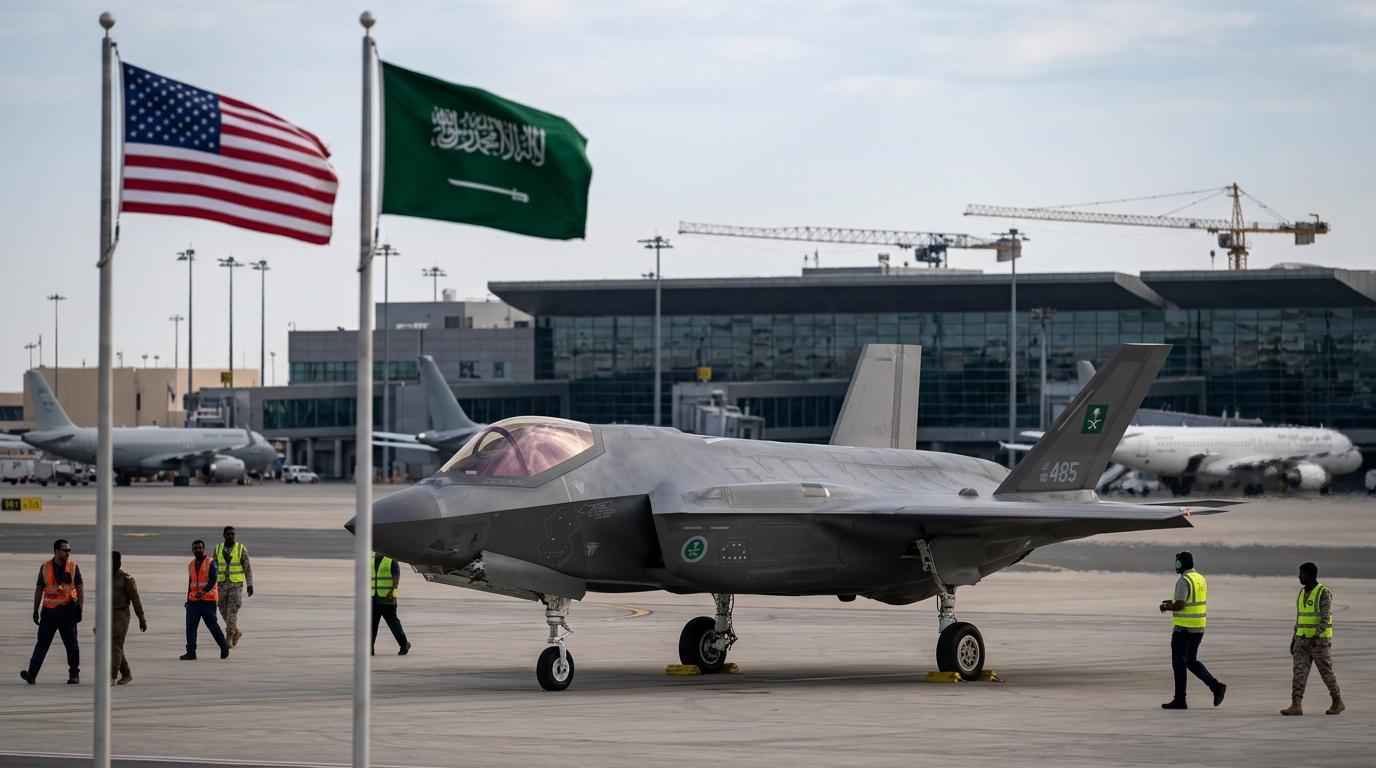
The question worth asking this week is not whether Congress will debate the $24.3 billion Saudi F-35 deal. It will. The more useful question for investors is what the approval says about where Lockheed Martin stands right now, before a single jet crosses the Atlantic.
Why This Stock Now
The State Department approved a potential $24.3 billion sale of 48 Lockheed Martin F-35A fighters to Saudi Arabia on Thursday, September 17, 2026. The timing is pointed: the potential sale comes as Saudi Arabia faces growing security threats from Yemen’s Iran-backed Houthis, with Saudi territory having come under drone and missile attacks. Gulf diplomacy around Iran resumes in the days ahead. Riyadh is not window shopping.
The Business
Lockheed is the world’s largest defense contractor by revenue, and the F-35 is its spine. The company derived 72% of its $75.0 billion in 2025 sales from the U.S. government. That duration matters. Most industrials sell widgets into a demand cycle. Lockheed sells weapons systems that require decades of sustainment, upgrades, and spare parts. If it goes through, Saudi Arabia would be the only Arab country that uses F-35s, adding a new sovereign customer to a platform already threading through allied air forces worldwide.
Why Wall Street Is Paying Attention
As of June 28, 2026, Lockheed’s ending backlog was $230.4 billion, an increase of $36.8 billion during the first six months of the year, driven primarily by an undefinitized contractual action awarded for the THAAD program. That figure is a record. For context, the company carried a $160.6 billion backlog at the end of 2023. In roughly two and a half years, Lockheed has added about $70 billion in future work.
In Q2 2026 alone, the company booked $65 billion in new orders, taking backlog to a record $230 billion, on sales of $20.1 billion versus $18.2 billion in the second quarter of 2025. The company generated $2.9 billion in free cash flow and raised its 2026 guidance, reflecting confidence in sustained profitable growth. Full-year sales guidance now stands at $79.75 billion to $81.75 billion, representing approximately 8% growth, with EPS guided to $29.95 to $30.65 and free cash flow of $7.0 billion to $7.2 billion.
The record backlog surged to $230 billion, up about $64 billion year over year, with a book-to-bill ratio of 3.2:1 driven by major missile-defense and munitions awards led by the THAAD interceptor procurement. No large-cap industrial peer is producing book-to-bill anywhere near that level.
What’s Driving the Opportunity
The Saudi deal is additive, not foundational. Saudi Arabia has requested 49 Pratt and Whitney F135-PW-100 engines, and the package covers spare parts, consumables, accessories, repair-and-return services, and support equipment for the aircraft and their munitions. The $24.3 billion ceiling equals roughly $506 million per requested aircraft, compared with a cited F-35A flyaway price near $82.5 million, leaving the bulk of the value in engines, software, cryptography, electronic warfare support, spares, simulators, training and logistics, work that sustains revenue for years after delivery.
LMT trades at approximately $533 today, well below its 52-week high of $692. The average 12-month analyst price target sits around $640, with a high estimate of $756. The stock is pricing in congressional risk on the Saudi deal and little credit for the broader backlog acceleration. That may be the real opportunity.
What Could Go Wrong
Congressional opposition to this particular sale carries more weight than usual. In a letter released last year by Reps. Raja Krishnamoorthi and Joe Courtney and Sen. Chris Van Hollen, the lawmakers said a Pentagon intelligence assessment raised concerns about potential Chinese access to Saudi air bases, as well as the kingdom’s use of telecommunications equipment supplied by Huawei and ZTE. Krishnamoorthi, a senior Democrat on the House Intelligence Committee, said the sale should not go forward when the intelligence community is warning it could put sensitive American military technology within reach of China.
The deal must go through congressional review and could still get stuck. Even if approved, it would take several years before the first jets were supplied to the Saudis. Investors pricing in 2026 revenue from this contract are getting ahead of reality. Separately, Lockheed relies overwhelmingly on U.S. and foreign governments for revenue, making any budget pressure or continuing-resolution risk a direct earnings threat.
The Bottom Line
The Saudi F-35 approval is a catalyst, but the investment case for Lockheed rests on something more durable: a $230 billion backlog built across THAAD and the F-35 program, expanding at a pace no industrial peer is matching. The stock sits roughly 23% below its 52-week high while guidance goes up and free cash flow rebounds sharply. That gap between operational momentum and current price is what makes LMT the most compelling large-cap industrial to own today.