September 27, 2026
Bonus Content: Warehouse Robots Are Hitting a Traffic Jam. AI Just Fixed It.

America’s Emergency Oil Reserve Just Hit A 44 Year Low
It is 40.6% full. Here is why that reaches your grocery bill and your retirement account.
284.6M
BARRELS REMAINING
Week ending September 18, 2026. EIA Weekly Petroleum Status Report, released September 21.
The Strategic Petroleum Reserve is the country’s emergency crude stockpile. Its job is to soak up a supply shock before that shock reaches the price you pay.
Federal data now puts it at 289.7 million barrels, roughly 40.6% of its 714 million barrel authorized capacity. That is the lowest level since 1982.
The short version of how it got there:
✔ Before February 28 of this year, the reserve held roughly 415 million barrels.
✔ After the Strait of Hormuz was disrupted, a chokepoint carrying close to 20% of global oil supply, President Trump authorized a 172 million barrel release in March.
✔ That release was part of a coordinated international effort, with IEA member nations collectively committing 400 million barrels. Reported as the largest emergency stock mobilization the agency has ever run.
✔ The reserve has kept draining since. It fell another 3.7 million barrels in the most recent reported week alone.
One analyst note circulated by CNBC put it bluntly, calling this another inflation impulse and saying the country effectively has no strategic reserve left to speak of.
That’s rhetoric. 289.7 million barrels is still a real stockpile, and it sits above the statutory minimum of 252.4 million barrels set under the Energy Policy and Conservation Act. Anyone telling you the tank is empty is overselling it.
But the cushion is thinner than it has been in more than four decades, and thin cushions matter for one reason.
Energy feeds into nearly everything you buy, from groceries and freight to utilities and building materials. When oil moves and there’s less reserve on hand to blunt it, more of that move ends up on the shelf. Gasoline has been running around $4.08 a gallon in recent reporting.
Inflation doesn’t arrive as an event. It works as a slow subtraction from every dollar you’ve already put away.
A retirement account does not need a crash to lose ground. It only needs prices to keep rising faster than the account grows.
This is the kind of stretch gold has historically been held for. It promises nothing about returns. It’s savings held outside the currency and outside the paper system.
Central banks seem to think so too. The World Gold Council reported they bought a net 288.9 tonnes of gold in the second quarter of this year, up 62% from a year earlier.
The tax code allows eligible IRA, 401(k), TSP, and 403(b) savings to be diversified into physical gold and silver through a properly structured self directed IRA, generally without triggering a taxable distribution when the transfer is handled correctly.
Send me the FREE Precious Metals Retirement Guide

Inside your free guide:
✔ How energy shocks have historically fed into consumer inflation, and how quickly.
✔ How gold has behaved during past inflationary stretches.
✔ How a Gold IRA generally works, and how you may be eligible to move a portion of an existing IRA, 401(k), TSP, or 403(b) into physical metals.
✔ How physical metals can help diversify savings outside the paper system.
✔ A simple, conservative way to get started.
Or call 1-888-691-8238 to speak with a precious metals specialist.
The reserve was the cushion. There’s a lot less of it now.
Warehouse Robots Are Hitting a Traffic Jam. AI Just Fixed It.
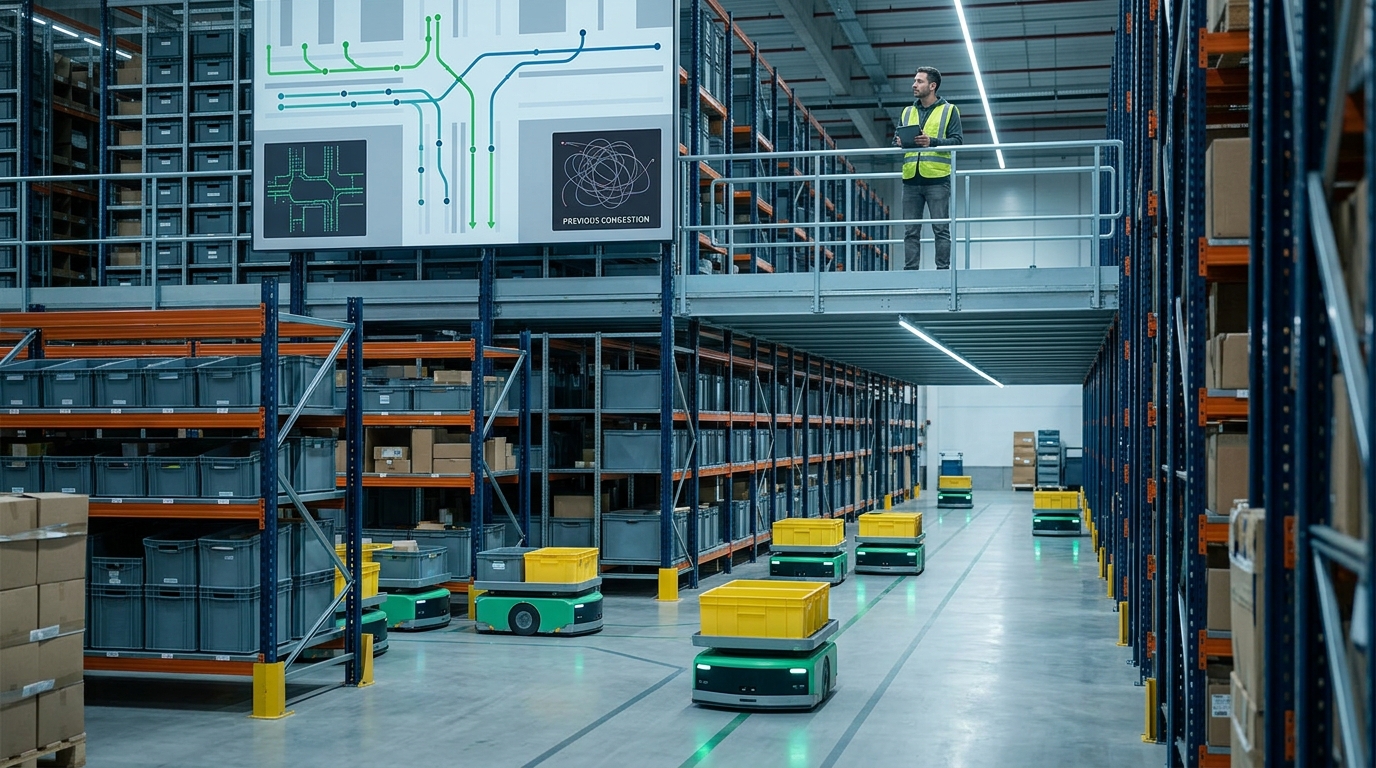
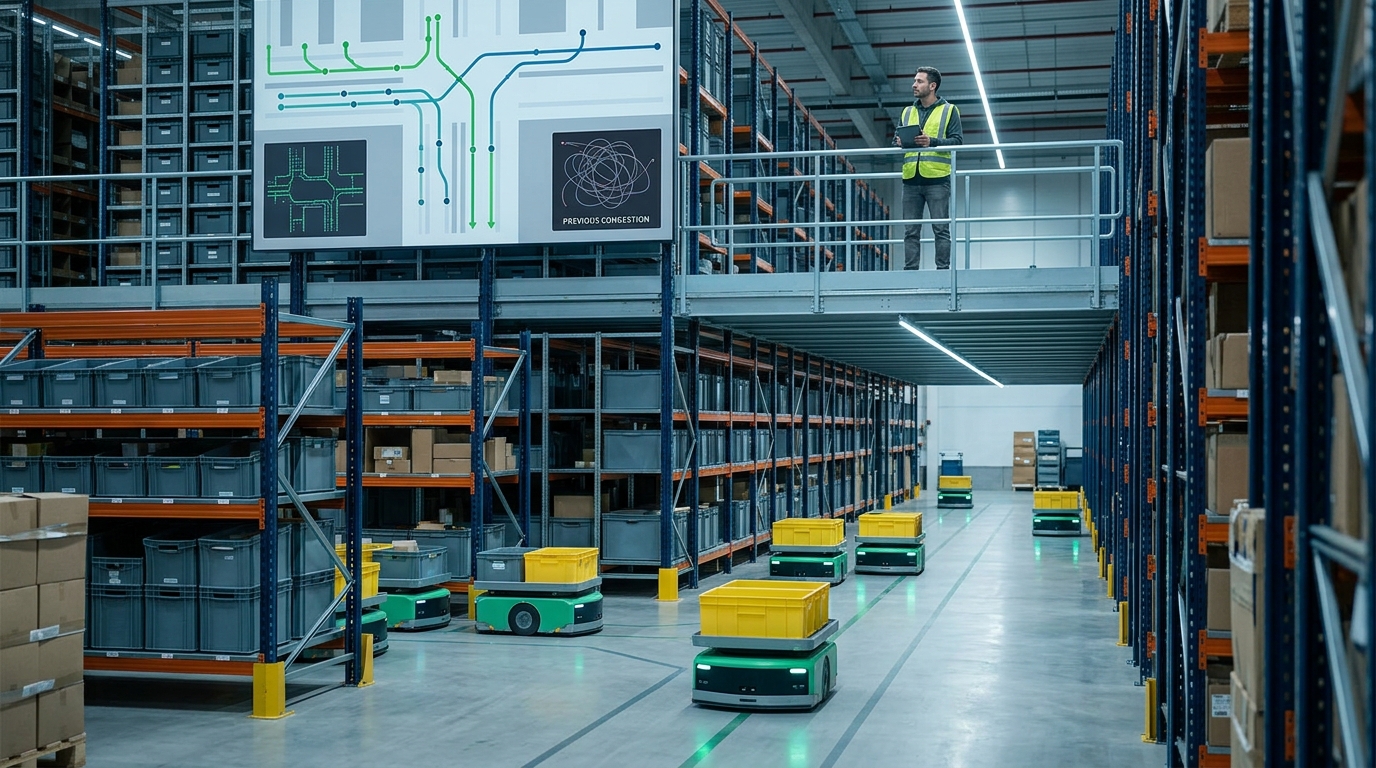
Every logistics operator scaling a robot fleet eventually hits the same wall. Add more autonomous mobile robots and throughput should rise proportionally. Instead, at higher robot densities, everything can slow: robots queue in narrow aisles, minor conflicts cascade, and in the worst cases the facility can suffer major interruptions while humans untangle the gridlock.
That problem, not picking accuracy or sorting speed, is a key ceiling on next-day delivery performance in 2026. And in March 2026, researchers at MIT and Symbotic published a method that addresses it directly.
The hybrid AI system uses deep reinforcement learning to determine which robots should be prioritized at any given moment, combined with a planning algorithm that directs movements in real time. It anticipates bottlenecks and reroutes robots before congestion forms, achieving about a 25% throughput increase over conventional approaches in simulations inspired by e-commerce warehouse environments.
To put that figure in context: a fulfillment center processing 100,000 packages daily would gain about 25,000 additional packages without adding a single robot. When each autonomous mobile robot carries a price tag that can run from roughly $30,000 into six figures depending on class and configuration, a 25% productivity gain from existing hardware can change the automation ROI equation.
Meanwhile, the computer vision layer that feeds sorting decisions keeps advancing at the hardware level. Some vendors now claim 98%-plus defect detection accuracy at speeds up to 20 items per second, versus 80 to 85% for human inspectors, and edge processing can deliver decisions in 1 to 10 milliseconds rather than the 50 to 200 milliseconds often cited for cloud round trips. That latency gap matters on a conveyor line where packages move continuously and a misread label means a misdirected parcel.
The live deployments confirm the gains are real. Prime Vision deployed a fully flexible robotic sorting system inside an existing DHL facility in Germany; during peak days, up to 75 robots operated simultaneously, sorting as many as 13,000 parcels per shift. The complete solution was operational within two weeks, without construction work or permanent modifications to the facility. Prime Vision has also said it is continuing to iterate on the concept.
Symbotic, separately, has pointed to material gains from its routing software, and it has also rolled out a next-generation storage structure aimed at boosting storage density and case-handling speed.
The market figures behind all of this are large. One major industry forecast pegged the global warehouse automation market at about $36.24 billion in 2026 and projected it to reach about $119.86 billion by 2034, implying a roughly 16% compound annual growth rate. U.S. e-commerce estimates for the first quarter of 2026 rose 9.7% year over year, which keeps the pressure on fulfillment speed firmly in place.
Supply chain leaders in 2026 face the same fundamental pressures they always have, just at higher intensity. Orders are less predictable, labor is harder to find, and delivery windows that were considered aggressive two years ago are now considered the bare minimum.
The practical implication for traders watching this space: the constraint that limits warehouse throughput is no longer the robot itself. It is the software that coordinates the fleet. The constraint shared by every major automation model is not the hardware. MIT researchers working with Symbotic identified fleet coordination, not individual robot capability, as the primary bottleneck in large-scale automated fulfillment. Companies selling coordination intelligence, not just iron, are where the durable margin will accumulate.