
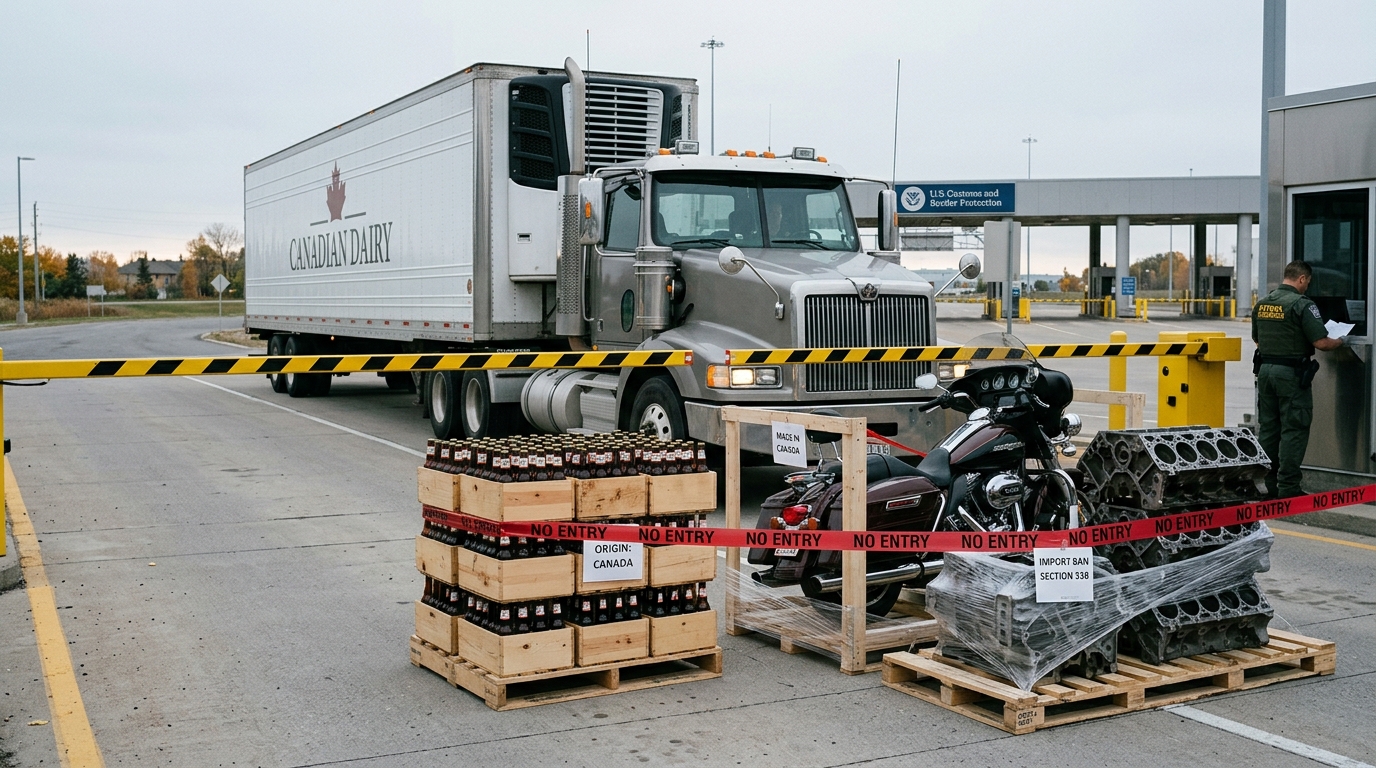
The escalation most traders were watching for arrived overnight. The U.S. moved from a 50% tariff on certain Canadian dairy, alcoholic beverage, and motor vehicle imports to outright import bans on a narrower list of those goods, effective September 29, 2026, with no USMCA exemption. For anyone holding autos or packaged food today, that is the structural shift behind any unusual moves at the open.
What Is Actually Banned
Read the annexes before trading the headline. The bans do not cover Canadian passenger cars or trucks, and they do not cover all Canadian dairy. On the motor vehicle side, the ban targets motorcycles and cycles fitted with a reciprocating internal-combustion piston engine over 800cc. On alcohol, it covers a defined list of Canadian alcoholic beverages in the alcohol annex rather than every Canadian alcoholic beverage as a category. On dairy, it hits certain dairy products listed in the dairy annex, including specified whey products.
The banned products total about $1 billion in trade value based on 2025 import data, according to the American Action Forum as cited by The Associated Press. That figure matters: this is surgical, aimed at consumer-facing packaged goods, not the industrial cross-border supply chain that underpins North American vehicle production. The motor vehicle ban itself is a narrow scope item in the tariff schedule covering motorcycles and mopeds over 800cc. Passenger cars, light trucks and most auto parts are not banned.
What the Stacking Does to Autos
The absence of a passenger car ban does not mean GM, Ford, and Stellantis are insulated. The underlying cost structure was already under strain. U.S. trade policy has left North American supply chains facing higher tariff friction than some overseas competitors in certain vehicle and parts categories, with EU, Japan, and South Korea auto trade widely reported at a 15% rate under current arrangements while other regimes affecting Canada and Mexico can be higher depending on product and origin treatment. The auto supply chain is where the damage concentrates, since vehicles and parts cross the U.S.-Canada border multiple times during production, meaning tariff costs can accumulate across stages when tariffs apply.
Based on the current tariff environment, GM has said it expects gross tariff costs of $2.5 billion to $3.5 billion for 2026. Canadian Pacific and Canadian National rail corridors, which carry a significant share of cross-border freight, face the secondary pressure of thinner volumes on lanes that had already been reshaped by the August 22 Section 338 duties.
Molson Coors Is the Clearest Stock Exposure
The ban can hit Molson Coors directly where it applies to covered Canadian-origin alcoholic beverages, while allowing already-imported product in the U.S. system to keep moving under the prior duty treatment. The nuance traders need: Molson Coors has previously said it imports a very small portion of its U.S. portfolio from Canada and Mexico, and that the bulk of what it sells in the U.S. is made domestically. Revenue impact is therefore more modest than the brand headlines imply, but the ban introduces uncertainty for cross-border portfolio planning and may affect Molson Coors’ North American sales dynamics at the margin.
The Retaliation Layer
Canada imposed a wide range of dollar-for-dollar retaliatory tariffs against U.S. goods, with rates ranging from 15% to 50%, effective September 8, 2026, on about $20 billion in annual U.S. imports, matching Washington’s Section 338 action. Vehicles built in the United States made up 28.4% of new-vehicle sales in Canada in the first half of 2026, down from 35.4% in the first half of 2025, according to JD Power Canada data as reported by multiple outlets. Canada is the largest export market for American automakers, larger than the next 10 markets combined, according to a Royal Bank of Canada analysis that has been cited in recent coverage.
One Rule That Matters at the Open
Goods that entered the United States before September 29 but have not yet been entered for consumption, or withdrawn from warehouse for consumption, remain subject to the existing 50% duty rather than the new ban, per CBP guidance on the proclamations. For traders: existing inventory moves under the old rate; the ban bites only on new shipments that would otherwise be imported. If a court strikes the import bans, the practical baseline in this dispute has been the prior Section 338 duty framework rather than a clean return to duty-free treatment for the covered goods. Watch GM, F, STLA and TAP for unusual volume off the open, and track CP and CNI for any freight guidance revision tied to cross-border lane compression.