
October 3, 2026
Bonus Content: Drone Networks Are Replacing Medical Couriers. The Rulebook Isn’t Finished Yet.
Editor’s Note: Jeff Brown is the former tech executive who picked Nvidia in 2016 before it jumped 37,000% higher. He’s now recommending another AI stock that’s the same size Nvidia was 10 years ago. He calls it “Elon Musk’s One Stock Retirement Plan” because he believes Elon Musk is about to create massive demand for this company’s patented technology. Click here to see the details or read more below.
Dear Reader,
Make your calendar…
By November 11, I believe Elon Musk is going to help trigger a historic rally in what could be…
“The Only AI Stock You Need to Retire.”
This little-known company has developed a technology…
That can produce intelligence up to 1,000 times FASTER than regular AI.
It’s the same size Nvidia was 10 years ago…
Before shares skyrocketed 37,800%…
And while I can’t guarantee you’ll become a millionaire…
That was enough to turn $5,000 into an entire retirement nest egg of $1,895,000.
I call this opportunity….
“Elon Musk’s One Stock Retirement Plan…”
Because I believe Elon Musk is about to accelerate the AI revolution faster than ever…
Creating massive demand for this company’s patented technology.
Again, I believe this might be the only stock you need to retire.
We have so much to look forward to,
Jeff Brown,
Founder & CEO, Brownstone Research
P.S. If I could buy only one stock, this would be it… it might just be the perfect tech stock.
It’s a leader in an AI breakthrough that’s protected by 150 patents…
It’s a small company, unknown to most people… still in the initial phase of exponential growth…
Plus, it has a near term catalyst that could send shares skyrocketing… starting November 11.
Drone Networks Are Replacing Medical Couriers. The Rulebook Isn’t Finished Yet.
The contract language is already final. The regulatory foundation is not.
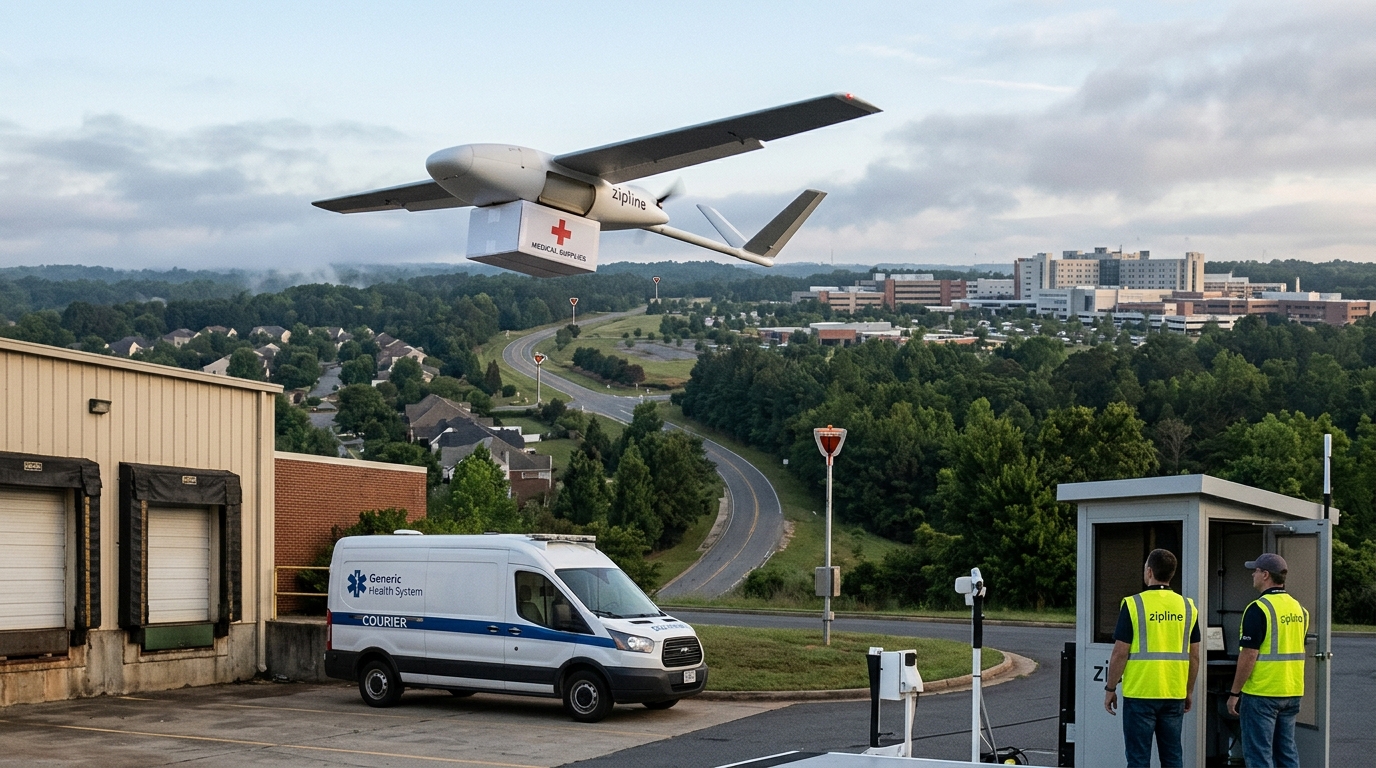
Advocate Health is partnering with Zipline to launch the largest hospital-based drone delivery network in the U.S., beginning in 2027, starting in Charlotte before expanding to Chicago and Milwaukee. At full scope, the program targets more than 100,000 deliveries annually. That figure is not a pilot. It is an operational commitment, and it directly targets volume that currently belongs to ground-based medical couriers.
Most of those shipments would typically be sent by automotive courier or ground delivery, Cleveland Clinic acknowledged when it signed its own Zipline agreement. Advocate is not alone. It joins Cleveland Clinic, Intermountain Health, Mayo Clinic, and MultiCare, all of which have already contracted with Zipline for drone deliveries. The consolidation of hospital-to-home and facility-to-facility logistics under a single autonomous operator is happening faster than the public conversation about it suggests.
What makes the timing unusual is where federal regulation actually stands. As of October 3, 2026, no final Part 108 rule has been published. The FAA’s Part 108 BVLOS final rule is currently listed as being in White House review, and public reporting says the agency has indicated it hopes to see it published by year end. OIRA review is not a rubber stamp. From the July 10 submission date that has been reported publicly, the nominal 90-day review window lands around October 8, 2026. That date is effectively here. There is no published rule.
Every drone corridor currently operating at a U.S. hospital runs on provisional authority, not permanent entitlement. Companies including Zipline, UPS Flight Forward, Amazon Prime Air, and Wing have obtained BVLOS approvals for specific operating areas, but the process is slow, expensive, and constrains operations to pre-approved geography and parameters. Part 108 is designed to move BVLOS operations away from a purely case-by-case model and toward a standardized framework intended to support broader scaling. Until it publishes, every expansion still tends to look like a new negotiation.
The economics driving hospital adoption are not waiting for Washington. Drones bypass road traffic entirely, providing more consistent delivery times regardless of surface congestion. Some health system and industry materials claim inter-facility drone transport can cut specimen transit times dramatically versus road transport, but the exact minute-by-minute comparisons vary by route, airspace, and workflow.
Facility-to-facility routes accounted for about half of 2025 medical drone delivery services market revenue, driven by predictable, high-frequency movements among hospitals, labs, and blood banks that allow operators to run thousands of flights per year off a single pad. That route profile is precisely where traditional couriers have earned steady, recurring income for decades. The displacement is structural, not incidental.
The corridor map is also widening beyond the U.S. By late 2026, multiple countries were operating medical drone delivery services at routine cadence, but “named corridors” is not a consistently defined category across regulators. The bigger point holds: medical drone delivery has moved from demonstration projects to contracted operations in more than a handful of markets worldwide.
Part 108 will matter when it finally publishes, because smaller operators focused on medical supply, agricultural logistics, and emergency response should benefit from more standardized certification pathways, and the rule is intended to help integrate routine BVLOS operations into the national airspace alongside manned aircraft. But the largest health systems have already signed the contracts. The question for medical courier operators is no longer whether this transition happens. It is how much ground they lose before year end.