October 10, 2026
Bonus Content: The Sensor Winning Smartphone and Drone Vision Contracts Before Anyone Noticed
Dear Reader,
President Trump went on a seething tirade about calls to regulate AI.
He said AI will not be stopped by brilliantly run destructive forces.
And that it will be the greatest economic development engine in history.
He said it will be “bigger than oil, gold, diamond, or even the internet.”
All while The New Republic reports that Republicans badly want to appear eager to rein in AI ahead of these midterm elections.
This divide is exactly why Whitney Tilson has stepped forward today.
The man CNBC once named “The Prophet” has a huge new warning for America:
In 100 days, a new kind of American Civil War will begin…
And it will have huge implications on your investments and your wealth.
If history is any indication, those on the winning side of this divide could see their wealth grow exponentially…
While the losers could see their portfolios cut in half – or more – within the next six months.
That’s why today Whitney Tilson is sharing all the details of this divide with you.
And what you must do right now to protect your wealth.
When “The Prophet” makes predictions, people listen…
In 2000, he called the dot-com crash before many investors lost everything.
He predicted the bankruptcies of Bear Stearns and Lehman Brothers during the Great Financial Crisis.
He appeared on 60 Minutes and called the bottom of the stock market right before the longest bull market in history.
Today, he’s sharing all the details of his new prophecy…
One that could be the most consequential to your wealth to date.
Regards,
Kelly Brown
Managing Director, Stansberry Research
P.S. Whitney believes what’s happening today could reset the financial system after these midterm elections. If Whitney’s even half-right, it’s going to have a huge impact on your money and your future. Get the details here…
The Sensor Winning Smartphone and Drone Vision Contracts Before Anyone Noticed
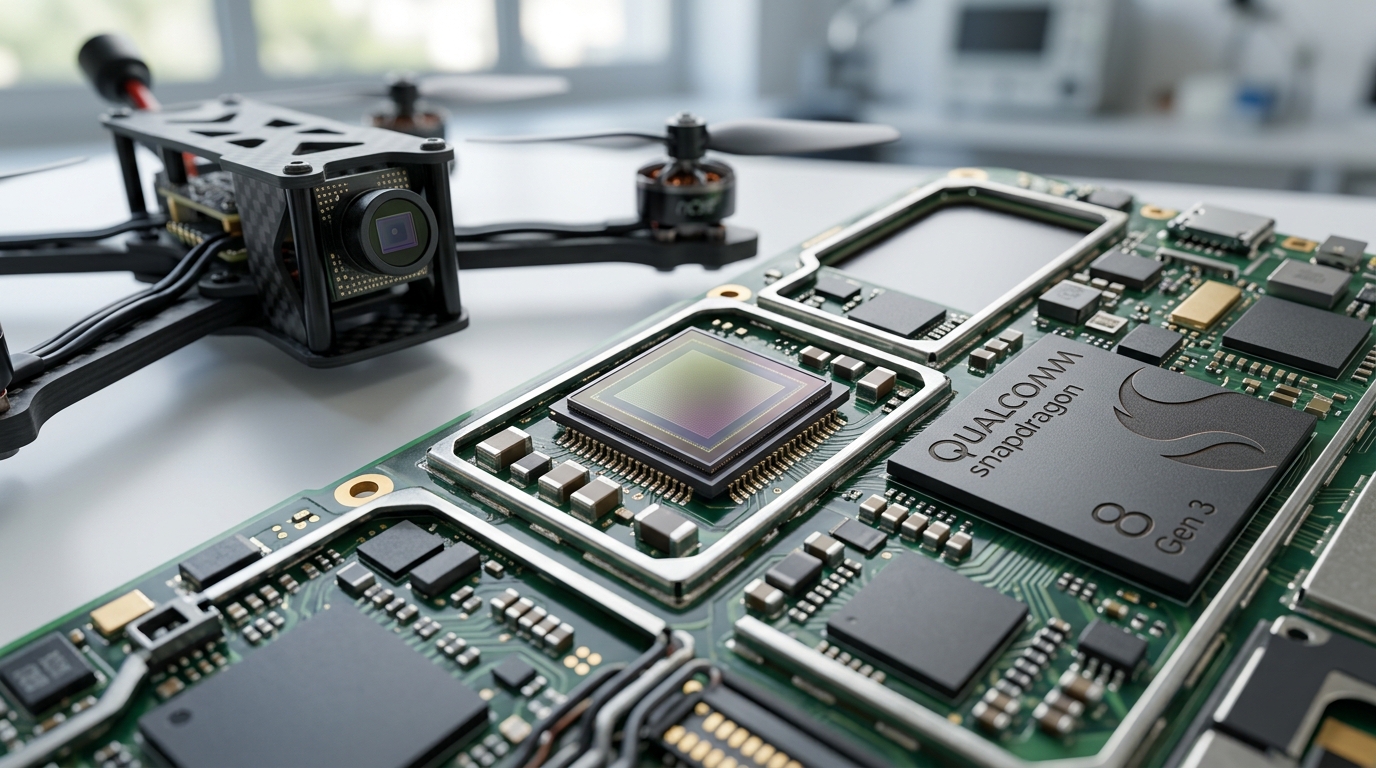
The contract flow has quietly started. Paris-based Prophesee co-developed the IMX636 sensor with Sony, and it has publicly described smartphone work that is production-ready on Qualcomm’s Snapdragon 8 Gen 3 platform. That is the clearest signal that event-based vision is moving from a research curiosity to a component-level specification. The angle most coverage misses is not the imaging quality story. It is the power budget story, and that is where the contract leverage actually lives.
Conventional camera chips process every pixel in every frame, whether or not anything in that frame moved. Event-based sensors only capture what changes in a scene, enabling them to skip processing and data capture for unchanged pixels. This vision category can reduce power, latency, and data processing requirements by orders of magnitude versus conventional imaging in change-driven workloads. That gap is not incremental. It is the kind of performance delta that rewrites component spec sheets.
Drones make the argument even sharper. GSI Technology has shown Gemini-II edge benchmarks running a 12-billion-parameter multimodal model at about 30 watts on a drone platform, with the company comparing that to substantially higher power for comparable edge-GPU-class platforms. Intel and ETH Zurich have also demonstrated very high-rate control workloads on Intel’s Loihi neuromorphic platform, including drone horizon tracking at 20kHz with 200 microsecond latency. Speed and efficiency arriving simultaneously is the combination that procurement teams for autonomous systems have been waiting for.
The First Options Lesson Most People Skip
Everyone wants to know which options to buy.
Far fewer ask how options actually work.
That one mistake can make the difference between trading with confidence… or learning expensive lessons the hard way.
Read the free Beginner’s Guide before you place your first trade.
On the defense side, contracts are already signed. BrainChip was awarded a roughly $1.8 million Air Force Research Laboratory SBIR Phase II contract for neuromorphic radar work, including mapping complex sensor signal processing algorithms onto neuromorphic chips. BrainChip has also disclosed a subcontractor agreement with RTX’s Raytheon to support completion of that AFRL contract.
Defense procurement is moving faster than most investors realize. The Pentagon’s broader AI supply-chain push reveals why edge compute and domestic chip manufacturing are now treated as national-security priorities, not just commercial ones.
The market itself is still small but growing fast enough to matter to early movers. Mordor Intelligence puts the neuromorphic chip market at $0.51 billion in 2026, expanding to $4.08 billion by 2031 at a 51.57% CAGR. Separately, Persistence Market Research says image recognition and vision processing is the largest application segment in 2026, at over 34% of the neuromorphic computing market and valued at more than $2.8 billion. Vision is where the first wave of commercial volume concentrates, and that is not an accident.
The edge, covering sensors, wearables, drones, and always-on devices, is where neuromorphic wins first and cleanly, because the enemy there is the battery rather than Nvidia. That framing matters for traders. The data center debate about neuromorphic versus GPU is a multi-year argument. The edge sensor contract cycle is already underway. Qualcomm, Sony, BrainChip, GSI Technology, and SynSense are the names showing up in actual commercial partnerships and deployments. Watch which of them convert pilots and early deployments into volume commitments over the next two quarters. That is the signal the market has not yet priced.
The contrast with data-center AI spending sharpens the edge case. Dell’s $95 billion AI server backlog shows where GPU-dependent infrastructure capital is concentrating — the opposite end of the power-budget spectrum from neuromorphic edge deployments.
No. 1 Stock to Buy for THIS MONDAY
Heads up: Tim Bohen’s new algorithm just uncovered a dirt-cheap stock that could DOUBLE or MORE this coming Monday. This powerful algo has already identified Monday moves of 149%, 190%, and even a whopping 536%…
Click here to see how to get positioned ahead of this Monday’s setup!