Dear Reader,
Trump just threatened a country.
No… not Iran.
Not Canada… Mexico… or even China.
None of the usual suspects.
And… the reason might surprise you.
In short… a country issued a new law that would mess with one massively profitable American company.
Trump went to bat for them… and said hurting this company would be a “big mistake.”
Why did he threaten one of the ten most powerful economies in the world… over a publicly traded company?
Well… with the Iran War looking like it will go well past the midterms… energy is a major issue for the country.
And Trump considers this company to be crucial to the U.S. economy.
It’s at the epicenter of two areas of the economy that Trump knows are key to success in his second term…
And it’s creating an urgent situation for investors… what I call “unicorn” opportunities.
They don’t happen often… but they have the potential to go up 1,000%… or more. Sometimes in months… sometimes in days.
Out of 23,281 publicly traded stocks… only ONE meets my criteria to be considered a unicorn right now.
Let me tell you about the ONLY unicorn stock I’ve found in the market
Yours in smart speculation,
Karim Rahemtulla, Head Fundamental Tactician
Monument Traders Alliance
P.S. The last time I found an opportunity like this…
My readers had the chance to get a stock at $2 in 2022…
It’s now nearly $20!
The window won’t be open long.
Ports That Automated Are Pulling Away. The U.S. Is Stuck Watching.
The gap between the world’s most efficient ports and America’s busiest docks is no longer a technology problem. It is a decision problem, and the scoreboard is getting hard to ignore.
Where the results are in
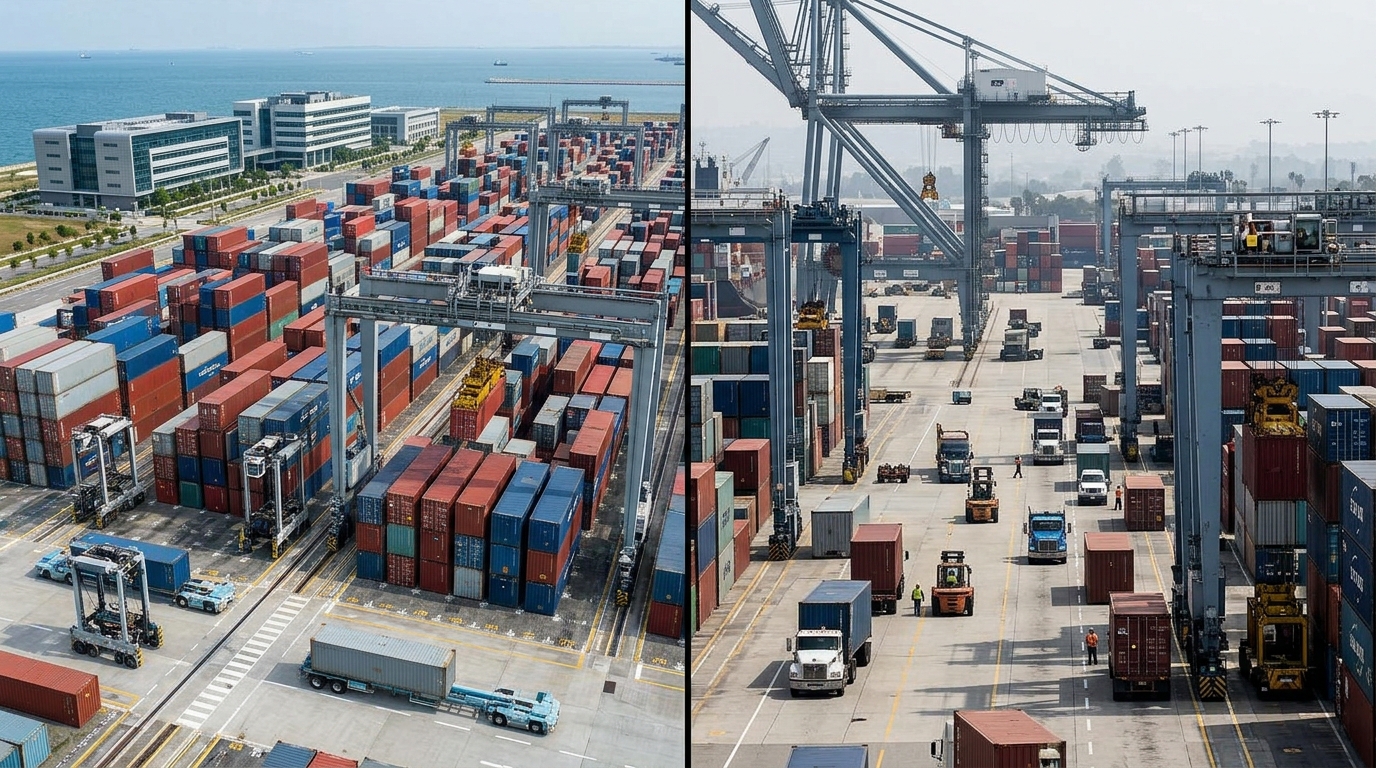
PSA Singapore hit 25 million TEUs of cumulative throughput at Tuas Port in August 2026, about four years after operations began in September 2022. That pace is not accidental. Tuas runs automated yard cranes, a fleet of automated guided vehicles, and a centralized digital platform for cargo flow management.
The throughput math is decisive. Some operators and vendors claim fully automated terminals can reach about 58 container moves per hour per crane, roughly 50% above a traditional manual baseline, but real-world performance varies widely by terminal design, labor model, and operating conditions. East-West Gate Terminal reported boosting handling from 23 to 25 containers per hour to 32 to 35 containers per hour after shifting to remote crane operations, and has described operating-cost reductions of about 40% tied to that shift. Rotterdam’s APM Terminals Maasvlakte II is a high-automation benchmark, but there is no clean, consistently sourced basis for the claim that it moves 2.3 million TEUs annually with 70% fewer personnel.
The technology doing the heavy lifting is not exotic. AI-enabled anti-sway systems can reduce load swing and smooth crane control in real time, while condition monitoring and predictive maintenance can surface issues earlier than traditional inspection cycles. These are not just pilot programs, but it overstates the case to call them the baseline at every competitive terminal from Shanghai to Rotterdam.
Where the U.S. stands
American ports are moving in the opposite direction on the political clock. The current ILWU-PMA West Coast contract covers roughly 22,000 workers across 29 ports and runs through July 1, 2028, with automation a longstanding point of tension. At the Port of Tacoma, the standoff is even more granular: Husky Terminal asked to add technology such as real-time location systems and optical character recognition hardware to port-owned cranes, and ILWU Local 23 has urged port commissioners to block the request, arguing it would accelerate job loss.
The cost of that friction compounds every quarter. Automation can reduce operating costs and improve consistency in some terminals, but broad claims like a nearly 25% cut in average turnaround times at major international ports are too sweeping without a specific, verifiable benchmark and definition of “turnaround.” Ports that cannot close the performance and reliability gap are not just slower. They are a structural liability for every shipper routing through them.
The angle traders should watch
The market sizing here is noisy. Instead of locking to a single set of figures, the cleaner takeaway is that spending is shifting from steel to software: remote operations, predictive maintenance, vision systems, and yard-optimization tools that can be layered onto existing fleets. Terminal operators are also increasingly separating maintenance analytics from original equipment suppliers, which can pressure OEM aftermarket economics while expanding opportunities for specialized industrial software and telemetry providers.
The compounding pressure from Red Sea rerouting makes this urgent. Maritime analysts have warned that a faster-than-expected normalization of Suez routings can create vessel bunching at European gateways, because schedule math snaps back faster than ports and inland networks can absorb the surge. Ports with stronger yard forecasting and planning tools absorb that bunching. Ports without it create the next backlog.
Singapore’s Tuas is already expanding. PSA has said Tuas has 14 operational berths and is on schedule to reach 18 by 2027. The terminals pulling away are not waiting for labor agreements to catch up.