Union Pacific reports Q3 2026 earnings on Thursday, October 22, 2026, before the open. Consensus sits at $3.47 per share on about $7.14 billion in revenue. Analysts expect roughly 13% earnings growth and 14% revenue growth year over year. Those headline figures will dominate the morning. They should not be the only thing investors watch.
Buried in the operational disclosures is a result that reframes the railroad’s long-term cost structure: on routes where Union Pacific runs its Automated Track Inspection technology under a Federal Railroad Administration waiver, the company has recorded zero track-caused derailments. Not a reduced rate. Zero.
What the Technology Actually Does
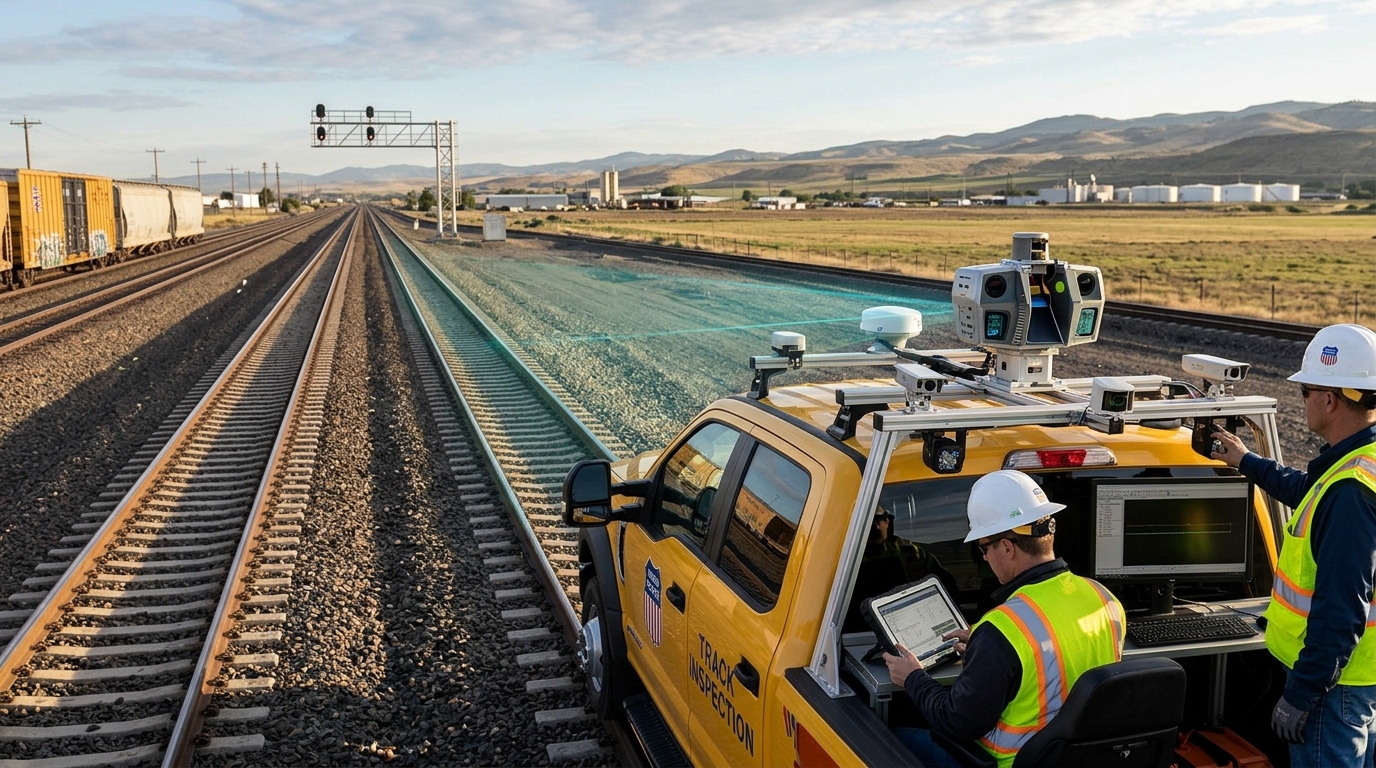
Union Pacific’s autonomous geometry machines operate directly on the rail lines, combining high-resolution cameras, sensors, and AI-powered software to scan track infrastructure and analyze track geometry data to proactively identify emerging issues before they impact safety or service. The machines measure the precise condition of rails, including alignment, elevation, curvature, and surface status, generating more than 100 billion measurements in 2025 for predictive maintenance.
Since deploying ATI on designated waiver routes, the automated inspection system has identified more than 200 geometry defects, five times the number identified through visual inspections alone. That detection ratio matters. Every anomaly caught before it fails is a derailment that does not happen, and each derailment avoided eliminates the associated cleanup costs, regulatory scrutiny, shipper attrition, and insurance exposure that the market rarely prices precisely until it is too late.
Union Pacific says its track geometry vehicles allow Engineering to scan more than 500,000 track miles annually, in addition to the roughly 4.5 million miles of track it inspects visually. In recent corporate disclosures and executive communications, the company has described a 28% decline in track-related derailments over the past 10 years. Union Pacific has also said it delivered its best-ever full-year derailment incident rate in 2025, improving 19% year over year.
The Regulatory Tailwind
The Federal Railroad Administration approved a five-year waiver program to expand field testing of Automated Track Inspection technology, announced on December 5, 2025 by Transportation Secretary Sean P. Duffy, blending high-tech tools with traditional human inspections. That waiver is what allowed Union Pacific to expand ATI coverage to the routes now showing zero track-caused derailments. It also sets a precedent for the wider network.
Not everyone is comfortable with the pace. Legislation introduced in March 2026 would require railroads to maintain visual track inspections alongside automated systems, with sponsors arguing that automated inspection detects only 26% of all track defects. The Association of American Railroads disputed that framing, arguing ATI identifies 200 times more track defects than visual inspections. The debate is unresolved and will shape how broadly any railroad can substitute machine coverage for boots-on-ground labor.
What Thursday Should Clarify
Union Pacific says it has more than 7,000 wayside detectors monitoring freight cars and locomotives in real time, generating more than 16 million data points daily to proactively identify and mitigate risks. That sensor density, combined with ATI geometry coverage and proprietary Physics Train Builder software, forms a layered infrastructure that incumbents cannot easily replicate. The question for the Q3 call is whether management quantifies the cost savings this stack is already generating.
Union Pacific’s market capitalization is about $171 billion based on recent closes, and its 52-week range has been roughly $215.53 to $315.99. Street price targets cluster around the low $330s. Those targets rest on earnings growth. But the cleaner the safety record, the lower the embedded risk discount, and that is a re-rating argument the market has not fully priced.
The operating ratio tells investors how efficiently freight moves. The derailment rate tells them what that efficiency actually costs to sustain. On Thursday, ask which one the guidance addresses directly.