October 22, 2026
Bonus Content: Cummins Sold Its Hydrogen Business. Now Its Rivals Are Scaling the Market.
Blane Markham here.
Alert!
If you still haven’t saved your copy of Options Trading Made Easy…
… do it right now before the download link expires.
We’ll be moving this book behind a paywall in the near future so grab it now while you still can.
You’ll thank me.
FREE: Options Trading Made Easy
To your success,
Blane Markham
Markham Trading Team
Reminder:
Grab your copy of Options Trading Made Easy before we move it behind a paywall.
Cummins Sold Its Hydrogen Business. Now Its Rivals Are Scaling the Market.
The company everyone assumed would own hydrogen in heavy trucking just handed its fuel cell business to a French train maker and paid $175 million to walk away. That is the central tension CMI investors are sitting with heading into Q3 earnings, which are expected in early November.
In Q1 2026, Cummins completed the sale of its low-pressure fuel cell business, the Hydrogenics entity it had bought for roughly $290 million in 2019. The transaction generated $199 million in charges and left the Accelera segment with a $277 million EBITDA loss for the quarter. CEO Jennifer Rumsey cited “lower hydrogen adoption expectations” as the driver. Separately, Cummins had already taken $458 million in hydrogen-related charges tied to its electrolyzer business in 2025, then said it intends to stop new commercial activity in the electrolyzer space. Its Spain plant, which once built electrolyzers, is now pivoting to battery management and maintenance work.
The math on that exit is blunt: Cummins absorbed more than $650 million in charges across 15 months, then sold the rail fuel cell assets to Alstom at a net loss to get clean. The Accelera EBITDA loss did narrow to $69 million in Q2 after those cost actions. But the hydrogen powertrain ambition that once defined Accelera’s identity is gone.
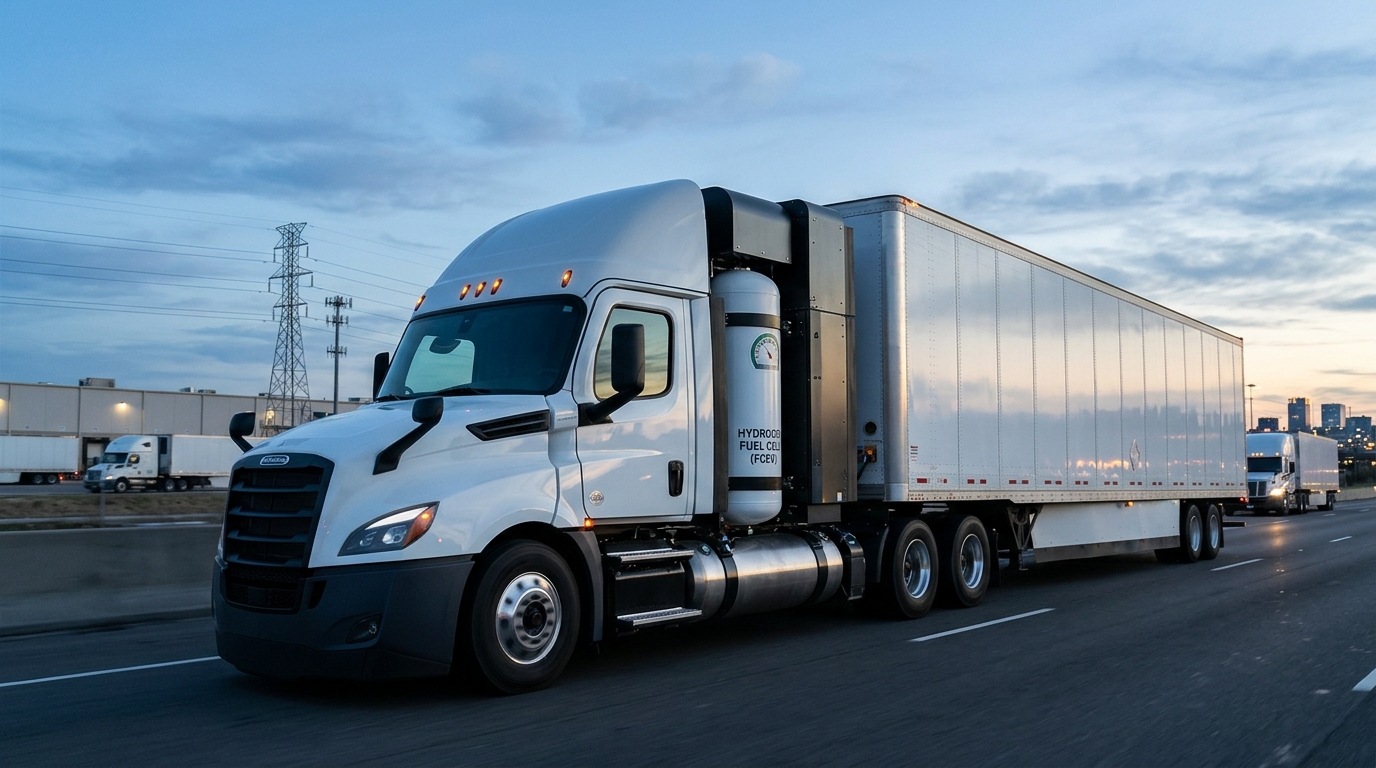
Here is where it gets complicated for traders. The market Cummins retreated from is not shrinking. In May 2026, Toyota and Hyroad Energy signed a deal to deploy 40 hydrogen fuel cell Class 8 trucks across Southern California freight corridors. Cellcentric, the Daimler-Volvo joint venture, launched the BZA375 fuel cell system for heavy applications in April 2026. And a September 2026 alliance between Toyota and Scania is now testing third-generation fuel cells in heavy-duty transport.
Cummins’ own engineering validated the physics. Its Accelera-powered truck set a Guinness World Record in December 2024, traveling 1,806 miles on a single fill of hydrogen using a 250-kilowatt traction motor and 175 kilograms of fuel. The range argument for Class 8 freight is real: a battery large enough to match that on a diesel-comparable payload would weigh 15,000 to 20,000 pounds and gut the truck’s legal cargo capacity. Hydrogen sidesteps the problem entirely.
The economics remain the constraint. Green hydrogen currently costs $4 to $5 per kilogram in realistic 2026 scenarios, still near or above the $4.90 to $5.85 per kilogram breakeven threshold at which fuel cell trucks reach total cost of ownership parity with diesel, according to peer-reviewed modeling published in 2026. IRENA and the IEA both project continued cost declines this decade, with some pathways reaching roughly the low-single-digits per kilogram by 2030 in favorable locations. The gap is closing, not widening.
What Cummins kept is its core diesel and natural gas engine business, its booming Power Systems segment, which posted a 19% revenue jump in Q2 on power generation demand tied in part to data center markets, and its electrified powertrain line. What it gave up is any direct participation in the FCEV freight ramp-up that its own record-setting truck demonstrated was technically credible.
The data center power demand driving Cummins’ Power Systems surge is the same force reshaping the entire energy equipment sector. GE Vernova’s record $24.2 billion quarterly order intake shows how deep the infrastructure buildout behind AI electricity demand runs.
Watch: Q3 results for Accelera’s revenue trajectory and whether management signals any re-entry into higher-pressure fuel cell work. The segment’s losses are narrowing. The question is whether the strategy behind them still makes sense as competitors deploy at scale.