Dear Friend,
Quick question.
Want the one stock Elon can’t build without?
I’ll hand it to you today. Free.
It’s not Tesla. It’s not SpaceX.
Every Tesla. Every Starlink dish. Every AI satellite.
Each one runs on a chip Elon doesn’t own. He licenses it. From this company.
And he wants 1,000,000 satellites in orbit.
Every one pays this company a royalty.
Dylan says get in before December 8th.
After that, the easy money’s gone.
Yes, send me the free pick here >>
The Buck Stops Here,
Kelly Maguire
Behind the Markets
P.S. No catch. It’s a public stock you can buy today. The window closes December 8th.
Prologis Has 5.8 GW of Data Center Power. The Grid Won’t Let It Use All of It.
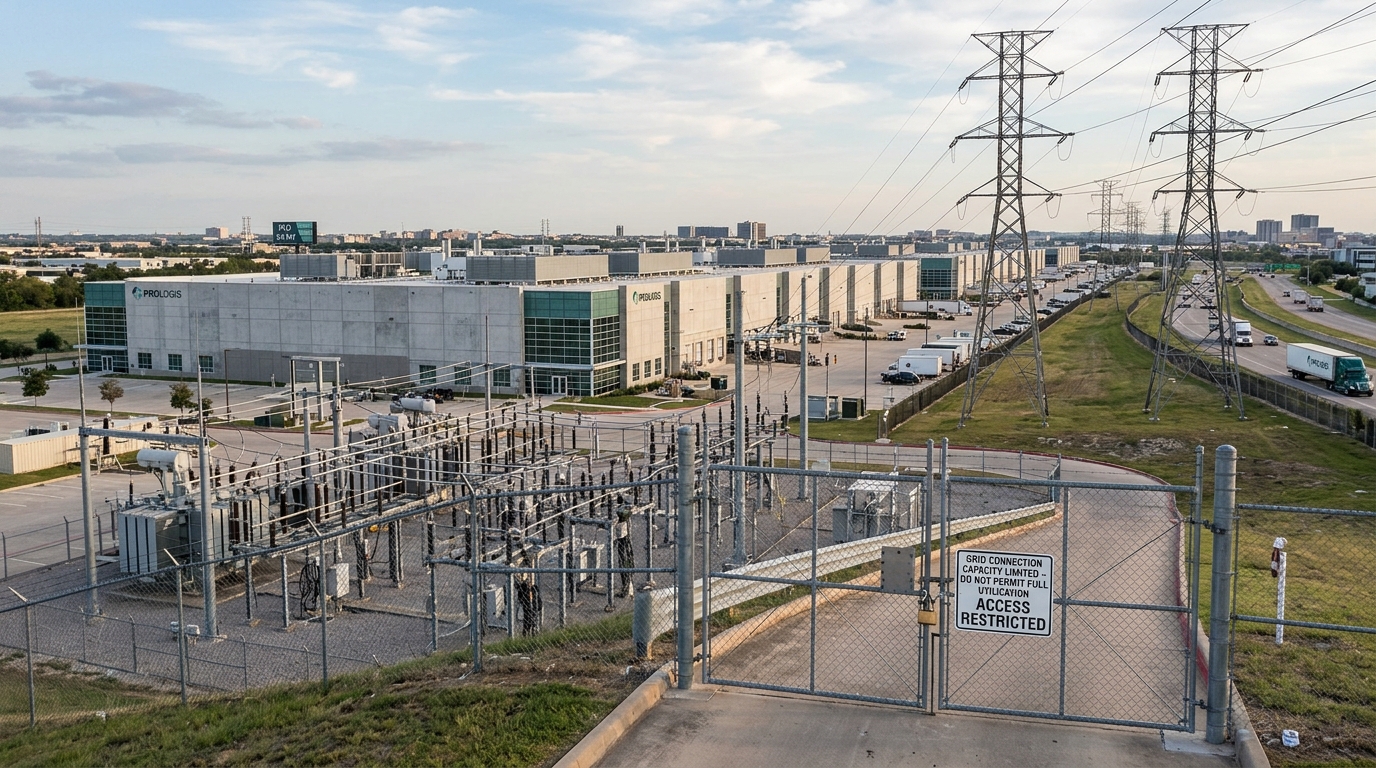
Prologis is not running short of customers or conviction. What it is running short of is grid access, and that distinction matters before treating PLD as a straightforward AI infrastructure play.
The company expanded its data center power pipeline to 5.8 gigawatts as of Q2 2026. Of the $4.7 billion in development starts through the first nine months of 2026, about $2.1 billion went directly to data center projects. Those are real numbers. The question is how much of that pipeline converts on schedule.
Where the Bottleneck Lives
In late September 2026, Prologis’s Texas data center venture with Skybox Datacenters ran into uncertainty after Governor Greg Abbott directed the Texas Commission on Environmental Quality (TCEQ) on September 21, 2026 to halt permits sought by data centers while ERCOT conducts an audit. The Hutto site was already rezoned. The partnership was contracted. It did not matter.
The incident shows that power access is not just an engineering issue but a policy bottleneck that can stall even rezoned, contracted sites.
Texas is not an isolated case. At least $260 billion in US data center investments were canceled in 2026 as local opposition and permitting friction stalled projects that looked contracted on paper.
This is the lever most warehouse-to-data-center analysis skips. Prologis controls the land. It does not control the substation queue.
Why SEGRO Is Actually a Power Trade
In August 2026, Prologis announced a recommended acquisition of SEGRO plc, valuing SEGRO’s entire issued and to be issued ordinary share capital at approximately $18.8 billion. The industrial footprint rationale is real, but the data center subtext matters more for PLD bulls.
Suitable sites with access to sufficient electricity are becoming increasingly difficult to secure, especially around established markets such as London, where grid capacity and planning constraints continue to hold back new development. A successful takeover would give Prologis access to SEGRO’s wider land and development pipeline across Europe. The deal buys grid capacity that Prologis cannot replicate organically in those markets. That is a scarcity premium, not just a square-footage story.
The Margin Math Still Works, If Timing Holds
Data center projects could generate margins between 25% and 50%, compared with 15% to 20% for warehouse developments. Prologis Research has also estimated 30 million to 40 million square feet of net absorption tied to data center infrastructure demand in 2026, meaning the logistics base can benefit from AI spend even when data center starts slow. The business is more self-reinforcing than the bears allow.
But the market is pricing a smooth conversion of that 5.8 GW pipeline. Texas showed that smoothness is a regulatory assumption. Any delay in grid access or lease-up feeds directly into whether development margins end up closer to the bullish or bearish end of that spread.
What Traders Should Watch
- Grid approvals outside Texas. ERCOT is not the whole story. Watch PLD’s disclosure on interconnection timelines for projects in Virginia, Chicago, and European markets.
- SEGRO closing timeline. The definitive cooperation agreement was announced in August 2026. The companies have said they expect the transaction to close in the first half of 2027. Any regulatory delay extends the period in which PLD carries acquisition costs without the European power assets on the books.
- Data center starts as a share of total development. Management has guided that about 40% of its owned-and-managed development starts are expected to be data centers. A miss on that ratio signals grid friction broader than Hutto.
The warehouse-to-data-center thesis is structurally sound. The execution risk is narrower and more specific than the bull case admits. Power policy, not demand, decides whether PLD’s pipeline converts at the margins management is projecting.