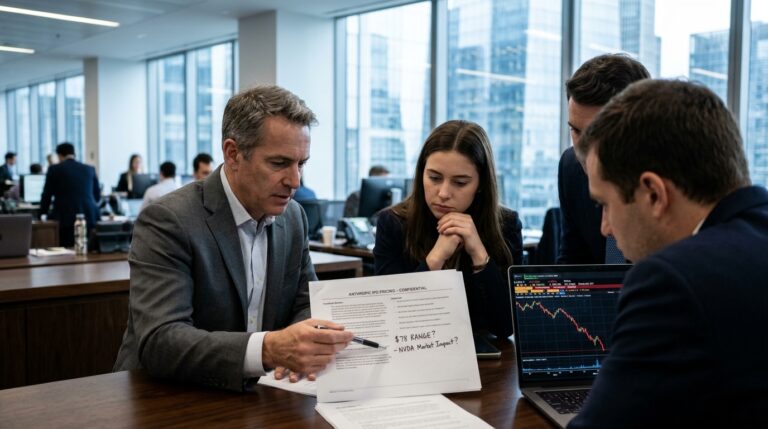
After the worst week for the Nasdaq 100 since 2020, two of Wall Street’s most closely watched research desks dropped notes over the weekend that agreed on the same uncomfortable fact: the conditions for a durable bottom are not yet in place. Goldman Sachs and Bank of America each laid out what they need to see. Working through the lists, only one item has a date attached to it.
Why This Stock Now
Goldman strategist Snider wrote that the selloff “expanded this week from an AI unwind to a broader growth downgrade,” noting that the S&P 500 excluding AI had held up until this week and is now 6% below its high. Goldman’s AI stock basket is down 32% since Oct. 6. That is not a rotation. That is a re-rating of the thesis that powered most of this bull market’s earnings growth.
The Three Conditions
Goldman said any one of the following would support a bottom and a recovery: news that raises confidence in AI earnings, a dovish Fed signal, or a big drop in investor positioning.
Rank them by proximity and the picture is sobering. The Fed condition runs directly into a rate environment where futures markets price roughly a mid-90s-percent probability of a hike in December. Some prominent forecasters also still see additional tightening into early 2027, with a peak range around 4.25% to 4.50%. The likelihood of a dovish signal in the near term appears low.
The positioning condition faces a different obstacle. Hedge funds have trimmed AI bets, but Goldman says mutual funds, ETFs and futures traders remain heavily invested, even with indexes in a correction. Asset managers’ net equity futures positions are in the 82nd percentile of the past 10 years. U.S. equity mutual funds and ETFs have taken in nearly $170 billion in the fourth quarter so far. Retail investors are adding, not exiting: equity funds drew $66.6 billion in the week to November 18. That is not a washed-out market.
The AI-profitability condition has no calendar at all. It requires a corporate announcement or a credible earnings revision cycle that proves the capital being spent on AI infrastructure is generating returns. No scheduled data release produces that.
Wednesday Is the Only Date
The next PCE inflation report, covering October 2026, is scheduled for Wednesday, November 25, 2026, at 8:30 a.m. ET. The U.S. October core PCE year-on-year rate is the Federal Reserve’s key measure of inflation. Market expectations call for a rise from 3.1% to 3.2%. A softer reading would not guarantee a dovish Fed pivot, but it would at least create room for one at the December meeting. A hotter number would foreclose the discussion entirely.
BofA’s Michael Hartnett is watching a separate signal. The bank’s global market breadth measure showed 68% of stock indexes in net oversold territory, nearing the 88% level that would trigger its breadth-based buy signal. The strategists said that threshold could be reached in the coming days, potentially supporting risk assets. But Hartnett’s framing is careful: he characterized a potential rebound as a pause rather than a reversal of the broader trend.
What Could Keep the Lid On
BofA’s strategists said they need to see more positioning capitulation before an all-clear, noting fund manager cash of 3.6% and a record $310 billion of equity inflows over four weeks. Those are not the conditions that precede a durable low. They are the conditions that follow a prolonged bull run where most investors have yet to feel enough pain to change behavior.
Hartnett also warned that markets were underestimating the risk of a hard landing. Household stock wealth that supports the economy had fallen about $5 trillion this quarter. Goldman’s downside scenario is explicit: if S&P 500 earnings estimates dropped to the 30-year trend and the price-to-earnings ratio fell to the 30-year average of 17x, the index could fall by roughly 23%, to around 5,600, Snider said.
The Bottom Line
Three conditions, one scheduled date. Wednesday’s PCE number is the only catalyst that arrives on a fixed clock. If core inflation surprises to the downside, the Fed story shifts and Goldman’s second condition gets a foothold. The AI-profitability condition requires something no calendar can supply. The positioning condition requires the retail and institutional buyers who added $66.6 billion in a single week to reverse course. Neither of those is imminent.
A short-term bounce around Thanksgiving is entirely plausible, perhaps even probable given BofA’s breadth signal approaching its trigger. But there is a meaningful difference between a bounce and a bottom. Right now, Goldman and BofA have each told you clearly which one this week’s data can deliver.