
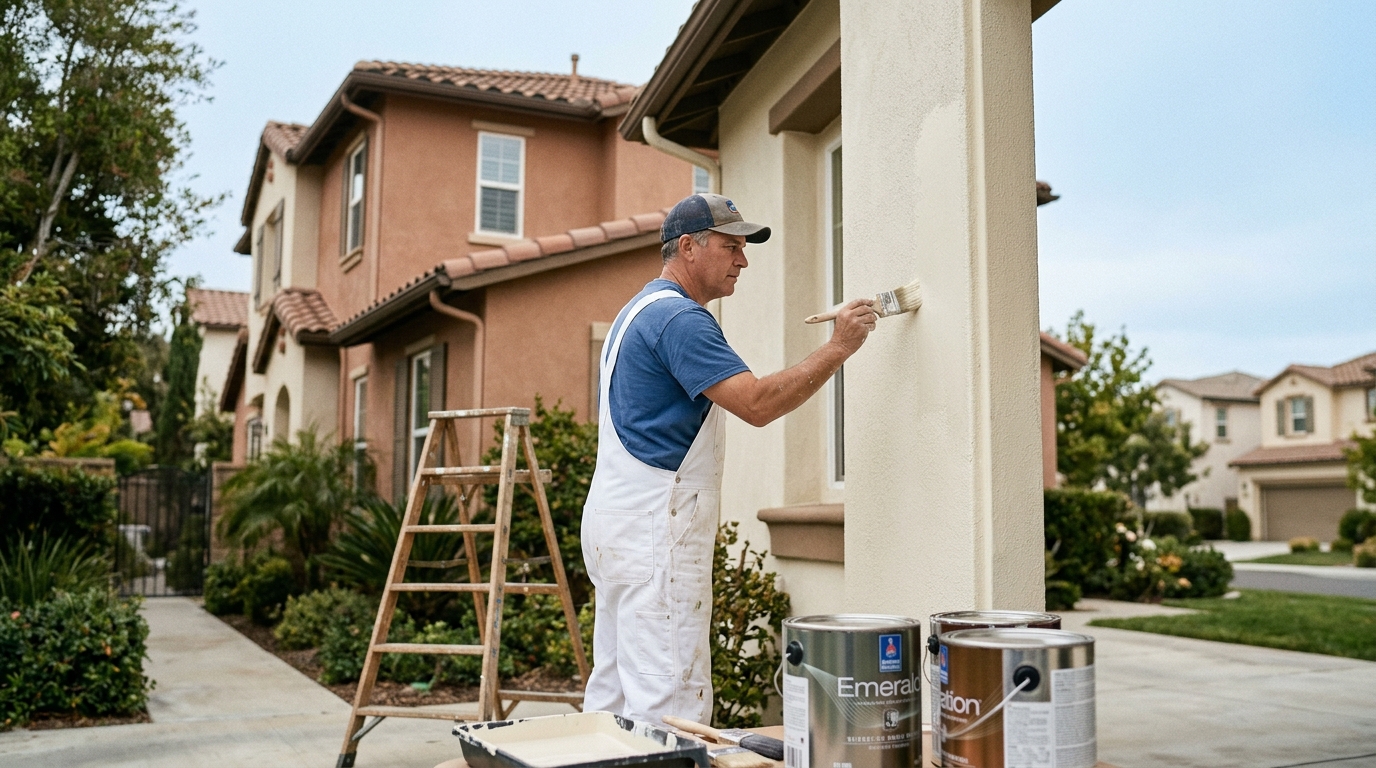
Here is a question worth sitting with. What happens to a business that keeps winning even when its most important market is losing?
Sherwin-Williams just answered it.
The Q2 numbers were not subtle. Adjusted earnings came in at $3.70 per share, up 9.5% year over year, on revenue of $6.79 billion that beat consensus by about 2.6%. Adjusted EBITDA grew 10.5% year over year with margin expansion of 60 basis points to 21.5%. Operating cash flow jumped 21% and free cash flow conversion hit 86%. These are not the numbers of a company struggling.
The stock jumped roughly 8% the day the results dropped. Then it pulled back. And that is where things get interesting.
The 52-week high for SHW is $379.65. The 52-week low hit $289.86 just two months ago in early June. Even after the post-earnings pop, the stock is still sitting well below where it was last summer. The market has not decided what to do with this company yet.
Here is the part people keep skipping. Management credited the Q2 beat to new account wins, pricing discipline, and operational execution across all three segments, even as residential new construction stayed weak and DIY demand remained muted. They outperformed without the tailwind. That is not a small thing.
The housing market recovery remains the biggest wildcard heading into the back half of 2026. New residential construction is under pressure from elevated mortgage rates, but any easing in rate policy could accelerate repair and remodel activity and new home builds. Because Sherwin-Williams serves both new construction and the renovation market, even a partial improvement in housing conditions could generate meaningful upside to current estimates.
Slight tangent, but it matters. The Suvinil acquisition added international revenue this quarter and is still being digested. That is a business layering new geography onto a recovering core market. The compounding is happening in more than one place at once.
For full-year 2026, the company raised its net sales growth forecast to the mid- to high-single-digit range and increased adjusted earnings guidance to $11.80 to $12.20 per share. Management was not tentative about it.
Now the honest part. Sherwin-Williams currently trades at roughly 30x earnings, above the chemicals industry average and peer group. This is not a stock at distress levels. You are paying a premium for a business with enduring advantages. The 47-year dividend growth streak and a projected EPS CAGR near 10% tell you this is a compounder, not a recovery story.
The valuation debate here is legitimate. But there is a difference between a stock that is expensive because the business is broken and one that is expensive because the market is waiting on a macro unlock that has not arrived yet. To own SHW, you have to believe that its brand, 5,158-location store footprint, and deep contractor relationships keep compounding value even when housing stays sluggish. The near-term catalyst is any stabilization in housing activity. The main risk is weaker-for-longer demand that makes the current multiple harder to justify.
The business is winning without help. The question is what it looks like when help finally shows up.