
November 2, 2026
Bonus Content: MPWR’s Q4 Guide Beats. The Module Fight Matters.
Dear Friend,
In 1976, a Chevron drilling team tapped an energy source so powerful it could run a city.
No fuel costs. No carbon. No supply chain.
They proved it worked. Then they killed the project.
Unocal proved it worked. Killed it.
Texaco proved it worked. Killed it.
Three of the largest oil companies on Earth confirmed the same thing.
And all three buried the results for the same reason: it would have destroyed their core business.
For fifty years, the official line was “the technology isn’t ready.”
The technology was fine. The threat was too big.
Now one company has spent sixty years perfecting what Big Oil refused to touch.
Google just locked in a 15-year contract. Bill Gates wrote a $100 million check. And on November 17th, the government hands it a competitive edge no other energy source gets.
Big Oil had fifty years to act. They chose not to.
See the company that didn’t wait >>
“The Buck Stops Here,”
Kelly Maguire
Behind the Markets
MPWR’s Q4 Guide Beats. The Module Fight Matters.
Monolithic Power Systems just crossed $1 billion in quarterly revenue for the first time. That milestone is not the story heading into year-end. The Q4 guide is.
Next quarter’s revenue guidance came in at $1.35 billion at the midpoint. Against a consensus that had modeled roughly $1.32 billion, the formal range sits at $1,315 million to $1,385 million. That gap between guidance and estimates is not noise. It reflects how far sell-side models have lagged the actual pace of data center shipments heading into December.
The enterprise data engine is driving almost everything. CFO Tony Balow said the company is comfortable raising the floor from 130% year-over-year growth for enterprise data to 150%. Channel inventory remains at the lean end of the normal five-to-eight-week range, and internal inventory is not limiting the business. That combination, a rising growth floor with no inventory buffer building, signals real demand rather than pull-forward stocking.
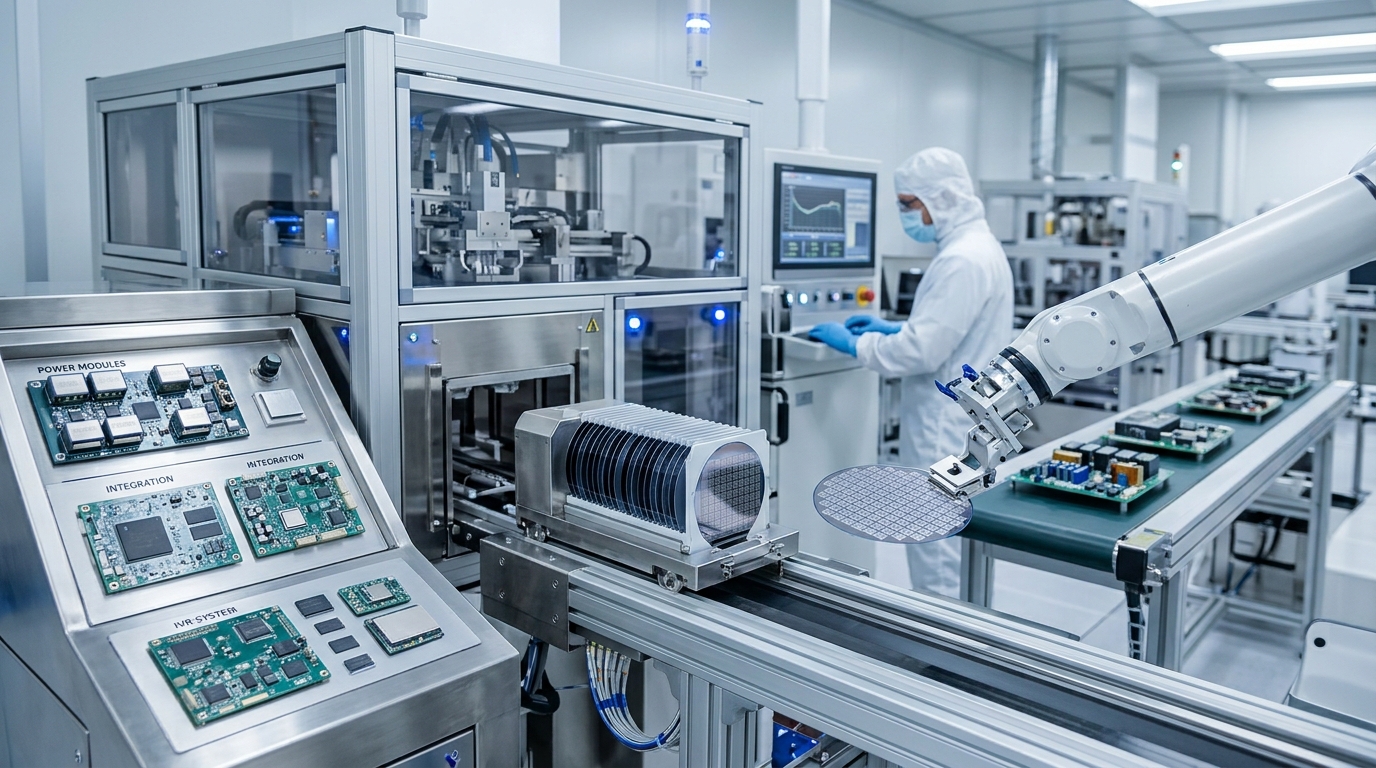
The more pressing question for traders is whether the module architecture holds its competitive position. Monolithic faces competitive risk from integrated voltage regulators and industry consolidation, specifically Analog Devices’ acquisition of Empower Semiconductor, which closed July 7, 2026. On the Q3 call, analysts pressed CEO Michael Hsing directly on the IVR threat. His response was measured, but the question itself tells you where scrutiny is concentrating as year-end shipments ramp.
Management has argued that higher GPU power requirements favor vertical power delivery and module adoption because lateral layouts run into space and loss limitations. That is the architectural argument for why MPWR’s module approach survives IVR competition near-term. Whether it survives a better-capitalized Analog Devices pushing integrated solutions into the same hyperscaler accounts is a longer debate.
The IVR debate does not exist in isolation from the broader custom silicon shift reshaping power delivery demand. The ASIC threat to Nvidia’s GPU dominance follows the same logic as integrated voltage regulators challenging discrete module suppliers.
Margin trajectory is the secondary watch. Q3 non-GAAP gross margin rose 10 basis points versus Q2, and Q4 guidance implies roughly another 10 basis points, keeping the company squarely in its 55% to 60% range with slow, methodical expansion. The company said it is absorbing some cost increases, and also sharing some increases with customers, which could pressure margins if costs keep moving. Ten basis points per quarter is disciplined progress, but the ceiling compresses if module mix shifts toward lower-value silicon under competitive pressure.
Longer out, capacity surpassed $6 billion in annual revenue support in Q3, with $8 billion targeted by the second half of 2027 on the way to $10 billion. The company began sampling GaN-based solutions for 800-volt data center architectures, though revenue from that technology is not expected until late 2027 or 2028.
GaN and 800-volt architectures do not ship into a vacuum — they ship into a buildout constrained by physical infrastructure. Liquid cooling manifolds and fluid handling components are now the supply chain bottleneck that determines when next-generation power architectures can actually deploy at hyperscale.
Several recent analyst reports include lowered price targets, with cuts from $1,700 to $1,500 and from $1,800 to $1,550, signaling concern about how much upside is already reflected in the current share price. The beats keep coming. The bar keeps rising. That is the tension traders need to hold heading into December.