
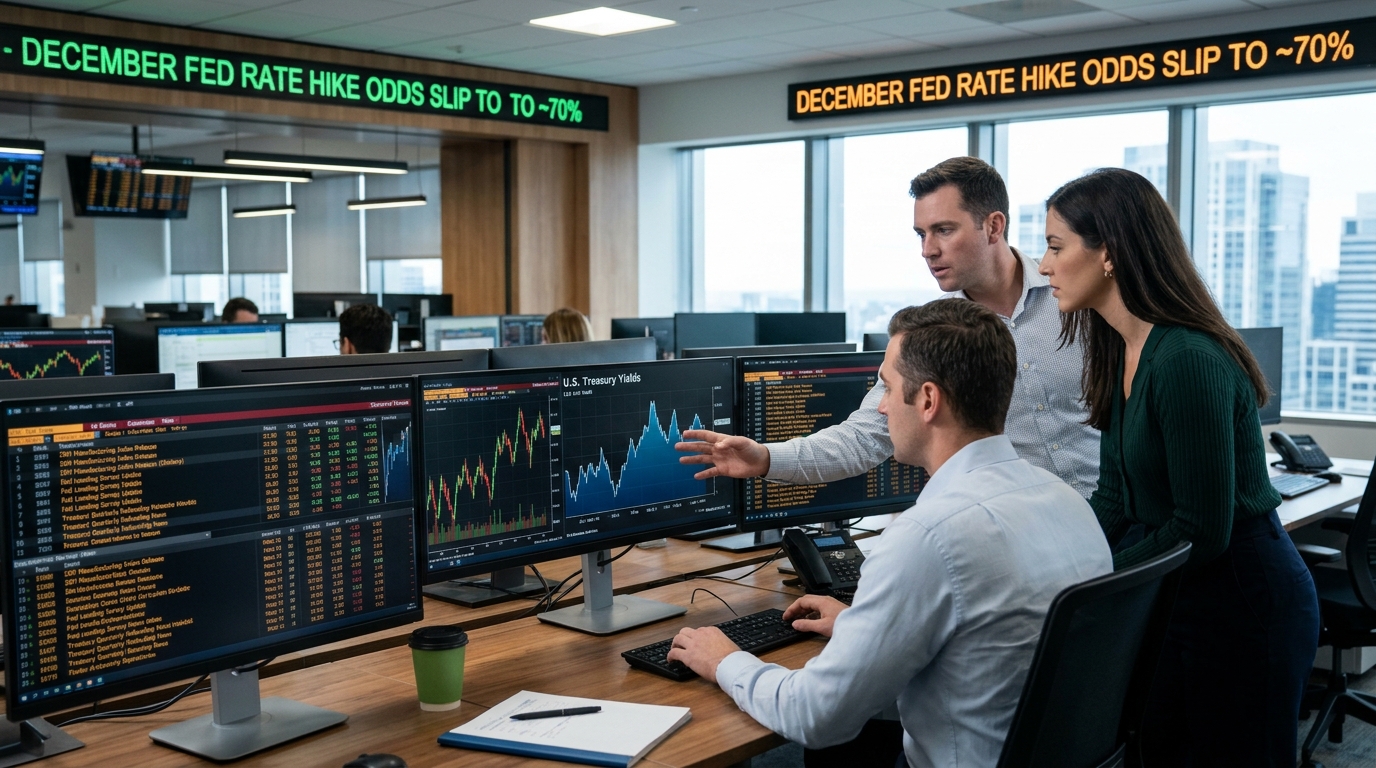
Three releases, six hours, one question underneath all of them: does the rate market reclaim any of the 15 percentage points of December hike probability it has given back since last Tuesday’s Fed decision?
Market Snapshot
The 10-year Treasury held near 4.93% in early trade Monday, while the 2-year sat around 4.57%, leaving the 2s10s spread at roughly 36 basis points, its widest in weeks. That steepening matters: the curve moved in the direction you’d expect if markets were quietly moving away from a near-certain December hike. Polymarket shows 69.5% odds for a quarter-point move at the December 8 to 9 meeting, down from about 85% in the hours immediately after the Fed’s October 27 to 28 hold. CME fed funds futures are in the same neighbourhood.
The Three Times That Matter
10:00 ET – ISM Manufacturing (October)
Consensus sits at 54.7, fractionally above September’s 54.5 actual. The ISM has printed in expansion territory every month since spring, and S&P Global’s October flash PMI at 56.0 offered a constructive backdrop. A reading at or above 55 would likely put upward pressure on short-end yields, reinforcing the case for a Fed move in December. A miss below 54 is the number that matters more: any weakness in new orders or prices paid would give the rate-easing camp its clearest data point of the morning.
Watch the sub-indices. A soft headline with a firm prices-paid component is the most Fed-hawkish combination, because it signals slowing activity without inflation relief.
14:00 ET – Senior Loan Officer Opinion Survey
The Fed publishes the SLOOS quarterly, and the November release is scheduled for 2:00 p.m. ET. Today’s release covers the October survey period, meaning it captures bank credit standards around the September rate hike to 3.75-4.00%. The key question is whether commercial and industrial lending standards kept tightening through October, or whether credit conditions stabilised. Widening tightening standards would suggest the hike cycle is biting into the real economy, which historically has given the Fed a reason to pause. A report showing stable or easing conditions removes that argument and keeps December a live hike.
The hawks driving December odds have been selective about which data they trust. Governor Cook and President Hammack have shown they weight labor-cost measures over headline employment when deciding whether credit conditions justify another move.
15:00 ET – Treasury Quarterly Borrowing Estimates
This is the Monday piece of a two-part quarterly refunding release. In August, Treasury estimated $628 billion in Q4 privately-held net marketable borrowing. Today’s update will either confirm that figure or revise it ahead of Wednesday’s full refunding announcement, which will set coupon auction sizes and clarify the forward path for Treasury’s long-end liquidity-support buybacks that were increased for this quarter. Any upward revision to the borrowing estimate pushes more duration supply into a market already watching the 10-year hover near 4.93%. A higher number without offset from other financing choices is the scenario most likely to lift long-end yields sharply before Wednesday.
December Hike Odds: The Slide and What Reverses It
The October 27 to 28 FOMC statement described economic activity as expanding at a “strong” pace, and both Governor Lisa Cook and Cleveland Fed President Beth Hammack voted for an immediate quarter-point rise. That pushed December hike odds briefly into the mid-80s. Since then, Friday’s Nasdaq selloff, sticky yields, and a softer global tone have pulled the probability back to around 70%. Dallas Fed President Lorie Logan said last week that skipping a meeting “does not change the monetary policy destination,” a line that makes clear the Fed isn’t being talked out of a December move by equity volatility alone.
A strong ISM combined with a SLOOS showing stable credit conditions would likely push hike odds back above 75%. A weak ISM combined with deteriorating loan demand could test 60%. The Treasury borrowing estimate is the wildcard: a large upward revision tightens financial conditions on its own, potentially making additional Fed action redundant at the margin.
Technical Radar
- 2-year Treasury: 4.56% is key support. A break below signals the market is pricing out December.
- 10-year Treasury: 5.00% is the level to watch on the upside if ISM and the borrowing estimate both disappoint bond bulls.
- 2s10s spread: At about 36bp, the steepest since July. A reversal back below 30bp after ISM would be a hawkish signal for short-end rates.
The Cheat Sheet
- Top Theme: Three scheduled releases today will re-anchor December hike odds that have drifted about 15 percentage points off their post-FOMC peak.
- Stock to Watch: Rate-sensitive financials, particularly regional banks. A SLOOS showing tightening credit standards would pressure net interest margin expectations; a benign result supports.
- Sector to Watch: Financials and Technology move in opposite directions on the same data: stronger ISM and stable credit favour banks over growth stocks.
- Biggest Risk: A strong ISM paired with a large Treasury borrowing revision, which would push both short and long yields higher simultaneously.
- Biggest Opportunity: The 10-year at 4.93% with December odds near 70%: if ISM disappoints, there is room for a fast 10-15bp rally in long-end bonds.
- One Thing to Remember: Today’s data points do not move in isolation. The sequence matters: ISM sets the tone by 10:15, the SLOOS reframes the credit picture by mid-afternoon, and the borrowing estimate at 3pm determines how much supply anxiety the bond market carries into Wednesday’s refunding.