
September 5, 2026
Bonus Content: CEG: Biggest Nuclear Fleet, Worst Stock Chart
Dear Reader,
Most people are looking at AI the wrong way.
They’re chasing the next hot stock.
The next chatbot.
The next flashy headline.
But AI does not run on excitement.
It runs on power.
It runs on data centers.
It runs on infrastructure.
And right now, that buildout is turning into one of the biggest money flows in America.
He believes it sits in the path of the AI infrastructure boom…
And could be one of the most important retirement opportunities most people have never heard of.
The part that makes this urgent?
Trump has reportedly invested up to $25 million of his own money.
Alex says regular Americans can learn how to access this fund for around $15 through a regular brokerage account.
This is the kind of thing I’d rather see early than read about later.
Good investing,
Rachel Gearhart
Publisher, The Oxford Club
CEG: Biggest Nuclear Fleet, Worst Stock Chart
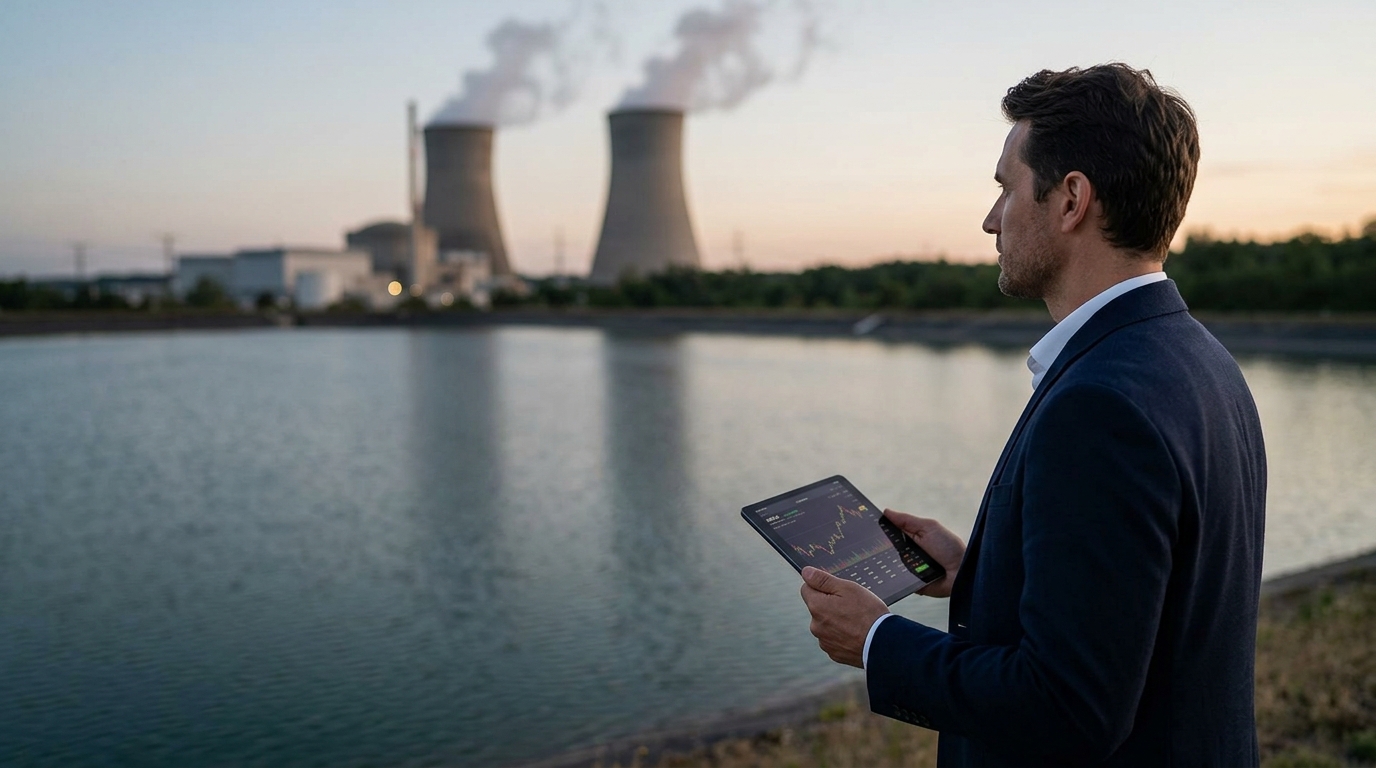
Nuclear power is one of the few energy inputs that Microsoft, Meta, and Walmart all want more of, and Constellation Energy holds the largest nuclear fleet in the United States. Yet CEG recently traded around $285 and is down roughly 20% year to date, while the company keeps delivering earnings beats and signing long-term contracts. That mismatch is what makes this stock worth a hard look right now.
Market Snapshot
Utilities are caught in a cross-current: strong fundamental demand from AI data centers on one side, rate pressure on the other. The 10-year Treasury yield hovering near 4.77% creates a valuation headwind for any long-duration cash flow, and CEG is not immune. The VIX has stayed elevated enough to keep risk appetite selective, which means quality names outside the obvious AI chip trade continue to trade at discounts they do not operationally deserve.
Stocks in Focus: CEG
What happened: Constellation posted adjusted operating earnings of $2.74 per share for Q1 2026, beating the $2.57 consensus as revenue climbed 63.8% year over year to $11.12 billion. More recently, in the second quarter the company reported $7.5 billion in revenue, up from the same quarter a year ago, while adjusted EPS came in at $2.55, up from $1.91 a year ago. Management responded by raising the bar: the company lifted full-year adjusted operating earnings guidance to $11.50 to $12.50 per share.
Why it matters: Constellation has entered long-term, carbon-free power agreements with Microsoft and Meta, aimed at supplying nuclear power for AI and data center growth. The company has also signed a long-term agreement with Walmart tied to output increases at its Dresden plant in Illinois. These are not letters of intent. They are multi-year purchase commitments against a fleet that runs continuously and emits nothing.
The Crane Clean Energy Center restart is the largest single growth catalyst. The company received an important NRC milestone when its request to revise the Crane license to allow receipt and possession of new fuel was accepted for formal NRC review, and FERC approved a waiver to transfer existing capacity interconnection rights from its Eddystone units to Crane, keeping the 2027 timeline intact. The facility is currently more than 80% staffed with over 500 employees, including engineers, mechanics, technicians, and licensed operator trainees. Beyond Crane, management is pursuing up to 1 gigawatt of uprates at existing plants over the next decade, including roughly 135 megawatts at Braidwood and Byron in Illinois.
What to watch: Policy around grid cost allocation and power-market structure has been the loudest political headwind for CEG in 2026. Any shift in that debate, or a Federal Reserve move toward cutting rather than holding, removes two of the three reasons the stock is where it is. The third, aging fleet maintenance costs, is real but manageable given the cash flow the company generates. Management has guided $8.4 billion in combined free cash flow for 2026 and 2027, rising to $11.5 to $13 billion in 2028 and 2029 as new contracts come online.
Sector Watch
Carbon-free baseload power is emerging as the sector-within-a-sector that data center operators are quietly competing for. The Crane restart and the new tech-sector contracts sit at the intersection of rising data center demand and interest in lower-carbon, reliable baseload power. Renewable energy cannot fill this role at scale today. Wind and solar are intermittent. Natural gas carries carbon and commodity risk. Nuclear is the only source that satisfies all three requirements simultaneously, which is why hyperscalers are signing 20-year deals to secure it.
Catalyst Calendar
- Crane restart progress: NRC safety and environmental review ongoing; any milestone update could move the stock sharply.
- Fed communications: September hold vs. hike debate directly affects CEG’s valuation multiple.
- Power-market policy: FERC rulings on grid cost allocation remain the primary policy risk to monitor.
- New PPA announcements: Management has indicated additional contracts are being negotiated.
Technical Radar
CEG near $285 is trading close to its 52-week low. Recently trading around $287, the median analyst forecast implies roughly 32% upside, supported by 17 Buy, 3 Hold, and 1 Sell ratings. Evercore ISI carries an Outperform rating with a $380 price target. The high target across the analyst community sits at $441, with the average near $347. Key resistance is the 200-day moving average, which CEG has not reclaimed in months. A close above that level on volume would be a meaningful signal.
Risk Radar
- Rate sensitivity: Long-duration cash flows face compression if the Fed signals hikes.
- Fleet maintenance: An aging nuclear portfolio carries rising operational costs that can surprise to the upside.
- Regulatory complexity: Risks include regulatory hurdles for data center colocation and execution on Calpine integration following its January 7, 2026 completion.
- Policy overhang: Grid cost allocation debates in Washington have already weighed on sentiment for months and remain unresolved.
The Cheat Sheet
Top Market Theme: AI infrastructure spending has reached the power layer, and carbon-free baseload is the scarcest input in that chain.
Stock to Watch: CEG. The fundamentals are improving. The contracts are signed. The stock has not followed.
Sector to Watch: Nuclear and carbon-free power, which is being revalued by hyperscaler demand faster than most investors have absorbed.
Biggest Risk: A Federal Reserve pivot toward higher rates extends the valuation compression on long-duration utility cash flows.
Biggest Opportunity: CEG at current levels is not priced for the contract pipeline already in place, let alone the deals still being negotiated. That gap between contracted earnings visibility and market price is where the opportunity lives.
One Thing to Remember: Every data center built this year needs power that does not go down. There is one source that guarantees that at scale. Constellation controls most of it in the United States, at a roughly 20% discount to where the year began.