September 24, 2026
Bonus Content: Japan’s Nikkei Surged Past 66,000. Now Watch the Yen.
Editor’s Note: Why did Warren Buffett hand the keys of Berkshire Hathaway to a man who cut his teeth at a tiny, little-known power company in the California desert? Whitney Tilson – who’s studied Buffett for more than 25 years and attended 23 straight Berkshire annual meetings – believes the answer points to possibly the biggest energy story of the decade. And he’s connected all the dots in a new presentation. Watch “Buffett’s Last Big Bet” below.
Dear Reader,
Did Warren Buffett just tip his hand one last time?
Before stepping back this year, Buffett handed the keys of Berkshire Hathaway to a man who cut his teeth at a tiny power company in the California desert.
Whitney Tilson – who has studied Buffett’s every move for more than 25 years – calls the strategy behind it “Project Vulcan.”
And here’s what makes it so remarkable:
The power source at its center runs 24 hours a day, in any weather… needs no fuel deliveries… and President Trump just locked in its tax credits through 2033, – even as wind and solar’s were gutted.
In other words:
It may be the only clean energy source built for the AI era.
And here’s why Whitney believes some of the companies positioned around it could be about to soar…
In Q4 this year – possibly as soon as October – the first commercial-scale plant supplying this power goes officially live.
And the moment this event happens, Whitney expects this niche corner of the energy market to go mainstream… and get flooded with institutional money.
Click here to get Whitney’s 3 best plays to potentially profit.
Sincerely,
Matt Weinshenck
Publisher and Director of Research, Stansberry Research
P.S. Berkshire’s new CEO started his career as a financial controller in a company that was acquired by Buffett over 25 years ago…
And this company was one of the earliest pioneers in mining this remarkable fuel.
Now he’s the leader of Berkshire Hathaway – at a time when arguably the biggest investment opportunity in the world is discovering the energy source that can power AI technology.
Coincidence?
Whitney thinks that’s unlikely.
And although Buffet and his successor got there early, there’s still a window of opportunity to get in on this for yourself…
But the window is closing fast.
Japan’s Nikkei Surged Past 66,000. Now Watch the Yen.
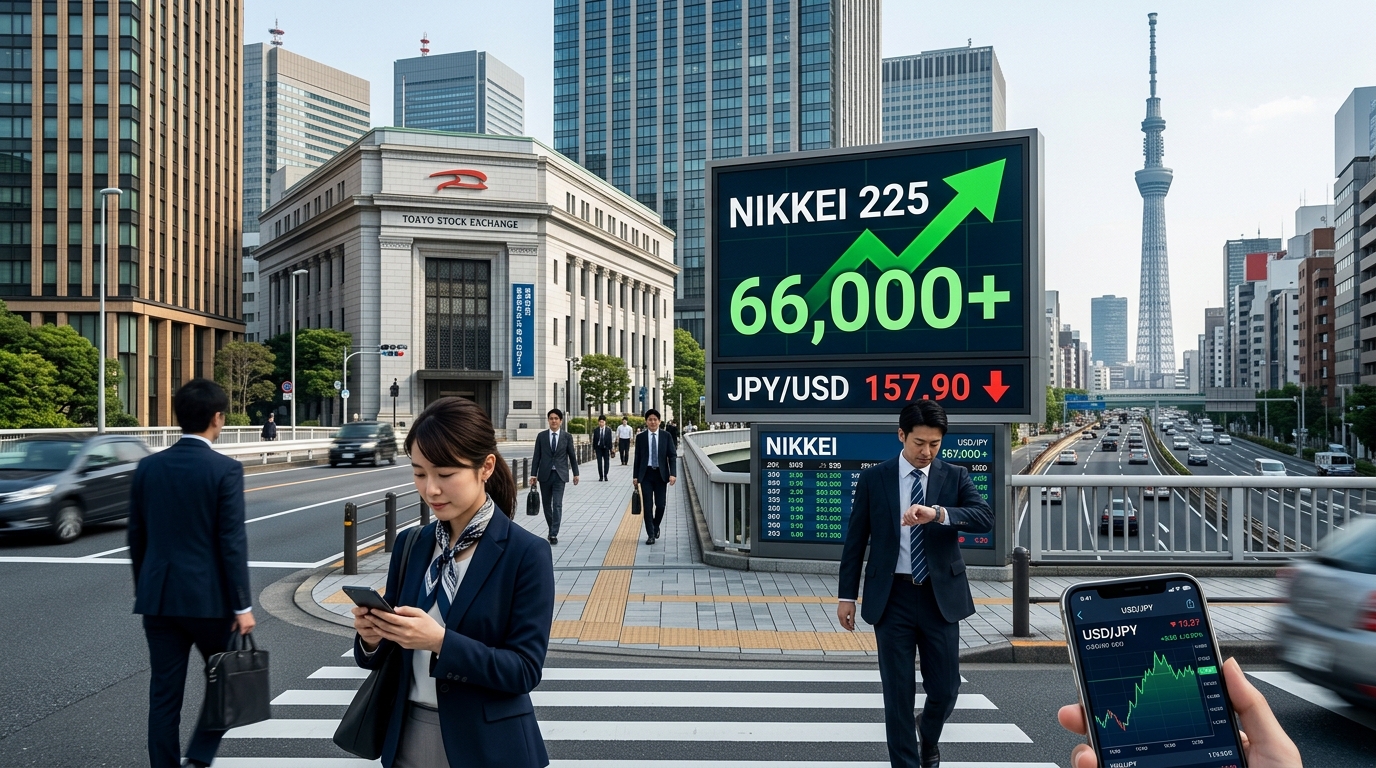
Tokyo came back from Japan’s first five-day Silver Week in 11 years and immediately ran. The Nikkei 225 jumped 1.6% to above 66,000 on Thursday as the market reopened following the extended holiday, with technology and artificial intelligence stocks leading gains as they caught up with global peers. The index had been frozen at 65,018.95 since September 18, but the world kept moving, and this morning’s open reflected it.
Market Snapshot
The Nikkei 225 Index gained roughly 966 points and remains 43.51% higher than a year ago. That year-on-year figure tells you the longer structural story. Today’s session is the short one, and the short one belongs to the yen.
USD/JPY reached 158.37 overnight, its highest since early September, then eased to 157.88 as Japanese markets reopened after the holiday. The 200-day moving average sits at 158.43, a level the pair has not managed a single close above since early September. The Ministry of Finance has already spent a record ¥15.4 trillion defending the currency from July 30 through August 26, so the question is no longer whether Tokyo will act, but whether a rate gap still north of 250 basis points makes any intervention stick.
Stocks in Focus
The session’s clear winners are the AI and semiconductor names that sat idle while U.S. and European peers were running. Global tech and AI shares outperformed in recent sessions after Meta’s Muse personal AI agent rekindled investor interest in the sector, and notable gainers in Japan today included Ibiden Co (+5.9%), SoftBank Group (+5.4%), Kioxia Holdings (+3.2%), Advantest (+1%), and Tokyo Electron (+0.8%).
SoftBank’s move is not a surprise in the context of what has been a historic year for the stock. SoftBank overtook Toyota as Japan’s most valuable company on June 1, with shares climbing 14% in a single session to push its market capitalization past Toyota’s for the first time in more than two decades. The AI boom thesis that drove that move is exactly what is driving today’s catch-up trade.
Toyota sits on the other side. Toyota shares have declined roughly 10% this year amid weakness in the broader auto industry. A weaker yen typically cushions exporters on the revenue line, but that tailwind is not enough to offset the structural headwinds Toyota is navigating.
The BOJ and the Yen
The Bank of Japan raised its policy rate by 25 basis points to 1.25%, the highest since 1995, and the move quickened the pace of its hiking cycle, arriving three months after the prior increase rather than the previous interval of six months. The decision was split 7-2, with board members Toichiro Asada and Ayano Sato dissenting.
The BOJ ultimately disappointed yen traders who wanted clearer guidance on the central bank’s next move. That ambiguity is exactly why the yen weakened after the hike rather than strengthening. The hike came just three months after the previous increase, the shortest interval between hikes since 1990, and followed increased pressure from Washington, including Reuters reporting that U.S. Treasury Secretary Scott Bessent ramped up pressure on the BOJ to raise rates this month.
Deutsche Bank flagged the Silver Week window before it even opened. Analysts noted that “the market is on watch with chatter that intervention could occur around the thin trading conditions of the Silver Week holidays that see markets closed for three days immediately after the BOJ meeting.” Those thin conditions are now behind us, but with USD/JPY parked just below its 200-day average, the window is not closed.
Risk Radar
Two risks sit at the top of the list. The first is a yen overshoot toward 160, the level traders widely associate with a Ministry of Finance response. Wall Street came under pressure on Wednesday after strong U.S. economic data and a rebound in oil prices fueled inflation concerns and reinforced expectations for further Federal Reserve rate hikes, pushing the dollar and Treasury yields higher. A stronger dollar adds fuel to the yen’s slide.
The second is yield risk. Japan’s 10-year JGB yield briefly touched 3% this month following the BOJ rate hike to a 30-year high. Rising domestic yields can compress valuations on the high-multiple AI and semiconductor names that drove today’s advance, creating a ceiling for the very stocks leading the rally.
The Cheat Sheet
- Top Theme: Tokyo’s Silver Week catch-up is real, but the yen trajectory near 158 is the session’s dominant variable.
- Stock to Watch: SoftBank (9984.T), up 5.4% today, is the index’s largest AI proxy and will track any shift in global sentiment toward the sector in real time.
- Sector to Watch: Japanese semiconductors and AI infrastructure, with Ibiden and Kioxia leading the bounce and the Nikkei Semiconductor index having surged 5.48% on the last trading day before the holiday.
- Biggest Risk: USD/JPY above 158.43 (the 200-day average) with MoF already committed to ¥15.4 trillion of defense. An intervention during U.S. hours would gap Japanese equity futures sharply.
- Biggest Opportunity: The AI catch-up trade is not complete. Names like Advantest and Tokyo Electron that lagged the pre-holiday semiconductor move still have room if U.S. tech holds overnight.
- One Thing to Remember: The Nikkei rally and yen weakness are pulling in opposite directions. Equity bulls need the yen stable enough to avoid intervention, because an abrupt reversal in USD/JPY is the fastest way this session’s gains unwind.