
September 24, 2026
Bonus Content: Pacific Power Set a Price Tag for AI Power. Others May Follow.
Below is an important message from one of our highly valued sponsors. Please read it carefully as they have some special information to share with you.
Dear Reader,
Jeff Bezos is terrified.
He will be down on his knees, hands out, begging Elon for mercy.
Because Elon is about to do something that will:
Cut Amazon out of the AI race ENTIRELY…
Completely DESTROY Blue Origin…
And take control of the potential $25 TRILLION DOLLAR PER YEAR AI INDUSTRY
And in his wake, potentially create 1,806,000 NEW millionaires over the coming years…
Starting September 25.
And this is your chance to be one of them.
Elon Musk is currently quietly planning the biggest project of his entire career.
And a single FCC filing proves it, click here to see why.
This is bigger than Tesla, SpaceX, and X combined.
And I believe it will not only cement Elon as the winner of the AI race…
It will allow Elon to control the entire industry.
Something of this magnitude has never happened in the history of the human race.
And it’s happening FAST.
According to my timeline, you must act by September 25.
I explain everything right here.
>>>This is your free Millionaire Maker Masterclass… and it starts right now.
Sincerely,
James Altucher
P.S. I am giving away a gift worth $1,000 to the first 1,000 people who watch and take action on my Masterclass offer today. No purchase necessary. ZERO credit card required. Just click here to watch my free video, and I’ll show you how to claim yours.
Pacific Power Set a Price Tag for AI Power. Others May Follow.
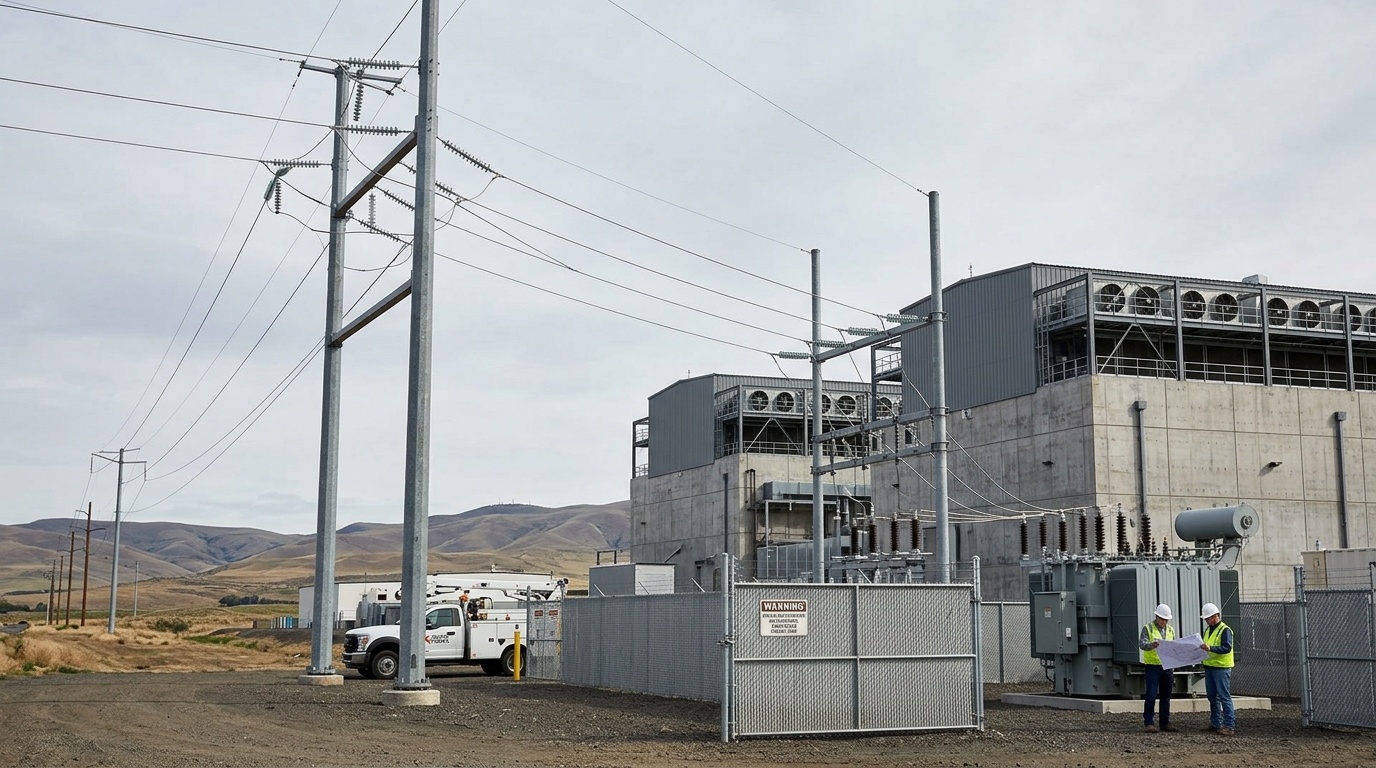
The story so far. Oregon’s second largest investor-owned electric utility is set to directly assign the costs of new energy projects and infrastructure needed for data centers to data center operators, after Pacific Power agreed to the deal last week following months of negotiations with staff of the Oregon Public Utility Commission, the watchdog Citizens’ Utility Board, and a handful of environmental and community advocacy groups.
The Citizens’ Utility Board called the agreement “the strongest from a for-profit electric utility yet” under Oregon’s POWER Act, which mandates that the state’s monopoly electric utilities create a separate rate class for data centers to ensure other customers aren’t subsidizing the massive energy demand from the server farms.
The three-member Public Utility Commission is expected to approve the deal on November 13. The Data Center Coalition, an industry group representing tech companies, is expected to attempt an appeal.
Why the Context Matters
The deal lands within days of a structurally different template taking shape in Georgia. Georgia Power struck a deal with Google for the tech giant to help fund upgrades at Plant Vogtle and the state’s other nuclear generating plant, with the utility saying this will bring hundreds of millions of dollars in savings for customers even as Google builds a wave of data centers. The new agreement, filed with the Georgia Public Service Commission, would have Google support uprates on Georgia Power’s share of the nuclear units at Plants Vogtle and Hatch. It will add about 96 megawatts of new capacity to the grid.
Both are cost-assignment frameworks. Oregon puts infrastructure bills directly on the data center operator. Georgia routes tech money into nuclear capacity that also serves the broader grid. They’re not identical, but they share a premise: the AI build-out does not ride free on existing customers.
Both Pacific Power and Portland General Electric have raised customer rates about 50% since 2020, while most customer classes became more energy efficient and data centers grew to make up about 23% of all retail electricity sales statewide in 2025. That political arithmetic is now hard to ignore in state capitals outside Oregon.
What Traders Should Watch
The spread of the model. Big-picture momentum is real, but the specific tally in this draft is too high to stand. Industry trackers compiling utility filings and commission actions show large-load tariffs are widespread and proliferating, with many states having approved at least one and others considering or holding pending proposals. Oregon’s deal is one of the more aggressive versions from a for-profit utility, which gives regulators elsewhere a benchmark to reference when industry groups push back.
Utilities with concentrated AI exposure. A February 2026 filing by Dominion shows roughly 70 GW of large-load interconnection requests in its queue, nearly triple the all-time peak electricity demand of about 24.7 GW (24,678 MW). American Electric Power has said it has signed nearly 63 GW of incremental contracted load by 2030. For both D and AEP, the investment thesis rests partly on those loads staying sticky and profitable.
As of March 31, 2026, AEP had filed large-load tariff proposals in multiple jurisdictions, with several receiving approval. During the second quarter of 2026, the Virginia State Corporation Commission approved APCo’s large-load tariff, applying to potential new large load additions greater than or equal to 150 MW on an aggregated basis. AEP has moved early. The question for investors is whether stricter cost assignment slows deal volume or protects it by reducing political blowback.
PacifiCorp and BRK.B. Pacific Power is the Oregon operating brand of PacifiCorp, which is owned by Berkshire Hathaway Energy under BRK.B. Pacific Power serves the Prineville-area data center tied to Meta, and it is often cited as the local retail utility for AWS’s Boardman-area campus. Tighter cost assignment does not eliminate those contracts, but it changes the economics of future ones.
VST and CEG. Vistra and Constellation operate in competitive power markets and are not directly exposed to state cost-allocation rulings in the same way regulated utilities are. If stricter tariffs at regulated utilities slow data center siting in those territories, competitive generators in ERCOT and PJM become relatively more attractive for hyperscalers seeking speed and flexibility.
The Risk
The Oregon model works cleanly where Pacific Power’s geography does: Pacific Power’s rural, large campuses make dedicated lines easier to assign than Portland General Electric’s smaller urban sites. Replication in denser service territories will be contested. Momentum is real, but a November 13 approval vote plus a probable industry appeal means this is a developing situation, not a settled one. Traders positioned in utility names with heavy AI load pipelines should treat Oregon as a leading indicator, not a resolved outcome.