October 3, 2026
Bonus Content: Paying 61% More Per Square Foot to Be Next Door to a Runway
Editor’s Note: While everyone was distracted by the SpaceX IPO, Elon Musk quietly filed a patent to protect his new invention, a new form of AI former tech executive Jeff Brown calls “M.A.G.I.” Read more below because Elon Musk is predicting his new invention will launch a NEW industry that will grow more than 7 million percent in the coming years.
Dear Reader,
Thanks to Elon Musk’s new patent…
I believe he’s about to unlock the biggest wealth creation event in history.
But you don’t have much time to act.
The Wall Street Journal even recently warned Americans that AI advancements like this could be…
“The last chance to amass generational wealth.”
I believe this will go mainstream by the end of this month…
And the world will never be the same again.
Look, scientists have been trying to develop something like this for almost 50 years.
Nobody was ever able to do it…
Until now.
Elon Musk did it…
And if you miss this rare window…
You’ll probably never see an explosive opportunity like this in your lifetime.
We have so much to look forward to,
Jeff Brown
Founder & CEO, Brownstone Research
P.S. By the way, when you click here…
I’ll discuss the stock you need to buy now… BEFORE this new product’s big launch. (No, it’s not Tesla or SpaceX.)
Paying 61% More Per Square Foot to Be Next Door to a Runway
Paying 61% More Per Square Foot to Be Next Door to a Runway
Specialized industrial developers are writing checks that only make sense if air cargo volumes keep climbing. So far, the math is holding.
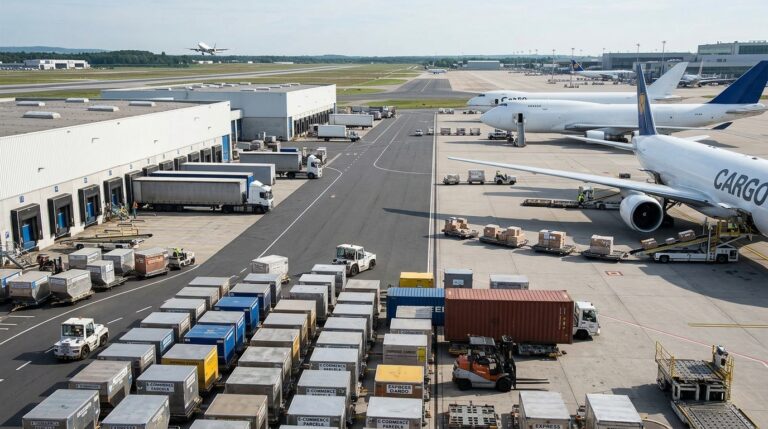
The premium is no longer a rounding error. Research from Turner & Townsend published earlier this year found that logistics assets within three miles of a major air cargo hub command rents roughly 61% higher than comparable facilities outside the airport catchment, with achieved rents averaging £15 per square foot against £9 per square foot beyond that perimeter. At Frankfurt, land directly adjacent to CargoCity Süd is trading at €470 to €560 per square meter, a 35 to 135% premium over typical suburban parcels a few kilometers away. These are not soft estimates. They are the prices at which deals are actually closing.
The buyers are not generalist REITs chasing yield. They are operators with airport-specific DNA. In January 2026, CIP Real Estate paid $51.6 million for the JAX Airport Logistics Center, a freshly delivered 425,000-square-foot park sitting directly adjacent to Jacksonville International Airport. The transaction was financed with acquisition financing of $44.6 million, and included a $35.6 million bridge loan component, meaning CIP accepted meaningful leverage to own a property with Class A specs, 32-foot clear heights, and airside proximity most logistics parks cannot replicate. That price per square foot only pencils out if you believe the location itself is a hard asset, not just a building characteristic.
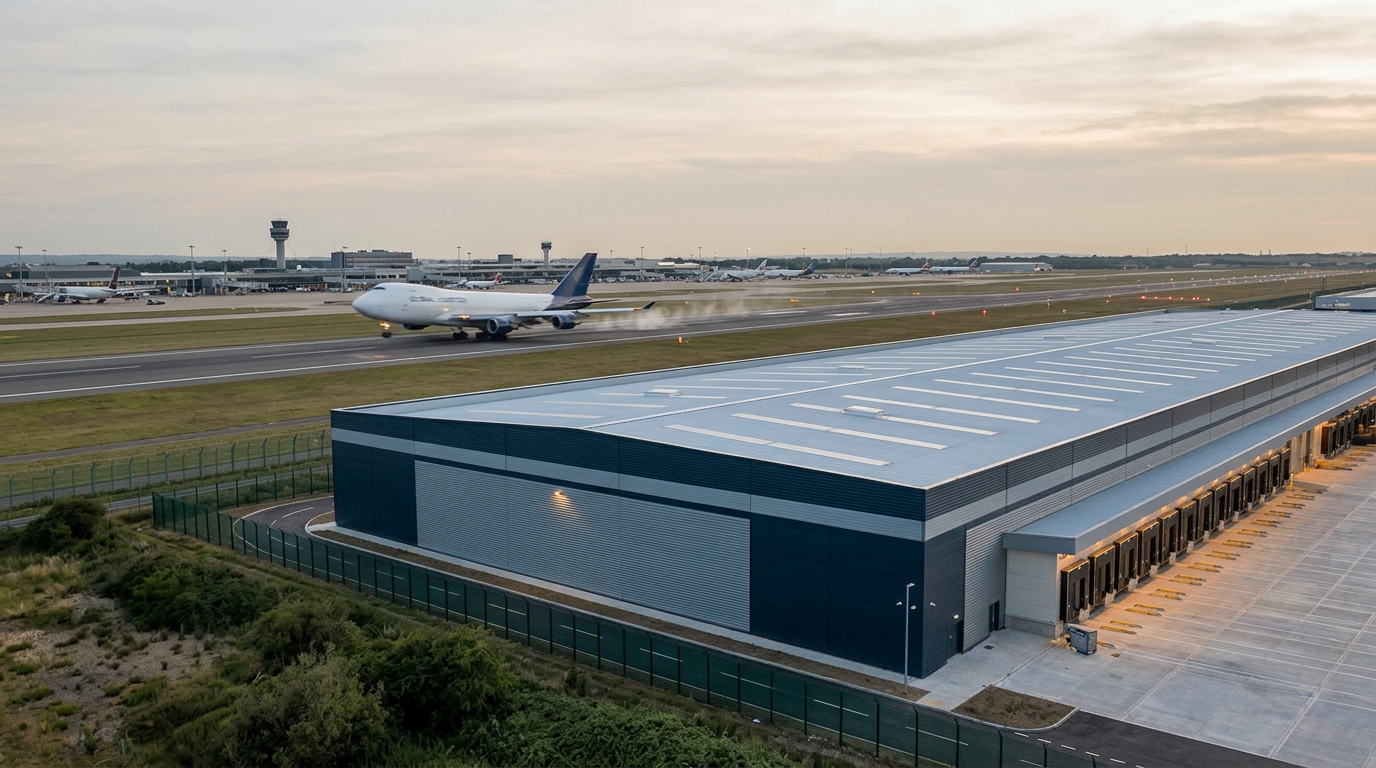
The same logic is driving Realterm, a firm whose entire thesis centers on transportation-critical real estate. In July 2026, Realterm partnered with the Susquehanna Area Regional Airport Authority to develop a new cargo facility at Harrisburg International Airport in Pennsylvania, delivering up to 105,000 square feet of first-line cargo space with airside drive-in doors that allow aircraft to park directly at the building. That is not a distribution center that happens to be near an airport. It is a piece of airport infrastructure wearing a real estate wrapper.
Near JFK, industrial rents have surpassed $30 per square foot as demand outpaces available supply. The airport’s $19 billion redevelopment, which includes a new roughly 350,000-square-foot cargo facility that opened in April 2025, has compounded scarcity. Prologis and Terreno have largely displaced local owners in the submarket, and the roughly 7 million square feet of supply there remains undersized relative to the cargo volumes JFK processes.
Houston tells the same story from the supply side. BCS Capital Group broke ground on a new industrial park targeting the IAH airport corridor after Houston Airports posted an all-time cargo record of 562,809 metric tons in 2025. Lovett Industrial’s SouthPort 45, a 668,077-square-foot Class A development near Hobby Airport, is expected to deliver in Q3 2026 into a market where vacancy across the manufacturing industrial sector sits near cycle lows.
The structural argument is simple: air cargo land does not expand. Airports are surrounded by infrastructure, zoning constraints, and in many cases decades of competing development. A developer who controls the first ring around a major cargo hub owns a position that cannot be replicated by building farther out. The freight cannot teleport from a warehouse three miles away; ground transport time at scale eats directly into the speed advantage that made air cargo worth paying for in the first place.
Prologis, whose portfolio of properties exceeding 500,000 square feet is now over 98% leased, launched more development projects in the first half of 2026 than it did in all of 2025. Cushman & Wakefield reported industrial leasing activity in 2026 has been running at its highest level since mid-2022. The recovery is broad, but the tightest spreads remain concentrated in the submarkets where the runway is visible from the loading dock.
For traders watching this sector: the premium is already priced. The question is whether air cargo volumes justify holding it. So far, every cargo record and every completed deal says yes.