
October 13, 2026
Bonus Content: Stablecoins Haven’t Faced a Real Crisis, Regulators Warn
Most traders have never noticed the weird market anomaly that happens at 9:35 AM every morning.
They’re too busy with lagging indicators trying to predict the next move… when the market makers have already set the tone for the trading day.
It’s this weird anomaly that points us to the market maker’s key levels above and below.
And by playing the move within that range…
Regular folks like you have been able to reach for $100 or more (on a $1K stake) over 600 times in the last 2 years.
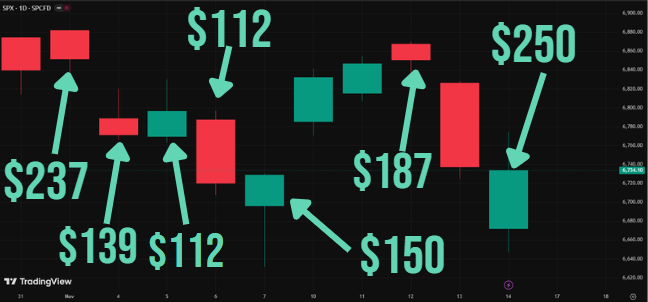
We’ve seen this straightforward approach play out whether the market broke out… broke down… or stayed choppy.
Granted, I can’t make trading guarantees here.
But I’ve opened up the data behind those trades, as well as how you can get in on the very next morning opportunity.
You’ll find the full details right here.
See you in the market.
Chris Pulver
Stablecoins Haven’t Faced a Real Crisis, Regulators Warn

Three regulatory clocks are now running on stablecoins at once, and traders in Coinbase (COIN), Circle (CRCL), and anything with USDT exposure should know the schedule before this week ends.
Market Snapshot
The Financial Stability Board handed the G20 a status report on stablecoins on October 12: a market worth about $300 billion, roughly 99 percent of it pegged to the US dollar, and a supervisory structure that remains untested in severe stress and insolvency. The FSB’s own language is the tell. Its central finding: “Global stablecoins and national regulatory frameworks remain untested in severe stress and insolvency.” That is not a description of an acute problem today, but of an open flank. Nobody knows what happens when a large issuer fails and holders in dozens of countries want their money back at the same time.
The FSB delivered its message to G20 finance ministers and central bank governors ahead of the October 15 meeting in Bangkok, alongside a cover letter from FSB chair Andrew Bailey, governor of the Bank of England. Bailey said international regulatory coordination remains underdeveloped, leaving authorities without mature arrangements for managing cross-border stablecoin failures.
Stocks in Focus
Tether / USDT. Tether’s USDT, the largest stablecoin at about $184 billion and the third-largest cryptocurrency of any kind, is the asset the question is really about in the Treasury rulemaking. USDT is not authorised under MiCA, which compounds its exposure to the ESMA expectation detailed below. The FSB specifically flagged the structural risk inside some stablecoin structures: stablecoins issued by multiple affiliated companies that share liability for the same token while maintaining separate reserves can create liquidity mismatches when redemption demand concentrates in one jurisdiction while much of the collateral backing the tokens remains in another.
Circle / CRCL and Coinbase / COIN. Circle’s USDC holds roughly $73 billion in supply and, unlike Tether, operates within MiCA’s framework. That regulatory distinction matters more this week than any price level. Coinbase has already flagged USDT and PYUSD as non-compliant and set an October 30 deadline for its European clients, running ahead of the broader January 8 ESMA date referenced below.
Catalyst Calendar
- October 19: Treasury’s proposed rule implementing section 3 of the GENIUS Act closes for public comment. This is a key opportunity for the crypto industry to influence the regulatory landscape before the GENIUS Act’s expected effective date of January 18, 2027.
- October 20: Comments close on the SEC’s Regulation Crypto Assets, after which the SEC will consider submissions before deciding whether to adopt a final rule that could differ materially from the current proposal. The proposal is unusually broad and runs deep into the Federal Register. Final rules are not expected before the first quarter of 2027.
- January 8, 2027: ESMA has said MiCA-authorised crypto firms should cease providing services tied to non-MiCA-compliant stablecoins, and it set January 8, 2027 as the date by which existing exposures should be addressed.
Risk Radar
The FSB warned that the roughly $300 billion stablecoin market could face redemption runs if affiliated issuers cannot move reserves across borders during market stress, potentially pushing tokens below their dollar pegs and spilling into traditional finance. It called for stronger international information sharing, monitoring, and crisis planning, while noting that its recommendations are non-binding and cross-border failure procedures remain underdeveloped.
The stress-test gap the FSB describes is not purely theoretical. Crypto-focused banks have already shown how deposit flight can force fire-sales of debt securities at steep losses when digital-asset customers withdraw en masse.
The non-binding nature of FSB guidance is precisely the gap. Neither the Treasury nor SEC comment deadlines change what a crypto asset service provider may lawfully do. Both are proposals, and comment deadlines do not bind firms. The binding date, on the GENIUS Act side, is January 18, 2027, the law’s expected effective date. That means this week’s deadlines are the last moment for industry to shape the rules before they harden.
The Cheat Sheet
Top Market Theme: Global regulators publicly acknowledged this week that a $300 billion market has never been stress-tested, and two of the most consequential US rulebooks for that market close for public input on October 19 and October 20.
Stock to Watch: Coinbase (COIN). It sits at the intersection of every thread here: GENIUS Act compliance obligations, SEC offering rules, and an already-announced European USDT cutoff date of October 30.
Sector to Watch: Crypto infrastructure and custody. ESMA’s expectation explicitly covers custody services, which pulls the largest regulated platforms directly into the compliance timeline.
Biggest Risk: Stablecoins could face redemption runs even with full reserves if reserves become inaccessible across borders during market stress. Affiliated issuers in different countries could struggle to meet concentrated withdrawals when reserve assets are held elsewhere. That scenario has no tested playbook.
One Thing to Remember: October 19 and 20 are not implementation dates. Nothing becomes binding when the comment windows close. But the shape of what becomes binding in January 2027 gets fixed by what industry puts on the record this week.