Dear Reader,
If you haven’t yet checked out this video below from my colleague Jen Stevens at International Living, don’t miss it. At a time when travel costs are increasing (along with the cost of everything from groceries to gas), she can show you how to save.
Because, as Jen explains, you don’t need to be rich to travel like you are. You just need the right shortcuts. I encourage you to check out her message, below…

Dear Reader,
One of the great pleasures of relaxing into a corner of the planet – and not just dipping in on a tour, like a lot of vacationers do – is that you can take a leisurely approach to exploration. Soak up the feel of a place. Make a rough plan in the morning and just see how your days unfold.
Jen Stevens here from International Living with some travel guidance for youfrom the South of France. Mine might sound like a wealthy-person’s approach to travel, but you don’t have to be super wealthy and famous to live a high-flying international life… to enjoy a retirement that’s rich with experiences you’ve always wanted to have…
I’m not rich. I just travel like I am…
It is 100% possible to live in comfort, travel often, and not worry about whether you’ll outlive your nest egg…
You just need to know the shortcuts.
I made you a video that talks about a bunch of them, here.
Warmly,

Jennifer Stevens
Executive Editor, International Living
P.S. All sorts of amazing shortcuts exist that can allow you to travel better than you do now but spend way, way less than you assume you have to.
I’m talking about little-known ways you can enjoy a genuinely international life… no skimping required. This is high-end travel without the high-end price tag… shortcuts that lead directly to “the good life.”
- Stay in luxury for 50% what the guy in the next room is paying…
- Winter over with your spouse on a sunny Caribbean island – with the ocean a few blocks away – and do it for $2,500 a month or less, all in, Here’s why.
- Shop for couture-quality clothes at Target prices…
Those are just a few of the shortcuts you can use to live and travel better while you spend less than you would to stay home.
UNP Reports Today. Its Robot Track Cars Are Now a Margin Story.
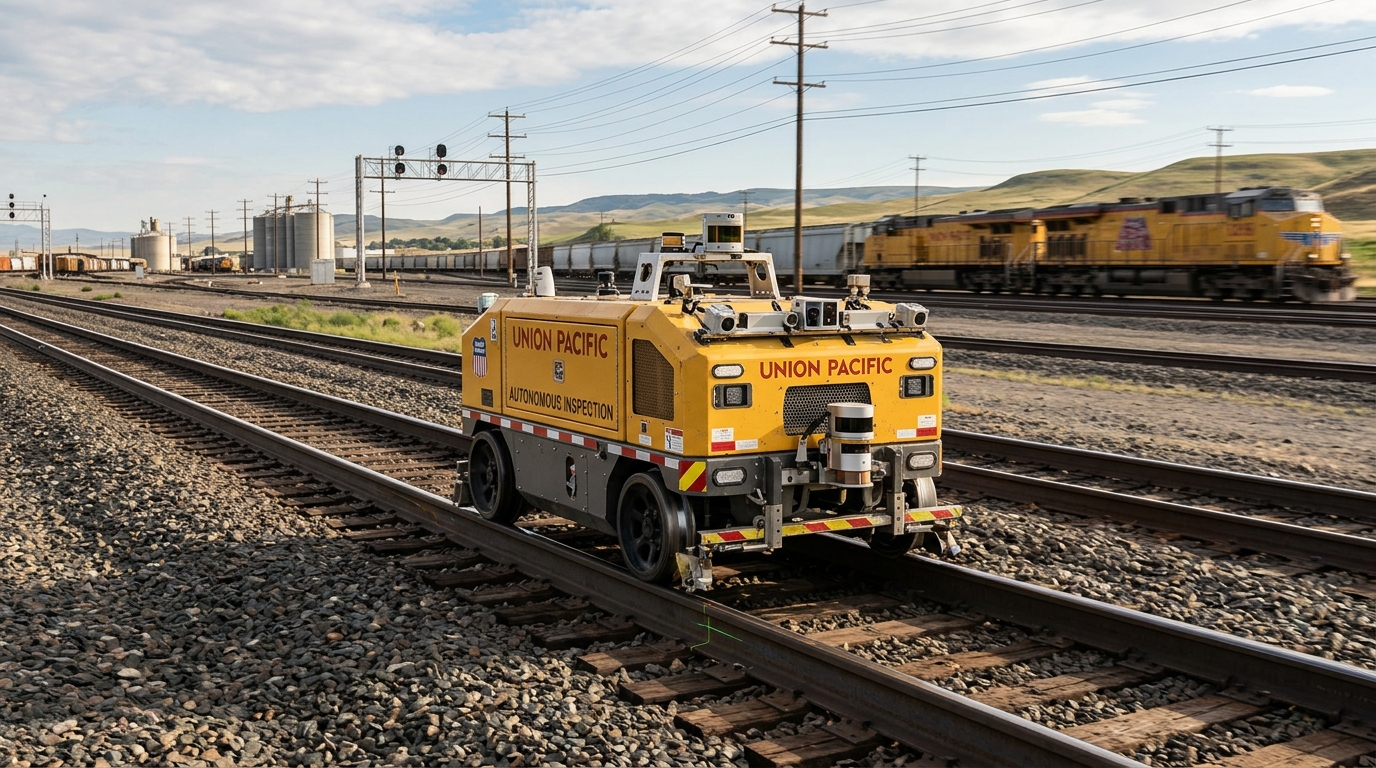
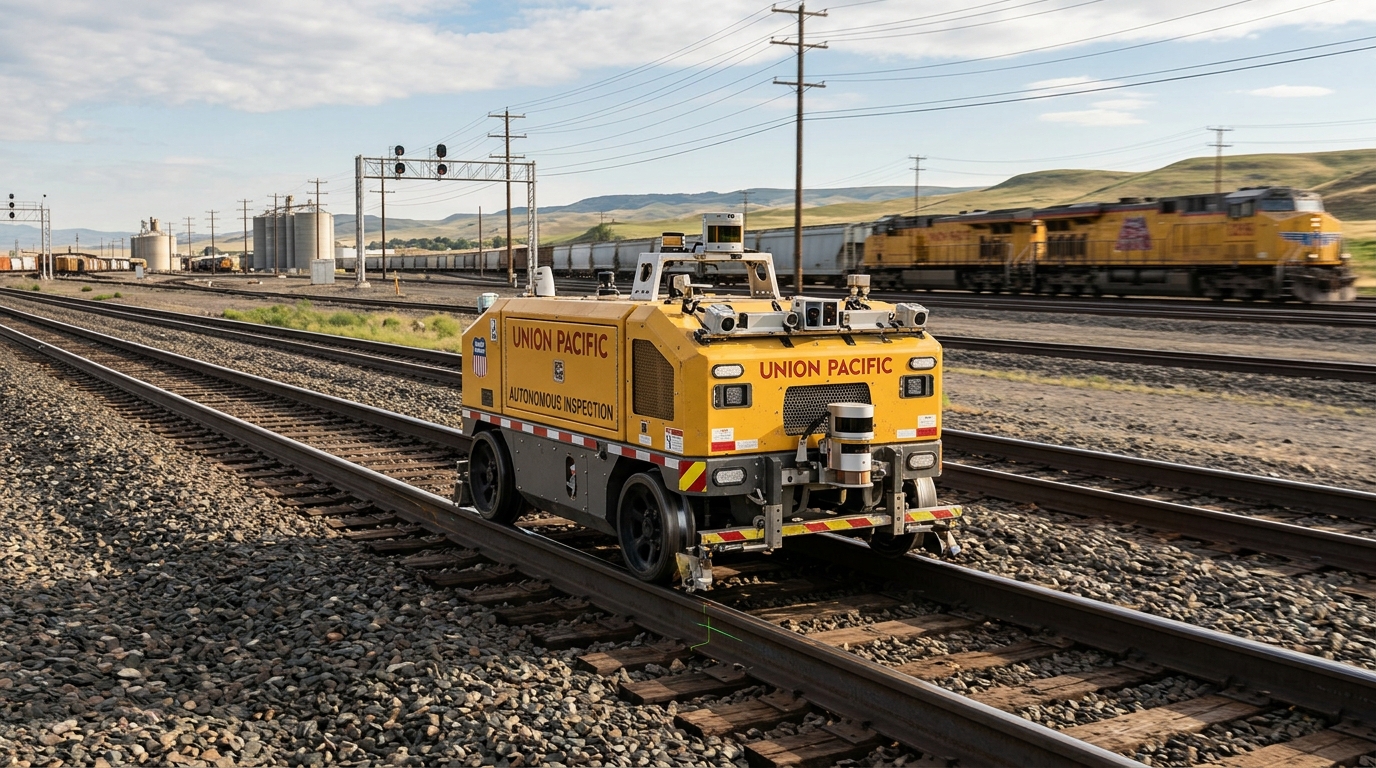
Union Pacific (UNP) drops its Q3 2026 results Thursday morning at 7:45 a.m. ET. Analysts expect adjusted EPS of $3.47, versus $3.41 in Q2 and $3.08 a year ago. Most previews focus on freight volumes and fuel costs. Fewer are asking the more structurally interesting question: how much of the railroad’s operating ratio improvement is being underwritten by machines that never stop inspecting the track.
What the Fleet Actually Does
Union Pacific’s autonomous geometry cars are not a pilot program. They are a scaled operation. The company’s own SEC filings confirm it uses the fleet to inspect 500,000 miles of track annually, with its Physics Train Builder software layered on top to flag routes most at risk of derailment before trains roll.
The data volume behind this is staggering. The machine vision program logged over 644,000 track miles in 2025 alone, generating 100 billion individual spatial measurements. That output feeds a digital twin of the physical rail network, where deep learning models identify microscopic degradation trends invisible to a human walking the line. Separately, more than 7,000 wayside detectors generate 16 million data points daily, monitoring freight cars and locomotives in real time.
The safety result is documented: the reportable personal injury rate improved in Q1 2026, and management highlighted the trend against three-year rolling averages on its Q1 call. Derailments can be volatile quarter to quarter, but fewer incidents generally mean lower disruption and faster recovery, all of which can feed directly into operating ratio.
The Operating Ratio Connection
UNP’s adjusted operating ratio improved from 60.7% in Q1 2025 to 59.9% in Q1 2026, and then to 59.2% in Q2 2026. That trajectory is not purely a pricing story. Workforce productivity rose 5% in Q2, freight car velocity improved 5%, and terminal dwell tied a record. Those metrics reflect a railroad moving more efficiently through the same physical plant, and a large part of that efficiency depends on infrastructure that does not fail unexpectedly.
The Association of American Railroads has argued that automated track inspection, when paired with existing inspection practices, can find geometry defects earlier and reduce the need for as many manual visual inspections under certain conditions. A defect avoided is a slow order avoided; a slow order avoided is a velocity drag removed. The math compounds across 32,693 route miles.
The Risk Traders Are Underpricing
The FRA approved a five-year waiver in December 2025 allowing railroads to reduce the frequency of visual inspections in specific areas where automated technology is deployed, subject to conditions. CSX formally notified the FRA it would implement the waiver beginning July 1, 2026 across about 3,000 route miles. Union Pacific has not yet announced an equivalent activation, and that regulatory gap is worth watching.
Labor opposition is organized and vocal. The SMART-TD union has argued the waiver does nothing to improve safety and that automated systems cannot detect the full range of defects a trained inspector catches on foot. The Brotherhood of Maintenance of Way Employees Division has also opposed the waiver. Lawmakers from both parties have proposed bills requiring both automated and human inspections to remain mandatory.
If Congress codifies dual-inspection mandates, the cost savings from autonomous deployment shrink materially. The technology stays, but the headcount reduction that amplifies the margin benefit does not arrive.
What to Watch at 7:45 a.m.
- Operating ratio guidance. Any narrowing of UNP’s path toward sub-59% adjusted OR will signal whether the inspection technology is being credited internally as a structural lever.
- Derailment rate language. If management quantifies the trend improvement, it gives analysts a basis to model avoided-cost savings explicitly.
- Capital plan commentary. UNP affirmed a $3.3 billion capex budget for 2026. Any expansion of that figure toward inspection tech would clarify how aggressively the railroad is betting on the autonomous maintenance wave.
The stock trades near $288 against a consensus target of $327. The gap closes on execution, and right now the most durable execution advantage UNP has is one that runs at freight train speeds without a crew on board.