

No one can tell you the exact day the AI bubble will burst.
That’s OK…
Because you don’t have to call the top to potentially profit from what comes next.
You simply need to get positioned before the crowd does.
I’ve identified four gold miners I’m buying for exactly that reason.
I’m Garrett Goggin, CFA and CMT.
I’ve spent more than 20 years studying gold, mining companies and the long market cycles that most investors experience only once or twice in a lifetime.
Porter Stansberry recently called me: “THE most knowledgeable gold investor in the world.”
I’ve spent decades traveling to mines and looking management teams in the eye before risking my own money.
Here’s what’s happening that no other source is talking about:
Gold miners are already producing record cash flows – far outperforming every other sector.
Mining is already one of the most profitable sectors.
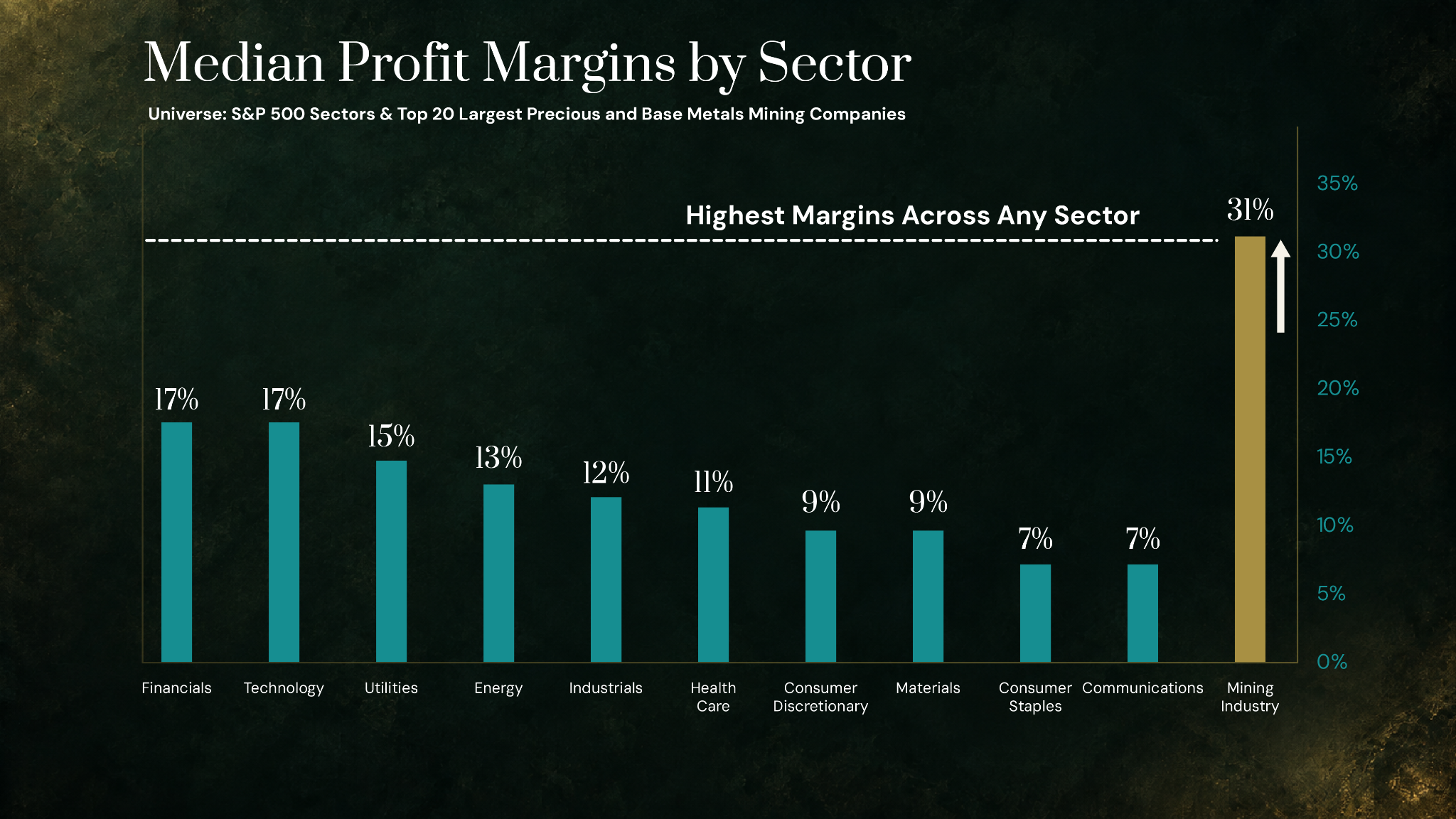
Yet mining remains only about 1% of global equities.
In other words…
The most profitable sector in the investing world…
All you have to do is position your portfolio in the best gold mining stocks first – before fund managers rotate hundreds of millions of dollars… and gold mining stocks shoot the moon.
Regards,
Garrett Goggin, CFA, CMT
Lead Analyst and Founder, The Golden Portfolio
Abbott’s Blood Test Can Find 50 Cancers. Medicare Won’t Pay Until 2028.

Abbott’s cancer diagnostics unit pulled in $968 million in Q3 2026, growing 13.8% on a comparable basis. That number gets cited as evidence that ABT’s bet on blood-based cancer screening is working. What rarely gets mentioned alongside it: the flagship product driving that momentum still has no FDA approval, costs patients $689 out of pocket, and is covered by no insurer.
That is the actual trade in ABT right now.
The product in question is Cancerguard, currently one of the commercially available multi-cancer early detection tests designed with a multi-biomarker class approach, combining methylation and protein signals to improve detection. Abbott acquired it when it closed the Exact Sciences deal on March 23, 2026, paying $105 per share in cash and assuming approximately $2.8 billion of debt. The strategic logic was straightforward: get ahead of a market that does not yet fully exist but almost certainly will.
The science behind Cancerguard is legitimately impressive. In a prospectively collected case-control study, nearly half of positive cancer signals were driven by methylation alone, with additional detection from protein-only and combined biomarker signals, and the false-positive rate came in at 2.6%. Long-term data from the DETECT-A program showed that in follow-up beyond four years, all treated patients with stage I or II cancers remained alive and cancer-free. Those are the kinds of numbers that make oncologists pay attention.
But the reimbursement clock is where traders need to focus. A federal law signed on February 3, 2026 creates a pathway for Medicare to begin covering FDA-approved multi-cancer blood tests starting in 2028. The catch: for Cancerguard to become eligible under that law, Abbott must obtain FDA approval, and as of October 2026, no multi-cancer early detection test is FDA-approved for general population screening. The FDA has granted Cancerguard an investigational device exemption for use in a real-world evidence registry, but that is a research designation, not an approval.
Meanwhile, Abbott is not standing still on the regulatory front. In September 2026 it launched SimpleScreen CRC, an FDA-approved blood-based colorectal cancer screening test, and Abbott has positioned it as part of a portfolio that includes stool-based testing. In the PREEMPT CRC study of more than 48,000 asymptomatic adults, SimpleScreen demonstrated 81.1% sensitivity for colorectal cancer and 90.4% specificity after age- and sex-adjustment. That approval matters strategically because it proves Abbott can move a liquid-biopsy product through the FDA. The question is whether it can replicate that across Cancerguard’s far broader 50-cancer scope.
For traders, the bifurcation is clear. Diagnostics revenue reached $3.305 billion in Q3, up 46.7% on a reported basis, with cancer diagnostics accounting for $968 million of that total. The Exact Sciences acquisition created a revenue engine. But Cancerguard remains a laboratory-developed test without FDA approval, which carries regulatory risk around future oversight requirements. And the Medicare window that would convert Cancerguard from a niche cash-pay product into a volume story does not open until 2028 at the earliest.
The reimbursement pathway is the mechanism that converts Cancerguard from a cash-pay niche into a volume story. Health insurers are already under pressure from rising medical costs, making coverage expansion for new screening tests a harder political and actuarial sell.
ABT is not mispriced for what it has. The question is whether the market is pricing in what Cancerguard could become before the regulatory hurdles are actually cleared. That gap between the revenue story and the approval timeline is where the real risk sits.