

When news broke overnight about China’s Moonshot AI unveiling its new model…

The market gapped down 1% before most traders even poured their morning coffee…
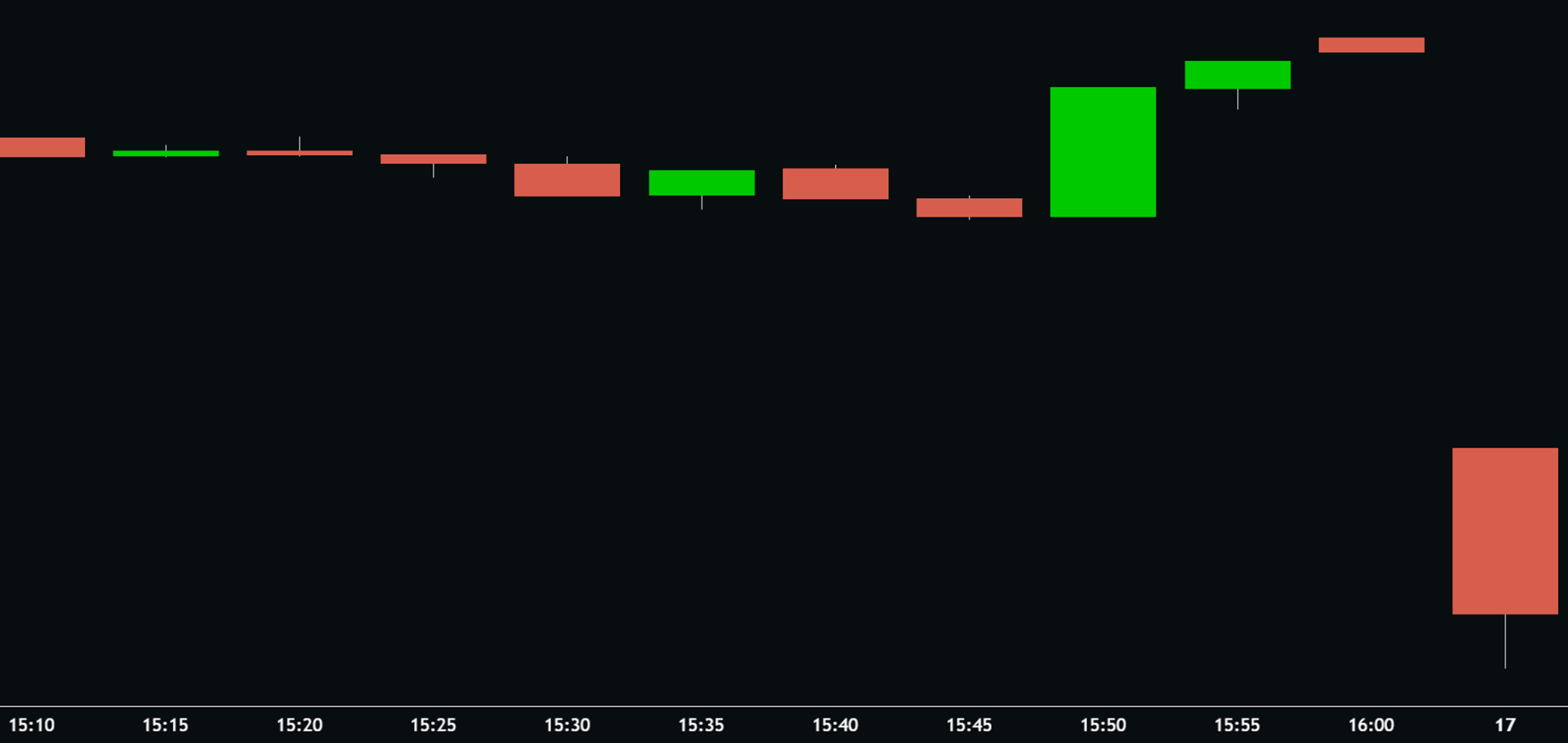
For standard portfolios, it looked like the start of another stressful day…
And over the next two hours, the market barely crawled higher… moving a tiny 0.2%…
To traditional buy-and-hold investors, a 0.2% move is practically useless…
Yet, according to our research, anyone who ignored the overnight headlines and waited until exactly 9:50 AM Eastern could have locked in a $529 payout before lunchtime… on a simple $1,000 starting stake…
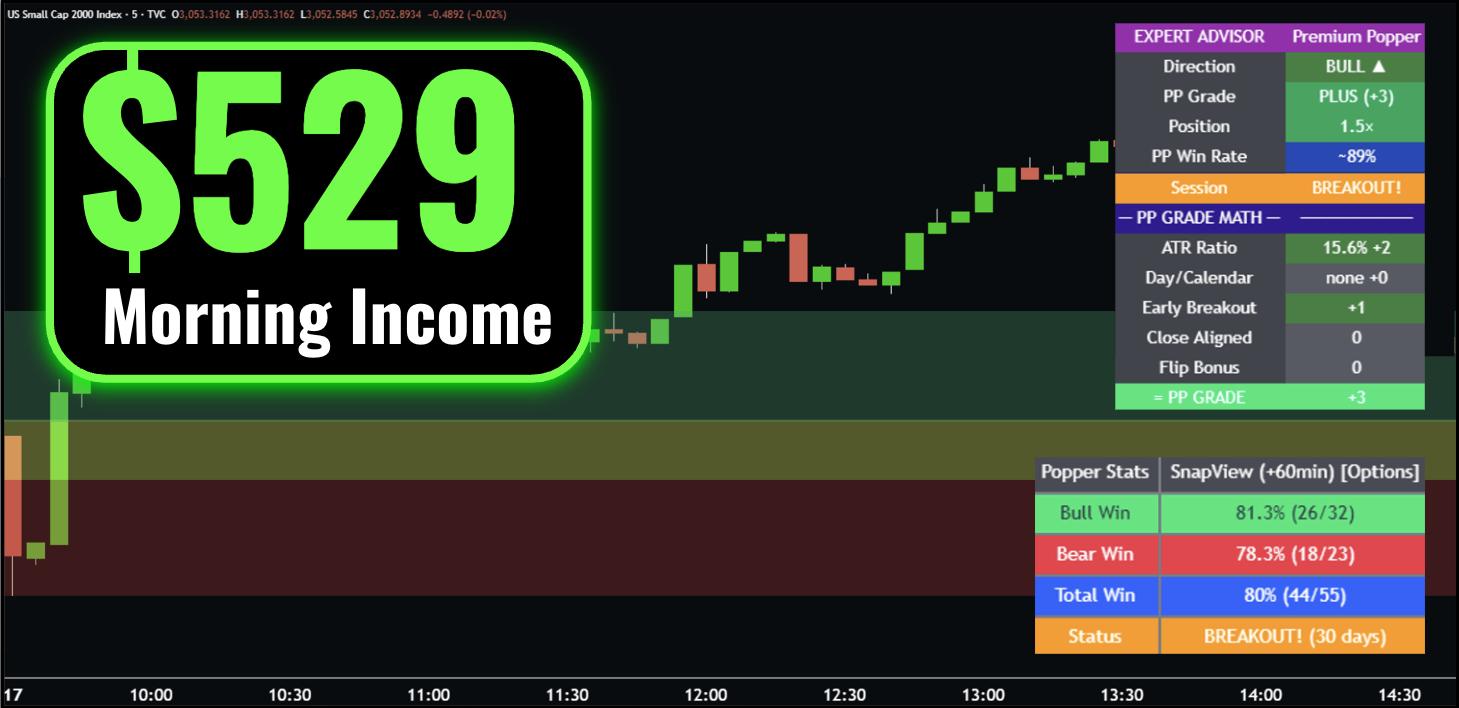
That would not have been an isolated fluke either…
Back on June 25th, when inflation surged past 4%…
And panicked investors expected a massive market beatdown… the market moved just 0.3% after the open… yet that exact same morning setup yielded another $526 payday before lunch…
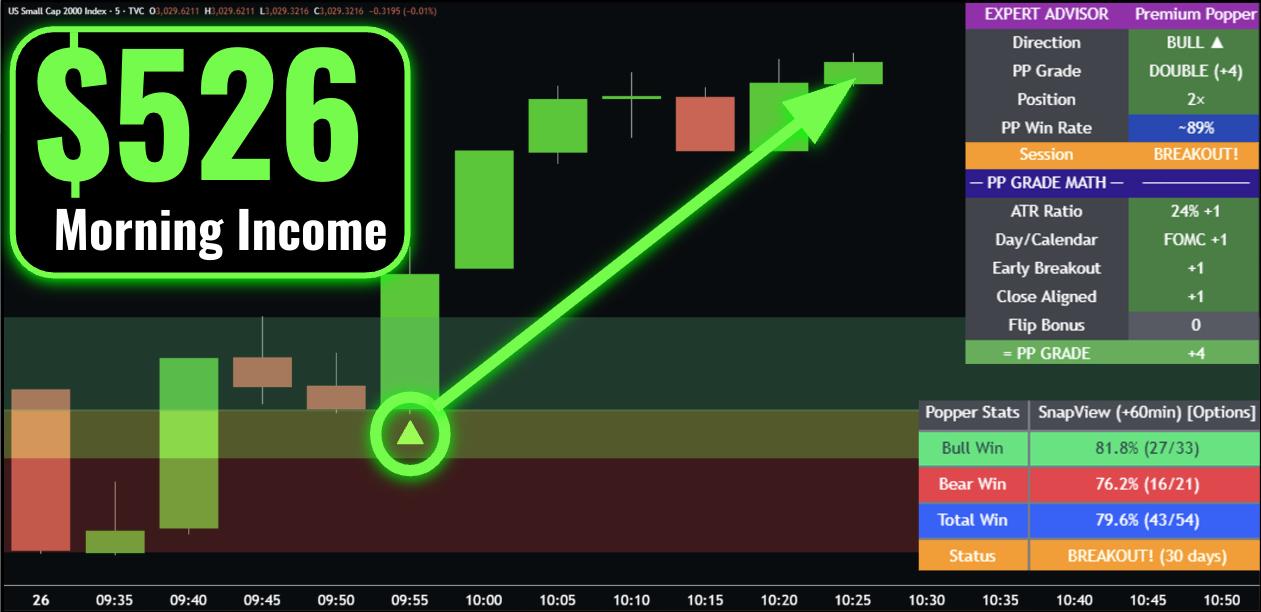
Of course, there would have been smaller gains and some that did not work out, but…
How would it have been possible to pull $500+ out of the market on a tiny fraction-of-a-percent crawl… while traditional traders are getting chopped to pieces?
It all comes down to an institutional phenomenon that happens during the first 20 minutes of every trading day…
Between 9:30 AM and 9:50 AM, Wall Street heavyweights enter a massive brawl to settle block orders… pushing nearly 25% of the entire day’s volume into a brief 20-minute window…
Right around 9:50 AM, the brawl ends… the dust settles… and the market literally hands us its direction for the rest of the morning…
By placing just one simple trade on one ticker right as that direction becomes clear…
You give yourself a shot to walk away with $500 in hand before lunch, leaving you completely free for the rest of your day…
While I cannot make any guarantees in the market…
Recently, I sat down live on camera with a former money manager to lay out the floor data behind this 9:50 AM morning phenomenon…
And how anyone with a normal brokerage account can take advantage of this step-by-step…
Tap here to watch the complete video breakdown before access is taken down.
See you there,
Silas Peters
Defense Stocks Won’t Collapse After a Ukraine Deal. Here’s the Split.

Every time a Ukrainian official hints at a deal, defense stocks sell off. European defense shares fell sharply on April 10, 2026 after Ukraine’s senior negotiator with Russia signaled a resolution could be in sight, with Rheinmetall finishing 5.9% lower, Hensoldt down 5.9%, and BAE Systems closing off 3.3%. The reflex is understandable. It is also wrong in at least half the cases where traders are applying it.
The core mistake is treating Ukraine-related revenue as the main driver of contractor valuations. It isn’t. European defense valuations are anchored in structural budget increases rather than short-term Ukraine revenue, and rearmament plans are unlikely to reverse even in the event of a peace agreement. Ukraine procurement is marginal for most of the large contractors. What matters is the multi-year NATO buildout, and that story has barely started.
The Backlog Reality
Rheinmetall is the clearest proof. The first half of 2026 was very strong, with revenue and earnings rising significantly, and Rheinmetall Backlog reached a record €80.5 billion, providing high visibility for future growth. That backlog represents years of contracted work, none of which disappears if Kyiv and Moscow reach a settlement tomorrow. Rheinmetall has already absorbed periodic sharp sell-offs linked to Ukraine peace-talk headlines, which have shown how quickly geopolitical de-escalation sentiment can weigh on defense names, even when the underlying order book keeps expanding.
In the United States, the numbers are similarly insulated. RTX reported third-quarter 2026 sales of $25.0 billion, up 11%, and its company backlog reached $340 billion, including $164 billion of defense, after being awarded Tomahawk and AMRAAM multi-year undefinitized production contracts. Lockheed Martin holds a record $230 billion backlog. A ceasefire does not cancel a Tomahawk contract.
Why NATO Spending Persists
The structural driver runs deeper than any one conflict. Five NATO members are projected to meet the alliance’s goal of spending 3.5% of GDP on core defense already in 2026, a target agreed at the June 2025 NATO summit in The Hague with a 2035 deadline. European allies and Canada are expected to spend about $634 billion on defense in 2026, an 11% increase from 2025, according to NATO estimates.
Hensoldt has argued that even if peace is achieved, a cessation of hostilities would give Russia the opportunity to reconstitute its military capabilities, meaning the underlying threat remains and could even intensify. That logic is what keeps NATO procurement cycles alive long after any ceasefire ink dries. Ammunition stocks need rebuilding, equipment sent to Ukraine needs replacing, and air and missile defenses need modernizing, with contracts often running for years. The more likely medium-term outcome is a shift in mix rather than a collapse in budgets: less emergency spending on immediate conflict, more steady investment in stockpiles, cyber, and logistics infrastructure.
The contract architecture behind that persistence is already visible in recent procurement. Lockheed and General Dynamics signed seven-year framework agreements to triple PAC-3 MSE and quadruple THAAD interceptor production capacity, locking in missile-defense revenue well beyond any ceasefire timeline.
Where the Trade Splits
Not every defense name is equal in a peace scenario. European contractors with high Ukraine exposure face a real, if modest, revenue gap. But the bigger differentiation is between companies tied to frontline consumption and those building strategic platforms. Northrop Grumman’s B-21 bomber program, Lockheed’s F-35 production, and RTX’s Patriot systems are driven by NATO capability commitments, not daily artillery burn rates in eastern Ukraine.
The trade that deserves more attention is reconstruction. Construction firms rallied on April 10, 2026 as investors bet peace-deal headlines would point to a post-war rebuilding boom. Assessed recovery and reconstruction needs for the ten years to 2035 stand at $587.7 billion, according to the fifth Rapid Damage and Needs Assessment published by the Government of Ukraine with the World Bank Group, the European Commission, and the UN. European construction and materials stocks such as Buzzi, Holcim, and Heidelberg Materials gained about 4% to 5% on the same day defense names fell.
What to Watch
The risk-reward in defense is less binary than headlines suggest. Stocks like Rheinmetall that sold off roughly 40% from a 2025 peak on peace-talk volatility while the backlog kept climbing present a different calculus than a pure conflict-premium play. Morningstar sees European defense stocks as undervalued after recent corrections, arguing the selloff reflects short-term headlines, not fundamentals.
Traders positioning for a Ukraine deal need to separate the three buckets: contractors with structural NATO backlogs, where peace headlines are a buying opportunity; smaller names whose revenue is genuinely tied to active conflict consumption, where a ceasefire carries real earnings risk; and reconstruction plays in building materials and infrastructure, where a deal is the starting gun rather than the finish line.