
Dear Reader,
On May 3rd, 2025, Warren Buffett looked at his shareholders for the last time and said:
“The dollar is going to hell.”
Six words. Sixty years defending the currency. He didn’t soften them.
Ray Dalio isn’t softening his either.
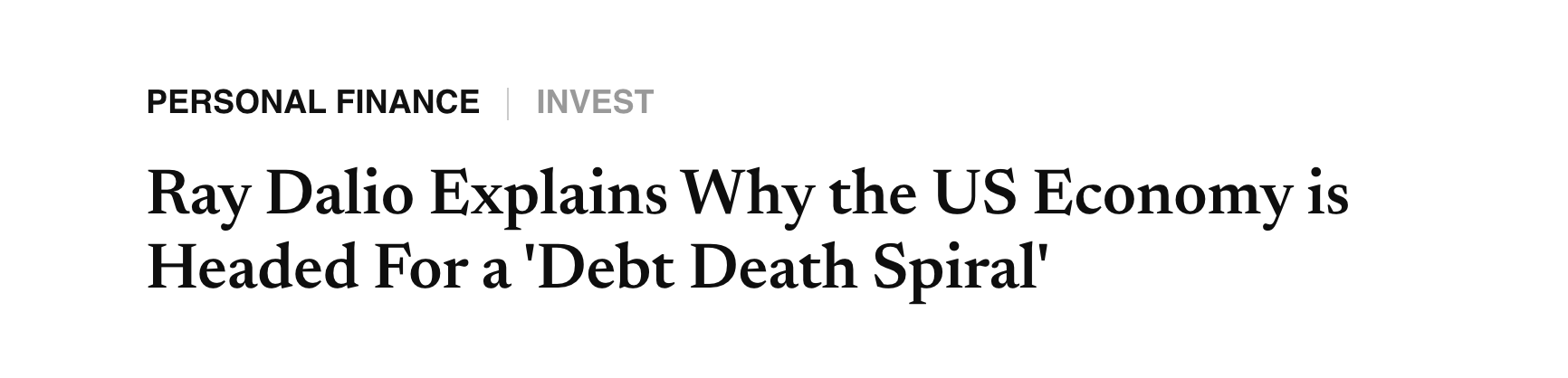
The founder of Bridgewater Associates, with $150 billion in assets under management, is calling it a “debt death spiral.”
*Source: International Business Times
Look at the math these two are staring at.
$40 trillion in debt. A trillion added every 60 days. A billion every 8 hours.
If the dollar falls, most people will get hurt badly.
But there’s a specific asset class and investment system built to thrive when the dollar collapses.
It’s called the ABN System.
It adapts the principles behind BlackRock’s own investing strategy so everyday investors can apply the same framework to protect themselves.
Over 4,500 of our members have already implemented it.
If you have $50k+ exposed to the dollar right now… including your 401(k), stocks, real estate, or savings… you need to pay attention.
Watch how to protect what Buffett and Dalio see coming →
To your freedom,
Tan Gera, CFA©
Decentralized Masters
P.S. JPMorgan warned we’ve crossed 120% debt-to-GDP. Greece collapsed at 130% and cut pensions 40% overnight. Watch the presentation now →
Intel’s Quantum-Safe Silicon Bet Lands Before Earnings
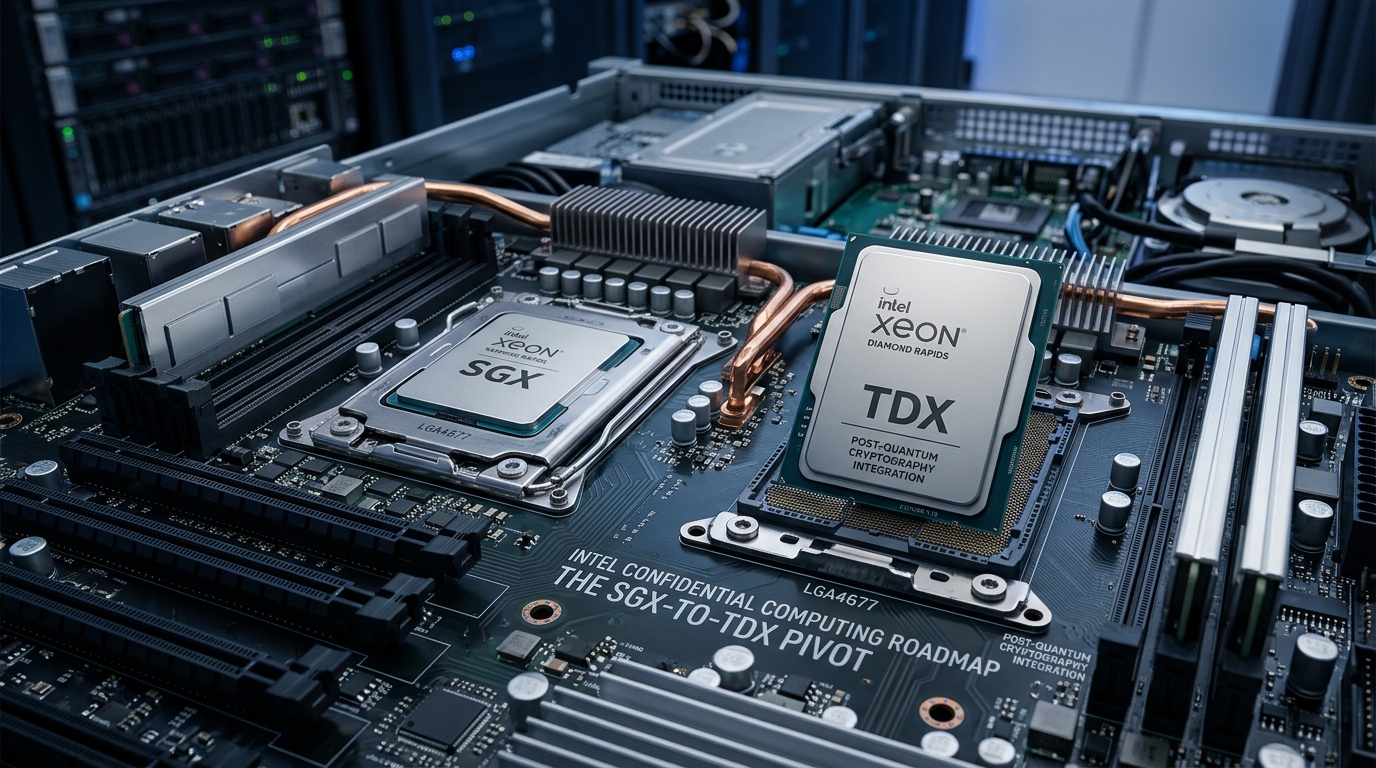
On October 9, 2026, Intel confirmed something the server market had been waiting on: Diamond Rapids, the next-generation Xeon expected in 2027, will be the final Intel Xeon generation to support Software Guard Extensions. After that, Intel’s confidential computing roadmap centers on Trust Domain Extensions, with a stated plan to expand post-quantum cryptography into platform security over time.
That is not a minor product revision. It is an architectural reset that will force every bank, government contractor, and cloud provider running SGX workloads to rethink their security stack before the decade closes.
Why the Hardware Move Matters More Than the Algorithm
Most of the industry conversation around post-quantum cryptography has centered on NIST standards: ML-KEM, ML-DSA, the migration timelines. Intel’s play is different. Intel is positioning itself as a CPU vendor aligning parts of its platform security roadmap with NSA’s CNSA 2.0 guidance and a multi-year transition to hybrid cryptography. That distinction matters because software-layer PQC can be patched in and ripped out. Silicon cannot.
Intel says it has started introducing PQC-related capabilities in commercial platforms beginning in 2023, including in server systems such as Xeon 6, and it frames the transition as a multi-year journey. Intel’s stated roadmap goal is full PQC integration across all new Intel platforms by 2030.
Intel has described using PQC-capable signature approaches such as LMS for firmware and platform signing flows in its platform security materials. The key point for traders is cadence: hardware security changes land in generations, not quarters, and competitors cannot fully replicate a platform security roadmap with a simple microcode update.
The SGX Exit Is the Real Signal
The discontinuation of SGX after Diamond Rapids is less about the technology failing and more about where enterprise demand went. The shift moves Intel from application-level enclaves to virtual-machine isolation. SGX protects selected code and data inside an enclave, while TDX isolates an entire confidential VM from the host OS, hypervisor, and neighboring VMs. Intel says that model is easier to deploy across cloud and enterprise workloads because applications need fewer code changes.
Planned TDX investments include trusted I/O via TDX Connect, post-quantum cryptography, and expanded attestation for AI workloads using sensitive data. Each of those additions targets a recurring enterprise pain point. Trusted I/O covers GPU and accelerator connections. Post-quantum attestation targets the verification chain regulators are increasingly focused on. Agentic AI workloads, which handle sensitive inference data at scale, need all three.
Those references describe planned capabilities rather than a claim that all TDX deployments already provide post-quantum protection, and Intel has not disclosed release dates for the enhancements. That gap between announcement and delivery is the honest risk in the trade.
What Traders Watch Wednesday Night
Intel heads into its third-quarter report after an 8.04% drop to $85.49 on October 22, when a broad chip selloff hit the stock amid macroeconomic pressure. Intel is scheduled to report third-quarter 2026 results after market close on October 29. The October 29 report puts market focus on gross margin guidance and the 18A manufacturing ramp, with consensus estimates clustering around roughly $16.47 billion in revenue and about $0.40 in adjusted EPS.
The post-quantum security push does not move the Q3 numbers. What it does is give Intel a defensible moat argument at a moment when the stock is sitting roughly 40% below its 52-week high. Based on S&P Global’s consensus data, 49 analysts rate INTC a Buy on average, with an average 12-month price target of $117.14, implying roughly mid-30% upside from the $85.49 close cited above.
The hardware security angle is not the reason to own INTC into earnings. The margin guide and foundry progress are. But if the 18A ramp holds and Diamond Rapids ships on schedule, the PQC infrastructure inside those chips becomes a procurement argument that AMD and Arm cannot yet match at the server level. That is the medium-term trade worth tracking.