
November 5, 2026
Bonus Content: Duke Energy Reports Today. Data Centers Are Now Political.
Let’s be real for a second.
While most traders are still squinting at lagging indicators and trying to “guess” where the next move is coming from…
My top AI trading engine is already light years ahead.
I’ve spent months and a small fortune making sure this engine outclasses any other trading tool you’ll find out there.
And right now, it’s flagging the kind of setups that typically stay hidden behind the velvet ropes of hedge funds and institutional banks.
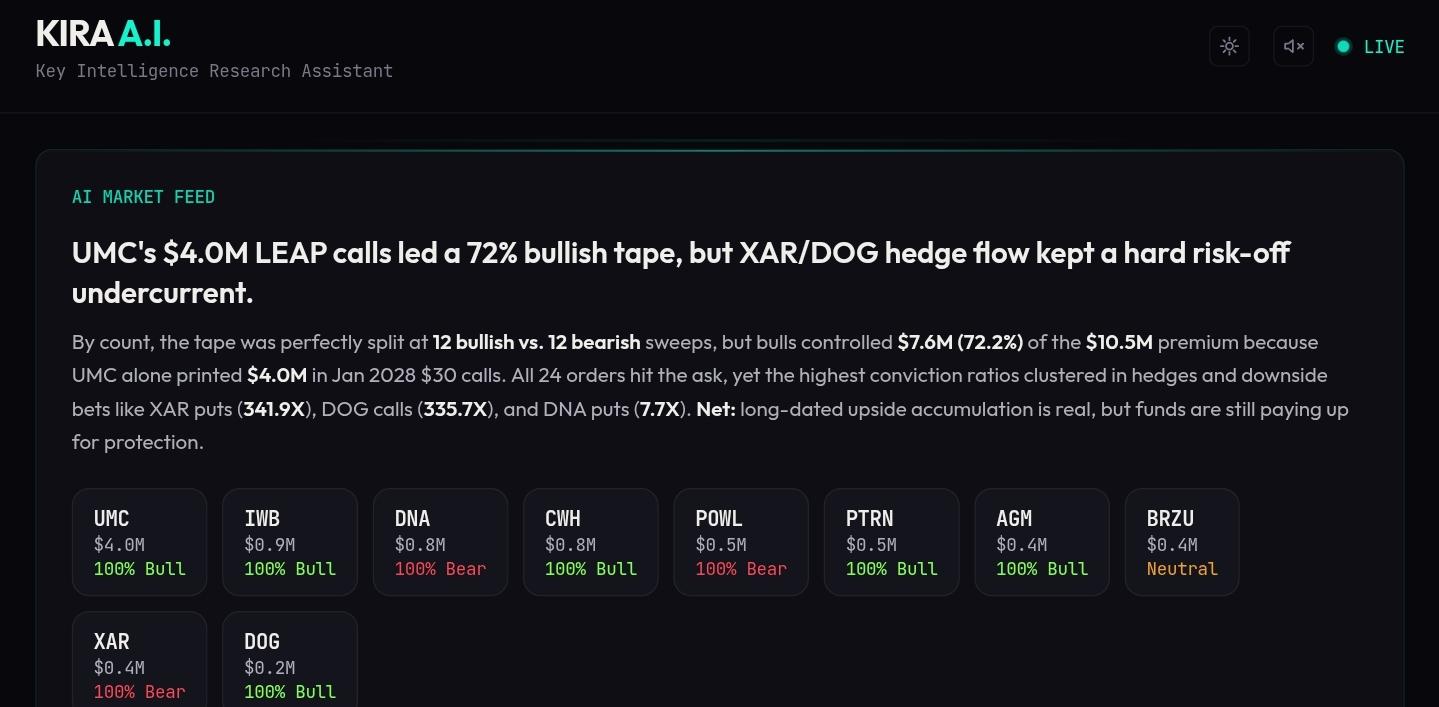
I’m talking about the ability to:
- Identify moves before they even register on a standard chart.
- Target “time-warp” returns that can compress years of gains into days.
- Choose your own risk so you never have to “bet the farm” to see results.
If you still haven’t grabbed your free access, I have to ask… What are you waiting for?
The market isn’t going to slow down for you. The robots running the show today certainly won’t wait for you to catch up.
You can keep doing things the hard way… dealing with the stress, the overthinking, and the emotional roller coaster…
Or you can let AI do the heavy lifting for you.
Claim your FREE access to the AI engine right here (No credit card required)
The proof is waiting inside.
Till the next trade,
Lance Ippolito
Duke Energy Reports Today. Data Centers Are Now Political.

Duke Energy posts Q3 results at 7 a.m. ET this morning, with analysts expecting about $1.88 per share on revenue of about $8.91 billion. Beat or miss, those figures are almost secondary. The real question from this call is what CEO Harry Sideris says about data-center demand in a week when that demand just became a ballot-box issue.
Market Snapshot
AI infrastructure names sold off Wednesday on fears of tighter data-center rules, including talk of a moratorium in Texas. GE Vernova fell 9.3%, Vistra dropped 13.83%, and Comfort Systems lost 15.08%. Duke itself was the outlier, actually rising 3.54% while VST fell 15.14% and CEG dropped 7.85%. That relative strength matters: regulated utilities with contracted load agreements behaved very differently from merchant power producers exposed to open-market electricity prices.
Stocks in Focus
DUK arrives at this report having steadily built its data-center position. As of Q2, Duke had secured 7.8 gigawatts of electric service agreements with data-center customers, including Microsoft, Amazon, Digital Realty, and QTS. Beyond signed agreements, the company maintained a high-confidence late-stage pipeline of roughly 15.4 GW, with management pointing to $5 to $10 billion of additional capital investment upside primarily in Indiana and Florida.
The growth case hinges on whether Duke will offer concrete updates on large-load customer agreements that could justify raising its long-term growth targets. Jefferies analyst Julien Dumoulin-Smith expects the company to narrow its 2026 earnings range, raising the bottom to $6.70 from $6.55 while keeping the top at $6.80, but does not anticipate a guidance increase above the 5-7% annual growth target until Q4 results in early 2027.
VST and CEG remain in the crosshairs. The selloff highlights a growing risk for investors betting on the AI infrastructure boom: electricity availability is not the only potential constraint on data-center expansion. KeyBanc downgraded Vistra citing increased regulatory risks after Texas elected Gina Hinojosa as governor, raising concerns about stricter regulations on data-center development in that state. Vistra fell 16% in a week to a new 52-week low, though it had hedged roughly 94% of its expected 2027 output as of early August, and most of its new gas plants are in PJM where peer analysis sees strong demand.
The regulatory picture for merchant generators is more complicated than the Texas headline alone. Vistra’s PJM capacity position and the FERC backstop auction delay add a second layer of structural risk that Texas exposure alone does not capture.
Sector Watch
Data-center ballot measures passed in most votes across 10 states on November 3, with an average of about 75% of voters favoring tighter limits. Multiple states, most importantly Texas, Ohio, and Georgia, now have governors vocally skeptical of data centers, and those states host a large share of the U.S. AI data-center buildout. That is a supply-side shock to the AI power trade, and Duke’s regulated model sits differently inside it than VST or CEG.
Energy is a top voter concern about data centers, centered on electric rates, and in several states rates have already risen, so voters are merging data-center opposition with affordability worries. Duke has tried to insulate itself from that dynamic. CEO Sideris has emphasized that contracts require data centers to pay their fair share through minimum-take provisions, deposits, and clawback provisions if they terminate. This morning’s call is an opportunity to sharpen that message in front of regulators watching from every state capital in Duke’s footprint.
The Cheat Sheet
- Top Theme: Political risk has reset the AI power trade. Regulated utilities that contractually shift demand-risk back to data-center customers are holding better than merchant generators with open Texas exposure.
- Stock to Watch: DUK. Any update on new Indiana or Florida large-load agreements, or a tightening of 2026 guidance, will move the regulated utility group broadly.
- Sector to Watch: Utilities. Wednesday’s divergence between DUK and VST/CEG showed the market is now sorting carefully within the group rather than selling it wholesale.
- Biggest Risk: The broader AI electricity demand story remains intact, but Wednesday’s selloff suggests investors may need to become more selective about which power companies stand to benefit. If Duke’s commentary on its pipeline sounds defensive or hedged, it could drag the entire regulated utility group lower.
- One Thing to Remember: Duke’s 7.8 GW of signed data-center agreements carry contractual protections VST and CEG’s merchant exposure does not. The political storm matters more for who wins the next contract than for who gets paid on the last one.