November 4, 2026
Bonus Content: Kioxia, SoftBank and Advantest Paid the Price US Chip Stocks Skipped
Dear Investor,
Here’s a crypto stat that tells you everything about small coins…
Over the past 30 days, eight altcoins gained three times more than Bitcoin.
Then, in the very next week, six of those eight fell.
That’s micro coin investing in a nutshell. The moves are huge. In both directions. Fast.
Most people only think about the first half: finding the coin before it runs. And that matters.
But the investors who actually come out ahead are the ones who know the second half too.
When to take profits. How much to sell. How to avoid riding a 200% gain all the way back down to zero.
Because in micro coins, the difference between a life-changing win and a painful story is usually not the buy. It’s the exit.
That’s why Micro Coin Revolution doesn’t stop at telling you how to buy…
You’ll get the process we use to find small coins early. And, most importantly, you’ll see how we decide when to get out.
Altcoin momentum is building. Make sure you have a plan for both halves of the trade.
See the Micro Coin Revolution Presentation now.
To your massive success,
Bryce Paul
Crypto 101
Kioxia, SoftBank and Advantest Paid the Price US Chip Stocks Skipped
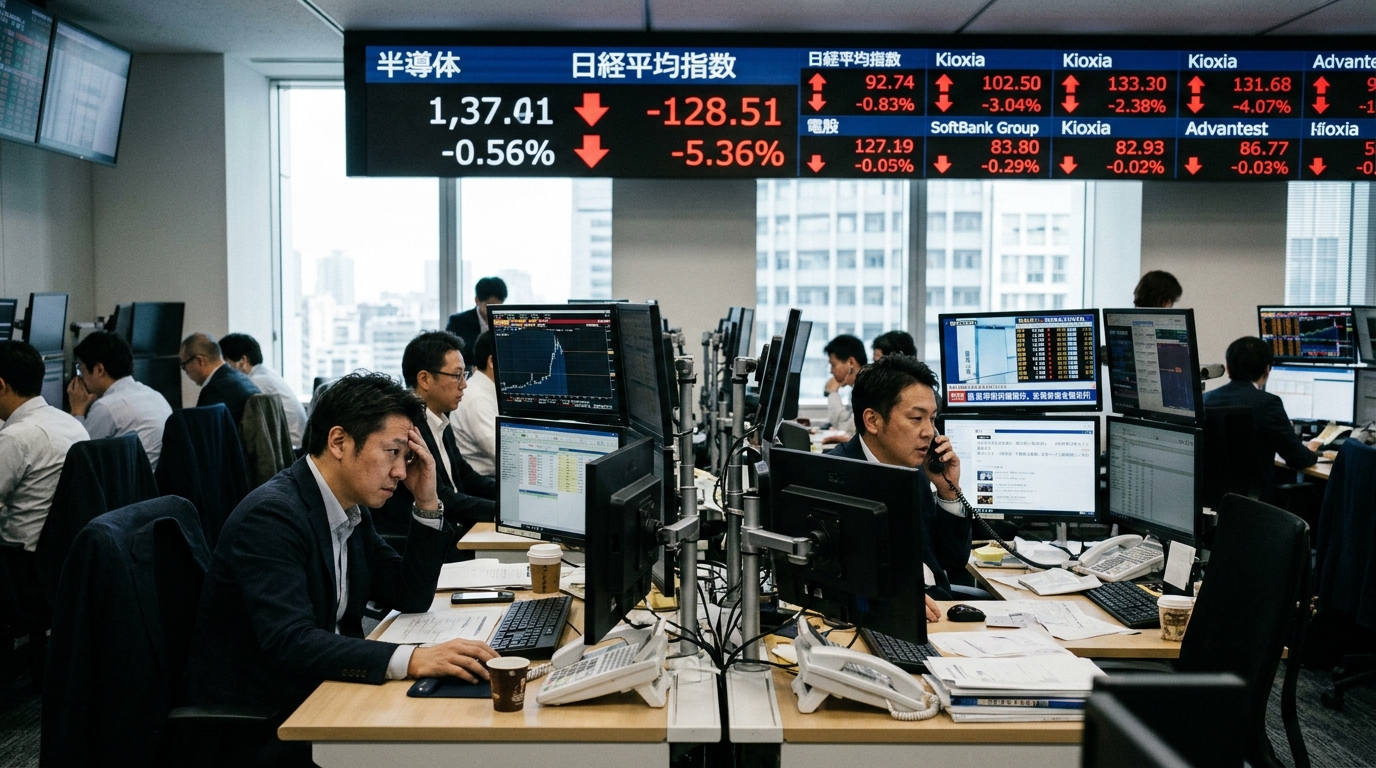
The Nikkei fell as much as 4.8% intraday and finished down about 1.4% on Wednesday as results from the Tuesday, November 3, 2026 US midterm elections pointed to Democrats winning control of Congress, with chip equipment makers, memory producers and AI infrastructure suppliers taking the brunt of the selling. Japan had been closed Tuesday for Culture Day, so it priced two days of political anxiety into a single session.
Market Snapshot
SoftBank fell about 7%, Advantest 6.4% and Kioxia 10%, while the broader Topix lost about 1.9%. Makers of fibre-optic cables, key materials for data centres, also fell, with Fujikura and Furukawa Electric down sharply. South Korea’s Kospi fell about 3.2%.
Of the 225 stocks in the Nikkei, 130 fell and 95 rose, suggesting investors were targeting AI-exposed names rather than selling Japanese equities across the board.
Stocks in Focus
- Kioxia: SoftBank shares slumped roughly 7% to 9% intraday, while Kioxia tumbled around 10%, extending losses after guidance for the October to December period missed market expectations. Kioxia projected operating profit of about ¥2 trillion (roughly $12.7 billion) for the December quarter, below consensus, and the shares had fallen as much as 17% earlier in the week after the outlook.
- Advantest and Tokyo Electron: Chip-testing equipment maker Advantest fell 6.4% and Tokyo Electron dropped about 5%.
- US semis going in: Tuesday’s Wall Street session saw the Nasdaq Composite gain about 0.83%. The Philadelphia Semiconductor Index rose about 2.6% to 3%, ending a three-session losing streak.
Why It Matters for US Chip Names
The sell-off shows US political risk being priced directly into the AI supply chain, with Japan’s chip equipment, memory and cable makers treated as proxies for US data-centre spending. The logic is straightforward: if Democratic control of Congress tightens oversight on data-centre permitting and AI infrastructure spending, the first orders to slow are the ones placed with suppliers sitting earliest in the chain. Advantest tests chips before they ship. Kioxia fills the memory that goes inside the servers. Tokyo Electron supplies the deposition and etch tools. These companies feel demand changes before Nvidia or AMD do.
Prediction markets signalled growing expectations of a Democratic sweep of the US Congress, with Reuters reporting more than $1.48 billion wagered on the midterm elections.
Political risk is only one layer of the repricing. Hundreds of billions in hyperscaler bond supply have already been reshaping the credit environment underneath AI equities, and tighter oversight on data-centre permitting would compound that financing pressure directly.
Catalyst Calendar
- US open: Watch whether US-listed semiconductor names gap down in sympathy with Asian suppliers, or hold Tuesday’s roughly 2.6% SOX gain as a floor. The divergence will tell you whether the market treats this as a supply-chain problem or a broader AI spending cut.
- Kioxia guidance: Management attributed the December-quarter miss to shipment timing rather than demand destruction.
- Election count: Watch whether the market treats the result as fully settled, or whether seat math and policy expectations keep risk premia elevated into the US cash session.
The Cheat Sheet
- Top theme: Democratic midterm gains are repricing AI infrastructure capex assumptions across the entire data-centre supply chain, starting at the Asian suppliers that sit upstream of US chip designers.
- Stock to watch: Kioxia. Election risk layered on top of a guidance miss that already sent the stock down as much as 17% earlier this week makes it the most exposed name and the clearest read on memory demand sentiment.
- Sector to watch: Semiconductor equipment. Advantest and Tokyo Electron both sold off despite solid earnings, which means the market is discounting future order risk, not current results.
- Biggest risk: For the Asian semiconductor supply chain, the policy tug-of-war between Congress and the White House will be a key variable affecting order expectations and valuation levels in the months ahead.
- Biggest opportunity: If the final picture lands short of the market’s most aggressive policy fears, Tuesday’s SOX gain could reassert itself quickly. The names hit hardest overnight, Advantest in particular, have earnings that do not support the implied demand cut.
- One thing to remember: Asia traded the result first and hardest, as it often does when Washington sets the tone after hours. US chip names had a roughly 2.6% tailwind walking in. How much of that they surrender in the first hour is the session’s clearest signal.