
Hello, my name is Marc Lichtenfeld.
And thanks to an obscure tax loophole (on page 1,794 of the U.S. tax code) …
Regular investors can collect payouts from what I call “SpaceX Royalty Shares.”
In this video, I show you everything, including:
How YOU can collect huge payouts…potentially thousands of dollars more… (depending on the size of your stake…)
Why JP Morgan increased its stake in “SpaceX Royalty Shares” by over 22X!
The easiest way to INCREASE your payouts – without investing any additional money!
And WHY you must hurry if you want to participate… The cutoff deadline for the next payout is November 18…
To find out more…
Watch my full “SpaceX Royalty Shares” briefing now.
Good investing,
Marc Lichtenfeld
Chief Income Strategist, The Oxford Club
P.S. I’ve already shown over 150,000 Americans how to start collecting consistent payouts from investments just like this…
Including Dean B., who grew his portfolio from $300,000 to $1.3 million in four years and is now collecting $75,000 per year in payouts…
Hurry! The cutoff deadline for the next payout is November 18…
Japan’s GDP Just Contracted. The BOJ May Hike Anyway.
Market Snapshot
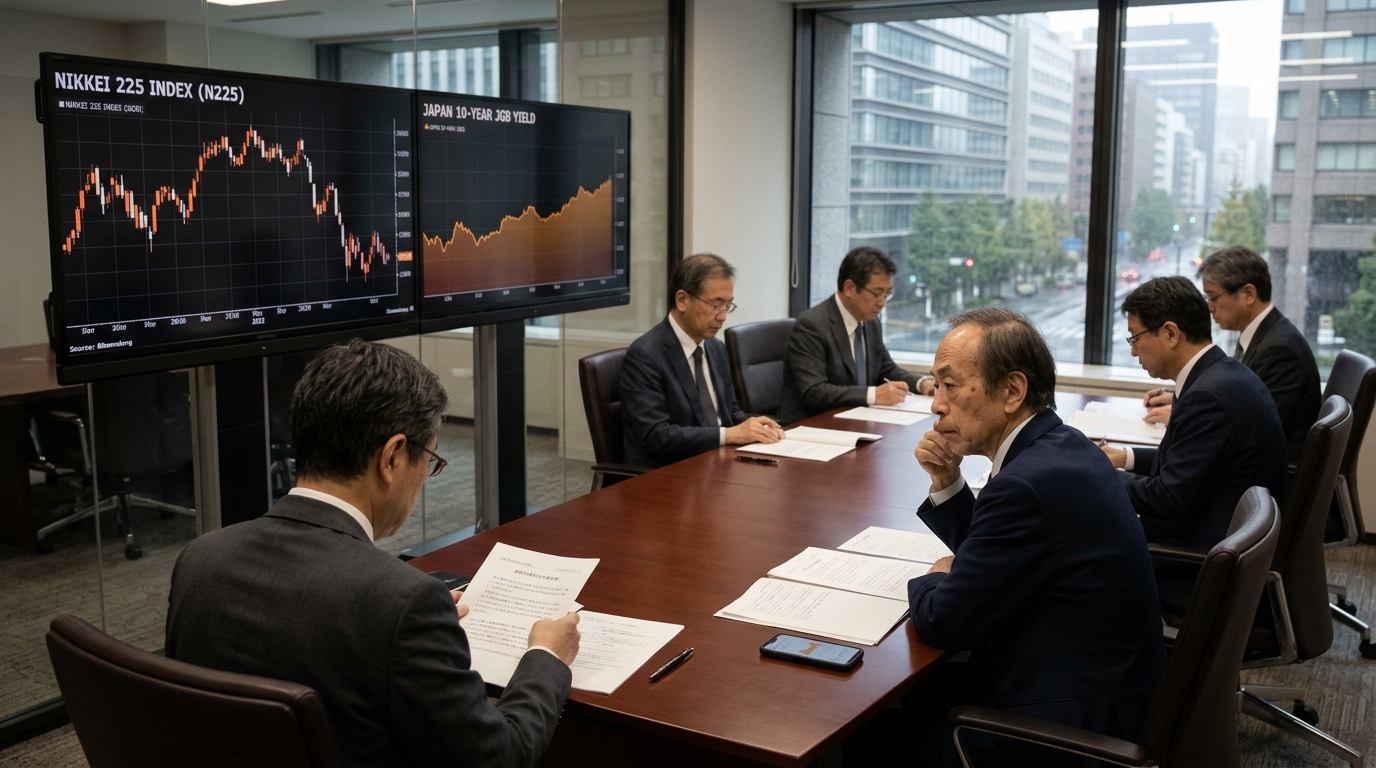
Japan’s GDP shrank an annualised 0.1% in Q3, its first fall in four quarters, as private consumption dropped 0.3% under high prices. The result missed the consensus forecast of +0.3% annualised growth by the full width of the sign. The Nikkei fell about 2.4% on the day. The 10-year JGB yield was around 2.885%.
The Household Problem
The decline is the first in four quarters and underscores the uneven nature of Japan’s economic recovery, with households remaining vulnerable to persistent inflation despite rising wages. Private consumption, which accounts for more than half of economic output, fell 0.3%, worse than the market estimate of a 0.2% decline.
Household spending had already flashed a warning last week, falling by the most since 2020, with outlays adjusted for inflation down 6.8% in September from a year earlier. Persistent inflation, heavy rain, and typhoons weighed on spending. The underlying picture is straightforward: real purchasing power is not keeping pace.
Real final sales of domestic product fell 2.1% annualised, the largest decline outside the Covid-19 pandemic and the first quarter of 2022.
The BOJ Dilemma
Weak consumption should argue for caution. It has not. Despite the data, markets still see a high chance of the Bank of Japan raising rates by 25 basis points in December, based on market pricing in TONA-linked OIS and futures.
“Today’s GDP data is hardly a green light for the BOJ to hike in December,” said Krishna Bhimavarapu, APAC economist at State Street Investment Management. The other side of the debate is not softening either. “It looks increasingly likely that the Bank will have to tighten policy more aggressively than we’ve been anticipating as inflation is about to surge,” said Marcel Thieliant of Capital Economics. Mizuho Securities economist Ryosuke Katagi warned that if consumption weakness persists, it could sharpen divisions among BOJ board members, as dovish policymakers may cite fragile private demand as a reason for caution.
Fiscal Pressure and Domestic Exposure
With continued uncertainty in the Middle East keeping energy-driven inflation elevated, expectations for additional BOJ rate hikes are unlikely to retreat sharply, leaving the JGB market heavy. The political channel matters here. Prime Minister Takaichi’s cabinet already approved a ¥21.3 trillion stimulus package aimed partly at support for inflation-hit consumers. A second consecutive quarter of contraction would sharpen the case for further transfers.
Among individual names, the exposure is not uniform. Capital spending rose 1.6%, above the market forecast, backed by investment in labor-saving technologies and AI-related projects, which buffers companies with heavy capex profiles. MUFG carries the most direct rate sensitivity: as Japan’s largest financial institution, its performance is tightly linked to sovereign yield curves and central bank policy signaling. A softer December hike path, if consumption data deteriorates further before the December 17 to 18 meeting, is the clearest near-term risk to that outperformance.
MUFG’s rate sensitivity is not theoretical. MUFG’s record first-half profit was driven directly by wider lending spreads from the BOJ’s rate cycle, making the December decision the single biggest variable for the stock.
The Cheat Sheet
- Top Theme: Japan’s first GDP contraction in four quarters puts the household squeeze at the centre of the December BOJ decision.
- Stock to Watch: MUFG. Rate-hike probability drives this trade more directly than any macro name in Japan right now.
- Sector to Watch: Japanese financials. Rate expectations are still broadly intact, but the gap between dovish and hawkish board members is widening.
- Biggest Risk: A further deterioration in consumption data before the December 17 to 18 meeting that shifts BOJ expectations lower and pulls MUFG and other rate-sensitive names down sharply.
- Biggest Opportunity: Domestic-demand names with direct fiscal tailwinds from the ¥21.3 trillion Takaichi stimulus package, if another supplementary budget is confirmed.
- One Thing to Remember: Capex rose 1.6% inside the same report that spooked markets. Japan’s contraction is a consumption story, not a corporate investment collapse. Those are different trades.