Markets read the August 5 announcement as a brain-drain story. GOOGL fell about 4% on the day, and the headlines wrote themselves: Demis Hassabis steps aside, Jeff Dean leaves after 27 years, two original Gemini co-leads walk out the door. The stock is now trading near $343 with a 52-week range between $196.60 and $408.61, sitting roughly 15% below its all-time closing high of $402.38 set in May. That gap looks like fear. The question is whether the fear is correctly priced.
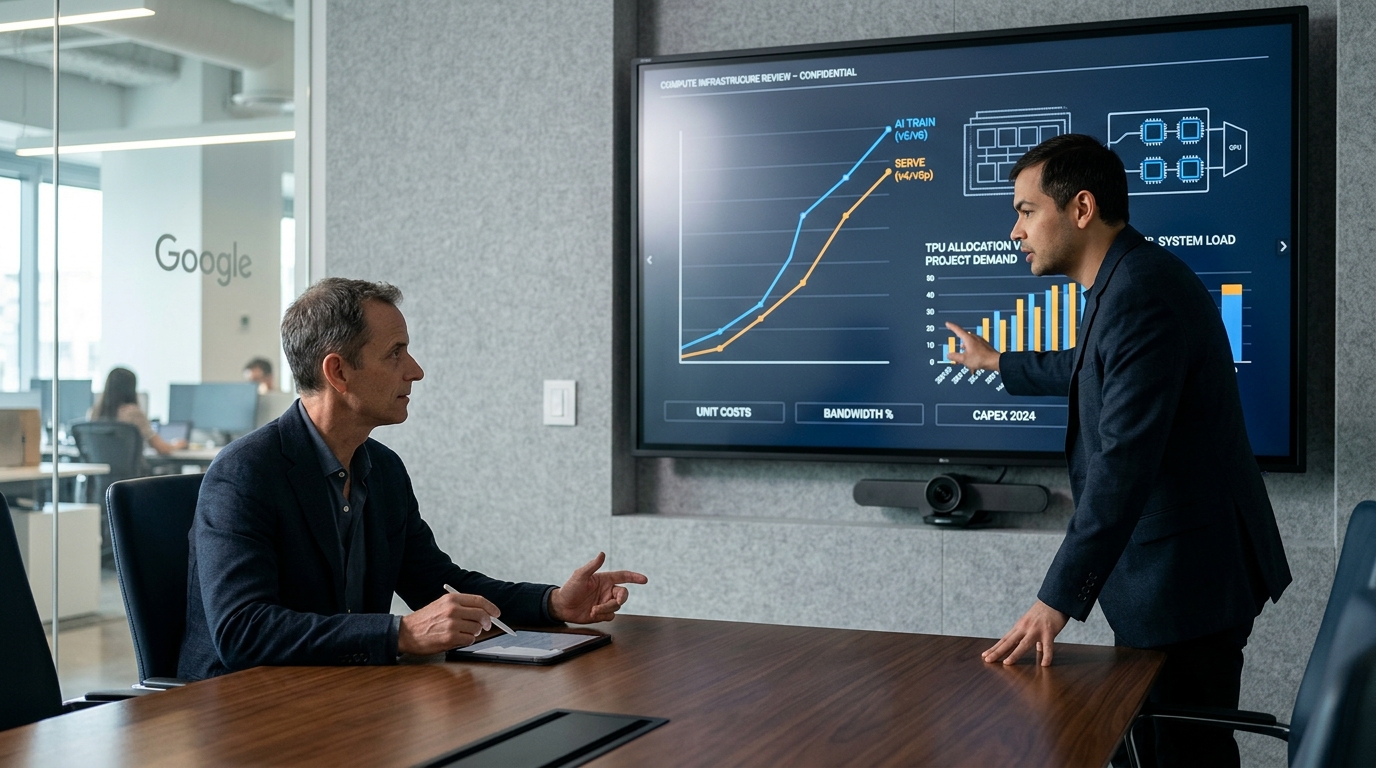
The actual structural problem inside Google DeepMind is not a personnel problem. It is a compute allocation problem. Google’s own AI researchers have been competing for TPU access even as the company sells large blocks of capacity to external customers, creating a collision between internal model development and external cloud revenue. The Anthropic deal alone covers 5 gigawatts of TPU capacity valued at up to $40 billion, turning research compute into locked-up cloud revenue. DeepMind scientists, especially junior ones, have been waiting weeks or months for training runs. That is what drove the Gemini 3.5 Pro delay past multiple internal targets. It is also what drove the departures.
This is the frame that matters for investors. The reshuffle is Google admitting the internal market for its own infrastructure is broken, and attempting to fix the power structure before the Gemini 4 ramp begins.
Data Section: What the Numbers Say
Before treating the leadership change as a pure negative, the financial picture requires context. Alphabet reported Q2 2026 revenue of $119.8 billion, up 24% year-over-year, its 12th consecutive quarter of double-digit growth. Google Cloud posted $24.8 billion in revenue, up 82%, with operating income from the segment more than tripling to $8.8 billion. Cloud backlog reached $514 billion. The Gemini app crossed 950 million monthly active users at the July earnings call. Gemini models now process 22 billion API tokens per minute. Nearly 90% of the Fortune 100 uses Gemini Enterprise.
EPS came in at $9.11 for Q2, against a consensus estimate of $2.88, a 216% beat driven in large part by gains on equity securities. Alphabet reported about $98.0 billion in other income, primarily from net unrealized gains on equity securities. Alphabet’s P/E has compressed into the high teens in recent weeks, despite 82% Cloud growth. Gemini’s annualized revenue run-rate stood at $12 billion in Q2. Google Cloud infrastructure is projected to generate over $73 billion in revenue and an additional $120 billion in TPU sales by end of 2027.
The catch: free cash flow turned negative in Q2 for the first time since Alphabet’s 2004 IPO. Capital expenditure guidance was raised to $195 billion to $205 billion for the full year, up from the prior outlook of $180 billion to $190 billion. About 60% of that spending goes toward AI servers. Alphabet tapped debt markets on August 6, targeting a $25 billion investment-grade bond sale the same week the leadership overhaul was announced. The commercial engine is running. The model development engine is not.
Strategic Interpretation: What the Market Expected vs. What Actually Happened
Markets expected a steady-state Demis Hassabis, a predictable Gemini release cadence, and a research lab that retained its founding talent. They got the opposite on all three counts in a single week.
Hassabis stepped back from daily DeepMind operations to become Chair of Google DeepMind and Chief Scientist of Alphabet, while continuing to lead Isomorphic Labs. In his note to staff, he said he believed artificial general intelligence is close at hand and wanted the time to focus on long-term strategy. That is a credible reason to reorganize. It is also a convenient one. The more complete picture, sourced from interviews with people knowledgeable about Gemini’s development, is that the reorganization is tied to Alphabet’s push for model supremacy, not away from it. Google Cloud CEO Thomas Kurian, who has argued that TPUs should function as general-purpose infrastructure for external customers, likely emerged from the internal political battle with more control over compute allocation, not less. The new structure formally subordinates DeepMind’s operational leadership to the Pichai org chart, ending the semi-autonomous arrangement that has existed since Google acquired the London lab in 2014 for more than $500 million.
The Jeff Dean departure is a separate but simultaneous signal. Dean co-founded Discovery Loop with Sanjay Ghemawat, Oriol Vinyals, and Quoc Le, representing contributions spanning MapReduce, TensorFlow, Pathways, TPUs, AlphaFold, AlphaCode, Gemini, and chain-of-thought research. Discovery Loop is structured as a public benefit corporation aiming to automate the scientific method itself, running thousands of experiments simultaneously. Khosla Ventures and Radical Ventures led the round, joined by Lightspeed, Kleiner Perkins, and Doerr Capital. Google is a founding investor and will supply compute for the first year.
The optics are uncomfortable. Google is funding the startup built by the researchers who left while Google is also selling scarce compute to external customers. Whether that is a contradiction or a hedge depends entirely on what Discovery Loop ships.
Sector Implications
The reshuffle has three direct sector effects.
First, Anthropic and OpenAI gain from every month Gemini 3.5 Pro stays delayed. Public model leaderboards are not the only signal that matters, but they shape perception. Claude Sonnet 5 is live. GPT-5.6 is shipping. Every enterprise that evaluates models on a quarterly cycle and finds Gemini absent from the frontier is a Cloud customer who routes workloads to a competitor’s inference layer. Google Cloud’s $514 billion backlog is a structural hedge against this, but it is not immune to it.
Second, Koray Kavukcuoglu’s promotion matters more than most coverage has acknowledged. He is a long-time DeepMind leader who has been overseeing Gemini model development in practice and now serves as SVP, reporting directly to Sundar Pichai. Morningstar’s analyst has argued that the appointment brings more focus to Google DeepMind, with LLM improvements being the clear route forward. Hassabis was architecturally more interested in building AGI beyond transformers. The new structure is explicitly a bet on winning the current LLM cycle, not the next paradigm.
Third, the safety team reshuffle creates regulatory exposure. Lila Ibrahim, DeepMind’s Chief AI Readiness Officer, now reports to James Manyika. Some safety teams are moving to Kent Walker, Google’s president of global affairs. The dispersion of safety oversight across three separate reporting lines is exactly the kind of structural change European AI regulators under the EU AI Act are watching. Any enforcement action on high-risk model deployment becomes more complex to defend when the oversight chain is fragmented.
Options Market Analysis
GOOGL is trading near $343.80 with an IV Rank around the mid-50s, placing premiums in the richer half of the 52-week range. The elevated IV rank reflects stock-specific catalysts: the leadership reshuffle, the capex overhang, the Gemini delay, and the free-cash-flow turn negative. Historical 30-day implied volatility on GOOGL has ranged from approximately 15% to 33% over the past year.
The stock is down roughly 9% over the past seven days. The 52-week low is $196.60 and the 52-week high is $408.61, putting the current price in the lower third of the annual range despite the strongest revenue quarter in company history. That compression is not purely fundamental. It is structural: investors are discounting the risk that Gemini 4 arrives late, underpowered, or both.
Put/call flow in the options market has leaned modestly bearish since the August 5 announcement, consistent with institutional hedging rather than outright directional bets. The implied volatility crush that typically follows an earnings event has not arrived, because the leadership story replaced earnings as the primary catalyst. That keeps IV elevated and creates a moderately rich premium environment for defined-risk structures.
Structured Trade Framework
Bull Case. For traders expecting Kavukcuoglu to ship Gemini 3.5 Pro within 60 days and establish a monthly release cadence, the fundamental disconnect is significant. With Cloud revenue accelerating 82% and backlog at $514 billion, Alphabet is being valued as if the model roadmap is permanently impaired. A defined-risk bull structure: a call debit spread in the October or November expiration, buying the 360 strike and selling the 390 strike. Maximum risk is the net debit. Profit potential is the spread width minus the debit. This approach captures a recovery toward the highs without unlimited downside if the Gemini 4 ramp disappoints again.
Bear Case. If you believe the TPU allocation problem remains structurally unresolved and Gemini 4 arrives into a market where Claude and GPT have extended their leads, the Cloud backlog compression risk is real. A put debit spread, buying the 330 strike and selling the 310 strike in the September or October expiration, defines maximum risk while giving exposure to further institutional selling. The stock’s behavior since the announcement suggests a range of $314.90 to $384.48 over the past month. A move toward the lower bound on a Gemini 3.5 Pro miss is not a tail scenario.
Neutral Case. With IV Rank in the mid-50s, premium sellers can find value in defined-range structures. An iron condor centered near current price, selling the 320 put and 380 call while buying the 305 put and 395 call in the September expiration, captures elevated IV with defined risk on both sides. This framework assumes the stock remains range-bound while the market digests the leadership transition and waits for the first concrete Kavukcuoglu-era model update. It performs best if Gemini 3.5 Pro ships quietly and without a market-moving reception.
Risk Analysis
The primary risk is model execution. Gemini 3.5 Pro has missed multiple internal targets. A further slip would deepen enterprise credibility damage at precisely the moment Microsoft Azure and AWS are competing aggressively for the same workloads. Kavukcuoglu’s first test, as Nick Patience of Futurum Group put it, is to ship and then maintain a predictable release cadence. One model is not a proof of concept for an organization.
The secondary risk is capital. Alphabet targeted a $25 billion investment-grade bond sale in early August as the reshuffle hit. Free cash flow is negative. Capital expenditure guidance extends to $205 billion for the year. If Cloud growth decelerates from 82% into the 60s or 50s, the spending pace becomes very difficult to justify at current multiples. The Q3 Cloud growth figure is one of the most important numbers for GOOGL over the next 90 days.
A third risk is less discussed: competitive cannibalization from Google’s own supply decisions. Selling $40 billion in TPU capacity to Anthropic while Gemini delays pile up is not a theory. It is a documented commercial arrangement. Kavukcuoglu’s appointment is expected to alleviate compute tension between DeepMind and the Cloud division, but the commercial incentives for external cloud sales remain unchanged. Google Cloud projected to generate over $120 billion in TPU sales by end of 2027. No SVP appointment changes that math without an explicit compute reservation policy for internal research teams.
Forward Outlook
The case that Alphabet is exiting the frontier model race is not supported by the data. Cloud revenue grew 82% to $24.8 billion. The Gemini app crossed 950 million monthly users. Gemini Enterprise is inside nearly 90% of the Fortune 100. Sergey Brin, who no longer holds an executive title but has been informally influencing model training efforts for months, has been telling key staff they need to catch up to the frontier. That is not the posture of a company retreating.
What the reshuffle actually signals is a consolidation of operational authority. DeepMind no longer has a CEO. It no longer has semi-autonomous status. Kavukcuoglu reports directly to Pichai. Safety teams are dispersed across multiple reporting chains. Every structural decision made on August 5 trades DeepMind’s independence for tighter integration with Google’s commercial priorities. The debate among experts is whether that trade accelerates the Gemini roadmap or permanently caps DeepMind’s research ambition. Both conclusions are defensible. The stock will ultimately be decided by whether Gemini 4 arrives at the frontier when it claims to, and whether Cloud growth holds above 70% into 2027.
The $514 billion Cloud backlog and the 950 million Gemini users are not noise. They are the moat. The question is whether the moat is widening or merely holding while the frontier moves away from it.
Action Checklist
- Verify model delivery: Gemini 3.5 Pro shipment is the first binary event under Kavukcuoglu. Track release dates against the stated cadence expectations discussed on the Q2 call.
- Watch Q3 Cloud growth: 82% in Q2 is the baseline. A deceleration to the mid-60s is manageable; anything below 60% reopens the capex-to-revenue debate and pressures the stock toward the lower end of the 52-week range.
- Monitor the TPU allocation question: Any disclosure that compute reservation policy has changed for internal research teams would be the most bullish signal the reshuffle could generate, and it has not yet been confirmed.
- Track Discovery Loop funding rounds: If the seed round closes at a valuation above $5 billion, the market will read that as an implicit vote on where top research talent can compound fastest outside Big Tech.
- Defined-risk structures only: With IV Rank in the mid-50s and the Gemini 4 timeline undefined, open-ended directional positions carry event risk that the premium does not fully capture. Spreads or condors define the maximum loss before thesis confirmation arrives.
- Safety oversight fragmentation: If EU regulators open a formal inquiry into DeepMind’s restructured safety reporting lines before Q3 earnings, the stock’s regulatory discount will widen independently of Cloud results.