
August 25, 2026
Bonus Content: Who Survives the EV Subsidy Wipeout
Hey Trader,
You’ve done the work.
Backtested. Journaled. Stared at charts until your eyes bled.
But every strategy eventually “gives it all back.”
It’s exhausting. And it feels like the only people making money are the ones selling courses.
I get it.
That’s why I want to send you my Opening Bell Breakouts Trade Guide.
For free.
It details the simple strategy I use to get in and out of the market before 10 AM.
No more grinding all day. No more getting chopped up by the afternoon algorithms.
This is about trading less, but smarter.
>> Download the FREE guide and escape the grind
Inside, you’ll see why weekly options are perfect for this strategy, and how to use them to trade stocks like GOOGL, META, and TSLA with as little as $75.
Stop the burnout.
Click here for your free guide.
Thomas Wood
Pro Trader, Base Camp Trading
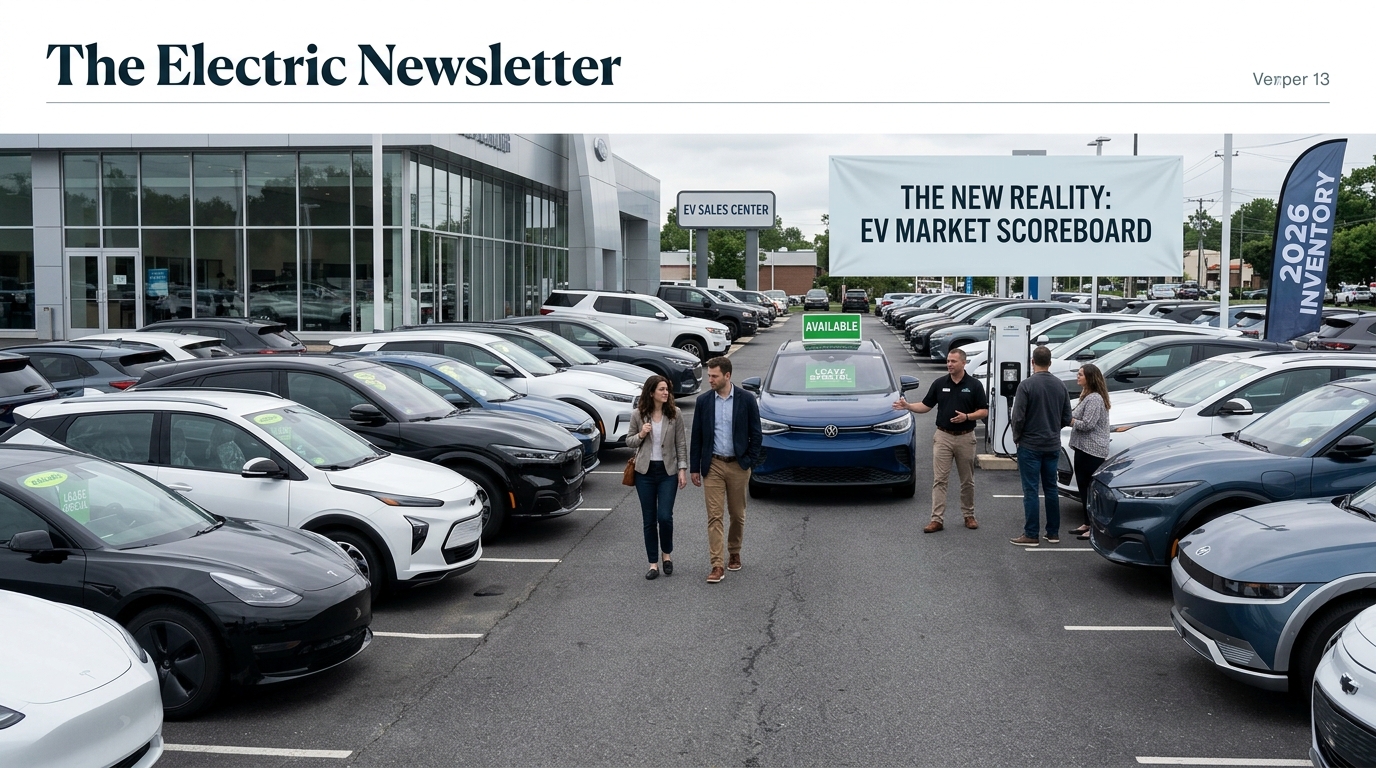
The federal EV tax credit did not fade out. It stopped. The $7,500 credit expired October 1, 2025. What followed was the clearest market stress test the U.S. EV industry has ever faced, and the results through mid-2026 are separating survivors from stragglers in ways that headlines have barely caught up to.
The Demand Drop Was Real
Americans purchased just 212,600 new battery-electric vehicles in Q1 2026, a steep 28% decline from 296,304 units a year earlier. That marked the first full quarter reflecting the end of the federal credit. Dealer lots reflect it: inventory stands at roughly 130 days’ supply for electric vehicles, far above the 89 days for gasoline cars. The Q2 rebound was real but modest. Cox Automotive counted 247,226 battery-electric vehicles sold in Q2 2026, up about 14% from Q1, though still 20.5% below the same quarter in 2025.
The honest read: stabilization, not recovery. The market has not returned to where it was.
Tesla Widened the Gap
Tesla has extended its lead in the U.S. EV market after federal tax credits ended, taking just over half of BEV sales in Q2 2026. Analysts point to Tesla’s vertical integration, controlling everything from battery supply to software updates, as a key advantage. Unlike rivals that outsource critical components, Tesla can scale operations without the same profit erosion. In Q2 2026 specifically, Tesla delivered an estimated 124,800 units in the U.S., up 6.4% quarter-over-quarter. The credit cliff did not hurt Tesla. It helped it, by hollowing out competitors that depended on the subsidy to close the price gap.
GM Chose Gas Over Gridlock
General Motors is not pivoting to hybrids. It is retreating to them. Reports said GM delayed plans for next-generation, lower-cost refreshes of the Silverado EV, Sierra EV, Hummer EV, and Escalade IQ that had been targeted for around 2028. GM has disputed that it cancelled or indefinitely delayed any electric trucks. The abandonment has a financial logic. GM is leaning harder into its profit engine: full-size gas trucks. Those trucks do not need a $7,500 government assist to move. GM posted Q1 2026 adjusted EBIT of $4.3 billion, with performance driven by its product mix and execution in North America. The EV writedowns sting on paper; the underlying business is generating cash.
Rivian’s Counter-Intuitive Moment
Rivian looked the most exposed heading into 2026. It has no gas vehicle to fall back on and burns capital at pace. But Q2 data told a different story. Delivery results topped Rivian’s outlook of 9,000 to 11,000 vehicles due to robust growth in commercial vans and R1 sales, plus the introduction of R2 deliveries, prompting the company to raise its full-year 2026 guidance to 65,000 to 70,000 vehicles.
The R2 is the variable that matters. The R2 crossover’s launch is a make-or-break moment for Rivian. The EV startup’s success largely hinges on how buyers react to its first mass-market model and how quickly it can ramp production. The R2 is expected to start around $45,000, putting it in range with Tesla’s Model Y. Competing at that price point, without federal help, against Tesla’s cost structure is the test no analyst can fully model in advance.
The Cheat Sheet
- Top Theme: The subsidy cliff has already reshuffled U.S. EV market share toward the most cost-efficient producers, with the structural damage to mid-tier players still unfolding.
- Stock to Watch: RIVN. The R2 ramp over H2 2026 is the single most important variable in whether Rivian closes the cost gap or runs out of room.
- Sector to Watch: Traditional automakers pivoting to hybrids. GM has said it plans to reintroduce plug-in hybrid vehicles to the North American market in 2027. That product cycle, not pure EVs, is where Detroit’s near-term margin story lives.
- Biggest Risk: A Q3 2026 demand reading that confirms the Q2 rebound was inventory-clearing rather than genuine consumer pull.
- One Thing to Remember: Buyers are now making decisions based on real price, range, features, and total cost of ownership rather than tax credits. Companies built around subsidy-adjusted sticker prices face a structural reset, not a temporary headwind.