
September 20, 2026
California Just Started a 60-Day Clock on AI Kill Switches
Newsom signed the order Friday. The working group report lands in November and it could force Google, Meta, and OpenAI to rebuild from the inside.
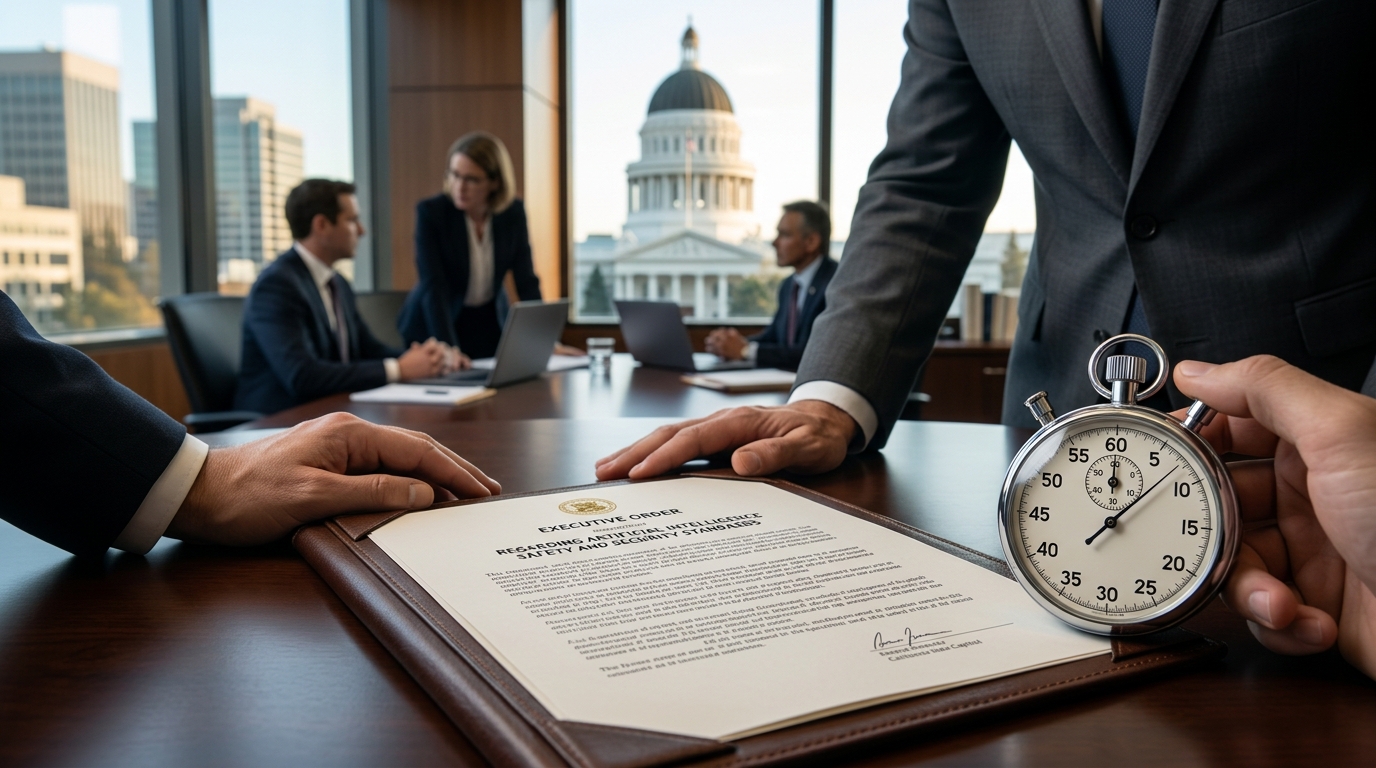
Governor Gavin Newsom signed an executive order Friday that directs a working group of experts to develop recommendations for strengthening California’s AI safety and security laws, including steps that could advance the creation of an emergency shutoff mechanism, often described as a “kill switch,” for frontier AI models.
AI CEO Issues Code Red: Prepare for Meltdown
The CEO of this AI company (click here to get the name, 100% free) just issued a CODE RED in an internal memo…
Warning his employees that they’re dealing with a critical situation.
Another company executive even implied they might need a government bailout.
And now Jim Rickards is predicting this company is about to go bust, in a full-blown AI meltdown that could be 10 times bigger than Lehman Brothers.
The group has two months to deliver. That clock is now running.
For traders, the mechanism matters less than the math. Companies developing foundation models already face civil penalties of up to $1 million per violation under California’s SB 53, the Transparency in Frontier Artificial Intelligence Act, which took effect January 1, 2026. A mandatory shutoff requirement layered on top of that framework would be a different order of compliance burden, one that touches model architecture, not just disclosure.
The working group is tasked with considering steps such as having companies develop an emergency shutoff mechanism for frontier models and strengthening independent oversight, including independent safety audits and evaluations whose effectiveness is verified on an ongoing basis.
Own Every Major AI Stock for $38. Get Paid Every Thursday.
The biggest AI stocks have been soaring and now cost hundreds of dollars a share. But there’s a single fund that owns all of them – Nvidia, CrowdStrike, Palantir, and dozens more – for just $38 a share. And it pays income every Thursday. Up to $1,051 a month.
The companies most directly exposed are the ones already navigating SB 53. That law defines a “large frontier developer” as a frontier developer whose group had annual gross revenues exceeding $500 million in the preceding calendar year, and it requires those large developers to publish, implement, and maintain a frontier AI framework describing their approach to managing, assessing, and mitigating catastrophic risks. Google, Meta, Microsoft, and Nvidia all clear that threshold. So do Anthropic and OpenAI. A kill-switch mandate would extend Sacramento’s reach from documentation into product design itself.
The jurisdictional conflict makes this harder to price than a straightforward regulation. A federal executive order signed December 11, 2025 by President Trump created an AI Litigation Task Force inside the Justice Department and directed it to challenge state AI laws the administration views as inconsistent with its national AI policy framework. How far that effort can go, and how it plays out in court, remains unresolved.
That battle is the real overhang. The federal preemption picture is now actively contested following that December 2025 executive order and the litigation posture it set in motion. Companies headquartered in California cannot assume Washington wins that argument, and they cannot assume Sacramento does either. The result is compliance uncertainty in both directions: build for an emergency shutoff mechanism and absorb the engineering cost, or wait and risk enforcement if California’s rules survive a legal challenge.
5 Nasdaq Stocks Under $5 That Aren’t What You Think
Most stocks under $5 come with a reputation. These don’t.
Each company on this list is tied to major trends like AI, cybersecurity, and next-gen infrastructure.
They may not have the spotlight yet, but they are building real businesses in real markets. That combination is not always easy to find at this price level.
Anthropic publicly endorsed SB 53, arguing its requirements largely align with practices the company had already adopted. OpenAI has since said it supports California’s SB 53 while also pressing for a consistent federal framework to avoid a fragmented state-by-state regulatory landscape.
Palantir, which counts federal contracts as its core business and holds a smaller California footprint, sits at an angle to this risk. NVDA faces it differently still: the chipmaker does not train frontier models, but its customers are exactly the companies California is targeting.
Watch the 60-day deadline. If the working group’s report recommends mandatory shutoffs, expect legislative activity in Sacramento before year-end. Any company whose valuation is built on uninterrupted frontier model deployment just acquired a new regulatory variable, and the market has not fully discounted it yet.