September 21, 2026
Bonus Content: Jensen Huang Is in the Room Where It Happens
Hey,
I’m going to do something that may seem a little out of the “norm” these days…
I’m going to give you my #1 trade setup. For free.
It’s the same one I used to find winners like:
- 113% on GOOGL in under 2 hours.
- 240% on META in a single session.
I call it the “Opening Bell Breakout.”
It’s one simple setup I look for every morning. When it shows up…
I simply take the trade. And by 10 AM, I’m done.
I’ve put all the details on how it works in a simple, no-fluff guide.
No credit card required. No strings attached.
>> Get Your FREE “Opening Bell Breakouts” Trade Guide Here
This guide shows you the exact 15-minute window I trade, and how to spot the same setups the big funds are watching.
It’s yours for free.
Thomas Wood
P.S. This isn’t a 100-page novel. It’s a short, actionable guide you can read in about 10 minutes and put into action by tomorrow morning. Get it here.
Jensen Huang Is in the Room Where It Happens
Market Snapshot
The AI policy debate that has hovered over chip stocks for two years got a decisive shove this week. On Saturday, September 19, President Trump announced he will soon name an AI czar and create an “AI Force,” explicitly modeled on Space Force. The Oval Office framing leaves little room for interpretation: acceleration is federal doctrine, and restriction is off the table for now.
For traders positioned in semiconductors, the implications run deeper than a single headline. The regulatory overhang that could have crimped compute demand, the scenario where Washington slows the data center buildout, has been substantially deprioritized. That matters directly to Nvidia.
Stocks in Focus
Nvidia (NVDA) sits at the center of this shift in a way no other chip company does. Nvidia’s fiscal 2026 revenue reached $215.9 billion, up 65% from the prior year. Data Center revenue reached $193.7 billion in FY2026, which works out to just under 90% of total revenue. Those figures reflect genuine hardware dominance, not valuation speculation.
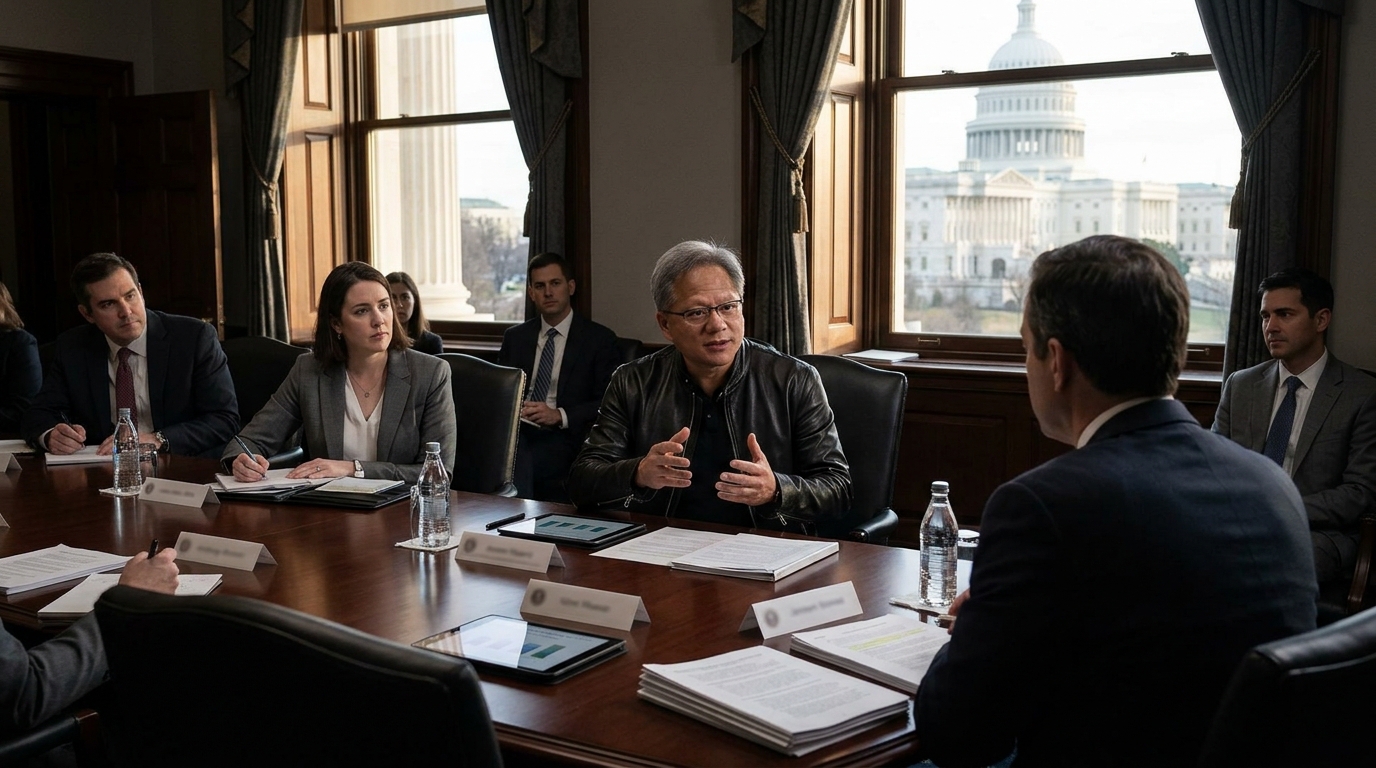
The political dimension is just as striking. Multiple outlets reported that Trump called Jensen Huang during a live taping at the All-In Summit in Los Angeles, after Huang put the call on speakerphone. In that exchange, Trump dismissed some AI safety concerns as a “hoax,” while also telling Huang the U.S. had to beat China in AI innovation. Days later, Nvidia’s Jensen Huang was among the tech executives invited to a White House state dinner tied to Chinese President Xi Jinping’s Washington visit, alongside OpenAI’s Sam Altman and Google’s Sundar Pichai. No other semiconductor CEO holds that seat.
Huang’s own public position aligns with the administration’s direction. Nvidia CEO Jensen Huang and PCAST co-chair David Sacks have both argued against a deliberate slowdown of AI development. When a company’s worldview becomes the government’s working assumption, its addressable market stops shrinking from political risk.
Nvidia is widely estimated to hold about 80% of the AI accelerator market in 2026. That share is real but not static. Amazon said its custom chip business saw nearly 40% quarter-over-quarter growth in Q1 2026, with an annual revenue run rate now over $20 billion. Google, Microsoft, and Meta are all scaling custom silicon in parallel. The competitive moat is wide; it is not permanent.
Sector Watch
AI infrastructure is the clearest beneficiary of the current policy stance. There is already an Artificial Intelligence Litigation Task Force within the Department of Justice with a stated mandate to challenge certain state AI laws, signaling that federal priority runs toward removing friction rather than adding it. That posture keeps the data center construction pipeline intact, which sustains demand for accelerators, networking, and power infrastructure across the sector.
Risk Radar
The single most durable counterweight is public opinion. A poll released by the New York Times and Siena College found that 61% of 1,503 likely voters surveyed in early September opposed building data centers to power AI technology. The poll also reported that among 2024 Trump voters, the split was nearly even: 49% in support, 45% opposed, while Harris voters and non-voters leaned against at 74% and 67%, respectively.
Federal cover does not override local permitting. Pressure is likely to appear first in local permitting, water management, environmental reviews, and negotiations with communities rather than as a single national campaign issue. County zoning boards answer to neighbors, not to Truth Social posts.
There is also a strategic concentration risk. When Nvidia’s market position depends partly on its CEO’s relationship with a sitting president, management faces less competitive pressure to stay ahead on merit alone. That is a comfort that can curdle quietly.
The Cheat Sheet
- Top Market Theme: Washington has formally adopted AI acceleration as policy, removing the regulatory risk that was the most credible long-term threat to compute demand.
- Stock to Watch: Nvidia. The combination of roughly 80% market share in AI accelerators, $215.9 billion in fiscal 2026 revenue, and a CEO embedded at the highest levels of policy makes it the clearest expression of this theme.
- Sector to Watch: AI infrastructure broadly, including data center REITs, power equipment, and networking, all of which benefit from a federal posture that prioritizes buildout over restriction.
- Biggest Risk: Grassroots opposition to data center construction is wide and bipartisan at the local level. That friction shows up in permitting timelines and utility negotiations, not in presidential announcements.
- Biggest Opportunity: If the AI Force announcement functions like Space Force did for defense contractors, early-positioned AI infrastructure companies could gain a captive, federally-endorsed procurement market.
- One Thing to Remember: Political moats and technology moats are both real, but they are not the same thing. Nvidia currently holds both. The risk is assuming one is a substitute for the other.