September 26, 2026
CFIUS is being redesigned in real time. $120B is already committed.
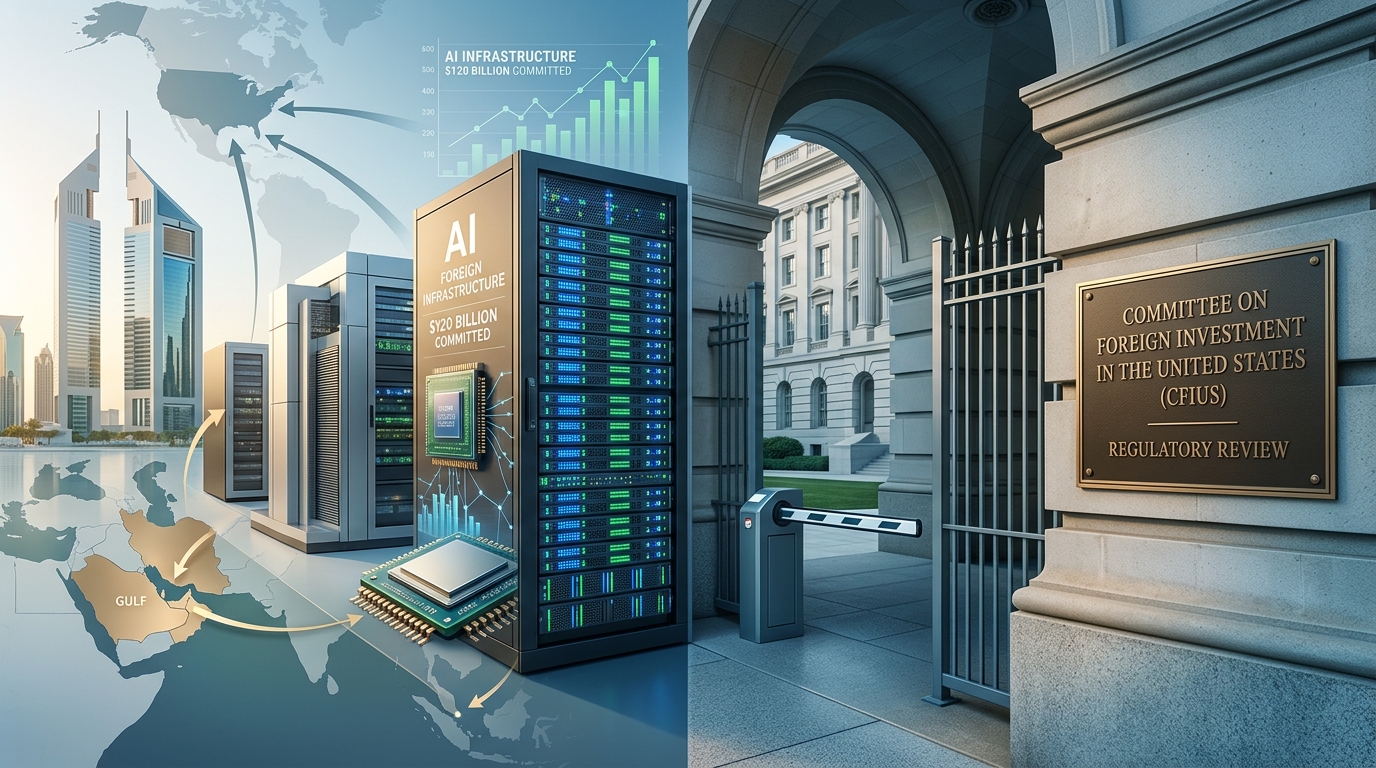
The numbers are not subtle. Sovereign wealth funds from Norway, the UAE, Saudi Arabia, and Singapore collectively held over $15 trillion in assets as of year-end 2025 and deployed a reported $66 billion into AI and digital infrastructure in that year alone. Their committed capital toward AI infrastructure buildout spanning data centers, compute networks, and semiconductor-linked assets is estimated to cross $120 billion through 2025 and 2026. That is not a portfolio tilt. That is a structural repositioning, and it is landing squarely on U.S. tech.
World’s Largest Investors Are Moving Their Money (Not Into AI)
While the media distracts you with stories about the next big AI IPO… The world’s largest investors are moving their money into one asset – at the fastest pace in a generation. This asset has crushed the S&P 500’s return over the past 12 months… More than TRIPLED the S&P 500’s return in 2025… and has outperformed the S&P 500 over the past 25 years by more than 1,100 percentage points. According to one Wall Street veteran, with over 40 years of professional investing experience… the biggest gains could be still ahead. That’s why he’s urging you to make one money move now.
Saudi Arabia’s Public Investment Fund, the UAE’s Mubadala, and ADIA have made large-scale, long-term investments in data centers and AI computing infrastructure. Unlike other major markets, where private operators must secure tenants before committing capital, the Gulf has developed a structure in which sovereign wealth fund financing absorbs a substantial share of initial construction risk. Saudi Arabia’s HUMAIN alone commits more than $100 billion across 11 data centers totaling 2.2 gigawatts with hundreds of thousands of Nvidia GPUs. The deal architecture runs straight through U.S. chipmakers, hyperscalers, and infrastructure platforms.
That scale of GPU commitment makes Nvidia the clearest direct beneficiary of Gulf sovereign capital — but the competitive picture around its hardware is more complicated than the headline numbers suggest. how custom silicon rivals are threatening Nvidia’s data center dominance is a risk that sovereign buyers writing decade-long checks may be underpricing, even as their sheer volume of orders provides near-term revenue certainty.
For traders, the more actionable question is not whether the capital arrives. It is what shape it takes when it does.
The Supreme Court Protected Your Location. What About Your Financial Data?
In June, the Supreme Court ruled that acquiring an individual’s cell-phone location data constitutes a Fourth Amendment search. But your financial activity on most public blockchains can still be visible. One overlooked altcoin was designed around financial privacy – and our team believes it deserves attention as crypto momentum builds.
Discover our next “Freedom Coin” and get the complete $3 research report today.
Data centers may fall within CFIUS’s jurisdiction on multiple grounds, particularly where they host sensitive personal data or support government or defense customers. SWF investments can attract heightened scrutiny, especially where the fund is owned or controlled by a foreign government. The America First Investment Policy memorandum mandates tighter controls over investments from adversarial nations and expands CFIUS authority to include investments into U.S. greenfields. At the same time, the policy memo emphasizes that the U.S. welcomes passive investment in cutting-edge businesses from all foreign investors, including sovereign wealth funds.
That carve-out for passive investment is the pivot point. SWFs that invest indirectly in data centers as limited partners may choose to structure investments to be sufficiently passive to limit CFIUS jurisdiction. In practice, that means Gulf funds write large checks, take no board seats, and stay away from anything that looks like operational access. The sovereignty of the technology stays nominally domestic. The capital does not.
In 2026, Treasury proposed a Known Investor Program that may streamline filing processes and offer benefits for certain foreign investors that frequently file with CFIUS. “The increase in non-notified inquiries reflects a fundamental shift from rules-based compliance to discretionary, intelligence-driven enforcement,” one legal briefing noted this summer. That means deal certainty is lower, and timelines are longer, even for allied-nation funds.
The same national-security logic that complicates SWF filings is simultaneously driving enormous domestic cloud procurement, and the two dynamics are not unrelated. how the Pentagon’s latest cloud contract reshapes the infrastructure investment case illustrates why U.S. government demand is becoming a counterweight to foreign capital flows — and why platforms with both sovereign and federal exposure carry a different risk profile than those relying on either alone.
Discover The Next Elon Musk and the Next 100x Darling of Wall Street
Today, we’ve found THE NEXT Elon Musk.
A man we call “Silicon Valley’s Oppenheimer.”
As a special thank you to our readers, we will show you how to get pre-IPO exposure to his newest company.
Including a free ticker symbol that you can use from any brokerage account.
The 2026 deal landscape reflects a sustained reallocation away from traditional equities toward alternative assets and long-duration infrastructure. GIC led several marquee transactions in the $2 billion to $4 billion range. The companies capturing this capital: data center platforms, power infrastructure operators, and semiconductor supply chains with exposure to Gulf compute buildouts.
The market implication is specific. Sovereign buyers are price-insensitive and horizon-agnostic. When they accumulate a position in an infrastructure platform or a chip supplier, they do not react to earnings misses the way a hedge fund does. They compress volatility in those names and provide a floor. That is not a reason to blindly follow them in. It is a reason to understand the ownership structure before the next selloff tests it.
Understanding that ownership structure also means understanding the cost pressures building inside the platforms sovereign funds are accumulating. which layer of the AI supply chain absorbs rising memory costs — hyperscalers, margins, or build timelines is the kind of structural question that a price-insensitive sovereign buyer can ignore in the short run but that ultimately determines whether the floor they provide holds when fundamentals catch up.