October 15, 2026
Bonus Content: Intel’s Drone Chip Has No GPS Problem. It Has a Product Problem.
Editor’s Note: Rob Spivey spent 25 years in the upper echelons of finance. His analysis is followed by BlackRock, JP Morgan, Goldman Sachs, and over 300 money management firms from coast to coast. He spotted Meta’s potential in 2013…Moderna, before it shot up 2,200%…and even AMD before it exploded 4,200%. But according to Rob, his latest discovery could make every single prior call pale in comparison.
Dear Reader,
If you are waiting for Tesla or SpaceX to save your retirement…
Wall Street insider Rob Spivey says you’re late.

Look, he called Tesla profitable in 2018 while the press was writing obituaries.
But THIS TIME, he’s NOT telling you to buy Tesla…
Not SpaceX…
Or any “AI darling” tied to Elon.
Instead, he’s focused on the layer BENEATH Musk’s empire.
He calls it Elon’s “Shadow Trust”.
It’s not a family office…
Not a government slush fund…
But a special group of stocks helping solve the AI bottleneck facing Elon’s (and America’s) growing empire.
And unlike the flashy names EVERYONE’S talking about…
This “shadow trust” does something special…
Long-term, our backtest shows it pays you.
In fact, it would’ve generated an average of $12,000 a month over the past two decades.
Just imagine…
Every time a Tesla rolls off the assembly line…
Every time a Starlink goes up…
Every time another gigawatt of compute gets eaten…
YOU’RE in position to see results.
In the last 12 months alone, it has paid out $4 billion.
And more than $1 billion since the SpaceX IPO.
The next payout window?
Which means we have a lot of urgency here.
The White House has already thrown its full weight behind this initiative…
And Rob Spivey reveals how YOU could tap into Elon’s “Shadow Trust” today.
It’s easy.
It takes as little as 3 simple steps.
Click here to see the full story in his latest presentation.
Best,
Dan Ferris
Chief Analyst, Stansberry Research
Intel’s Drone Chip Has No GPS Problem. It Has a Product Problem.
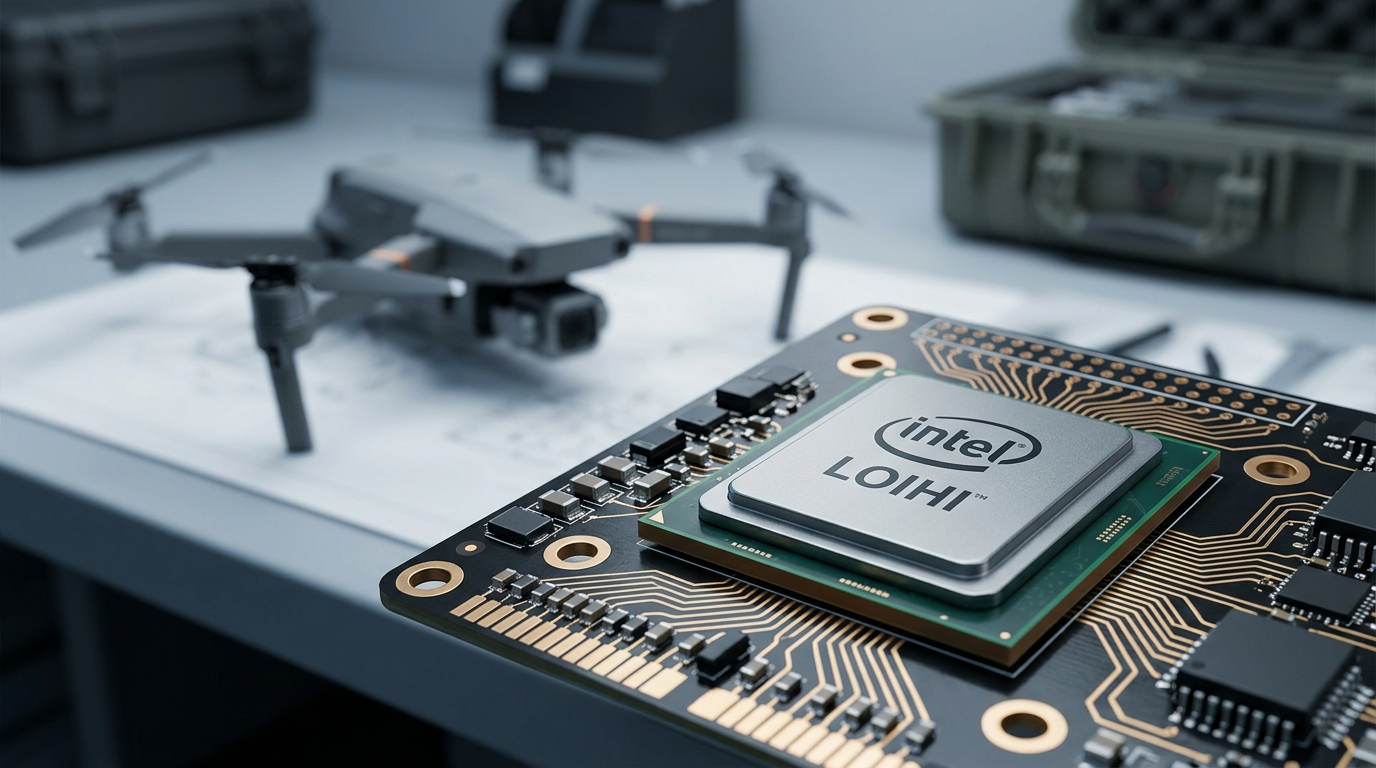
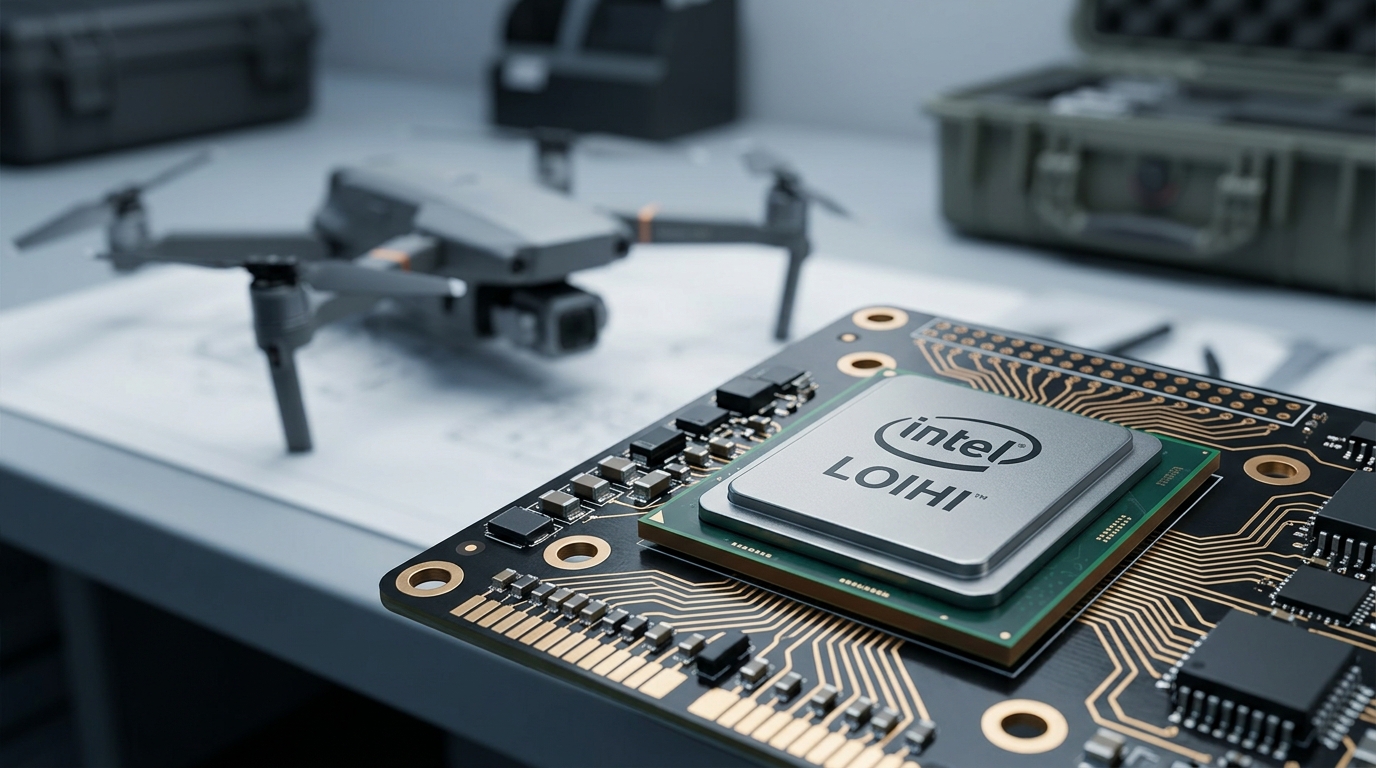
Intel just closed the research chapter on neuromorphic computing. The question is whether it can open a commercial one before the Pentagon spends $54.6 billion on drones that need exactly what Loihi does best.
On May 13, Intel (INTC) archived Lava, the open-source software framework that gave researchers access to its Loihi chips. Months later, Mike Davies, director of Intel’s Neuromorphic Computing Lab, has described Loihi 3 as being in development and positioned it for the coming era of physical AI. Intel has not published a public spec sheet for a next-generation Loihi processor or a new SDK.
That sequencing matters for traders watching INTC ahead of its Q3 earnings call on October 29. The stock closed at $102.81 on Monday, up roughly 175% year to date. Intel reported Q2 revenue of $16.1 billion and non-GAAP EPS of $0.42. Q3 revenue guidance is $15.8 billion to $16.8 billion, with a midpoint of $16.3 billion. Neuromorphic is a small but strategically loud piece of the story, but the financials are still being driven elsewhere.
Intel’s silicon roadmap depends on the same advanced lithography commitments now reshaping the broader chip industry. TSMC and Samsung have both made dated High-NA EUV production commitments that set the competitive clock for every chipmaker on an advanced-node roadmap.
Why Drones Are the Signal Worth Tracking
The Pentagon’s FY2027 budget request put $54.6 billion into the Defense Autonomous Warfare Group (DAWG), up from $225.9 million in fiscal 2026. Much of that money is framed around autonomy and operations in contested environments, including GPS-denied conditions, which is the kind of setting where low-latency, low-power processing matters.
The results are validated. Intel and ETH Zurich demonstrated adaptive horizon tracking on a drone platform with closed-loop speeds up to 20 kilohertz and 200 microseconds of visual processing on Loihi. Separately, a Science Robotics paper demonstrated a fully neuromorphic vision-to-control pipeline for autonomous drone flight running at 200 hertz on Intel’s Loihi processor, with about 0.94 watt of idle power and only a small additional draw while running the network. For a battery-powered platform navigating a jammed corridor without satellite links, that kind of power budget can translate into materially longer endurance than conventional high-power approaches.
Neuromorphic chips process sensor data asynchronously, firing only when inputs change. GPS-denied navigation leans on optical flow and visual odometry, workloads that match the sparse, event-driven signals these chips handle natively.
The Gap Between Lab and Procurement
None of this is contracted revenue. Loihi 2 is described by Intel as a research chip, and Loihi 3 remains in development without a public spec sheet. Lava’s archival removed the most visible open-access path for outside teams, even as Intel continues to describe Lava as its neuromorphic software framework. Until Intel ships and supports a clear product-grade SDK and commercial distribution model, integrators beyond Intel’s research community still face friction that can slow real procurement timelines.
That is the tension the trade sits on. Intel carries one of the most validated neuromorphic stacks among U.S. chipmakers, and the defense autonomy budget request is large. The commercialization timeline is Intel’s to control, and right now it is still hard to underwrite.
What to Watch October 29
- Gross margin guidance: Q2 came in at 41.8%. Any slip would matter for sentiment.
- Physical AI language: Intel’s August $15 billion common stock offering announcement cited physical AI and purpose-built silicon as growth vectors. If management maps neuromorphic explicitly to defense autonomy on the call, that signals a posture change.
- SDK timeline: Any specific date on a next-generation Loihi toolchain would shorten the gap between the Pentagon’s procurement appetite and Intel’s ability to address it.
The hardware case for neuromorphic drone autopilots is no longer speculative. The commercial execution case still is. October 29 is one of the few near-term moments where management can close that gap, or widen it.