
Before any options trade, there are exactly 4 questions worth 5 minutes of your time:
When does this company report earnings next?
What’s on the economic calendar during my trade?
Does this stock pay a dividend – and when’s the cutoff?
And how many days does my option have left?
Four questions. Four free lookups. Five minutes, total.
Get a bad answer to any of them, and you’ve just found a landmine – a scheduled event that would have detonated your trade no matter how good your analysis was. Skip the trade, shift the date, or pick a different expiration… and the disaster simply never happens.
My new report walks you through all four: what each event is, why it blows up options positions, where to find each date in 30 seconds, and the exact check to run every time.
The Options Landmine Calendar. Normally $29.97. Free today.
Good Trading,
Bill Poulos
P.S. Five minutes before the trade beats five weeks of regretting it after. Grab the check free.
Neuralink’s Big Surgical Step: Going Transdural
Market Snapshot
Brain-computer interface stocks don’t trade on the NYSE. But the money moving through the sector right now is shaping which public companies, partnerships, and pre-IPO positions will matter when the first commercial approvals arrive. Traders who ignore the BCI race until an S-1 lands will have missed the positioning window.
Stocks in Focus: The Neuralink Signal
Neuralink is still private. Its last widely reported formal valuation was about $9.6 billion post-money in a May 2025 round, and secondary market chatter in 2026 has suggested far higher implied marks, though those figures are not confirmed. What changed the conversation was not the price. It was a procedure performed in Toronto.
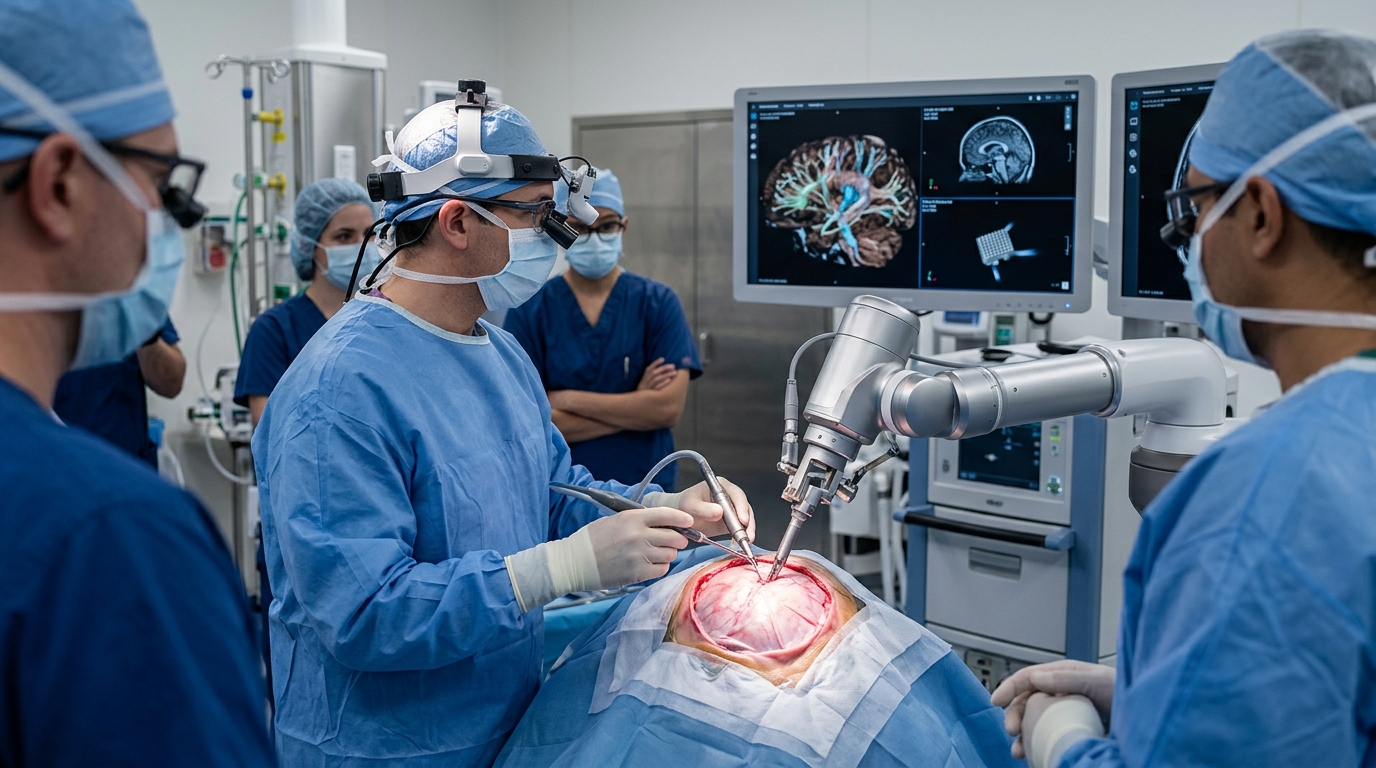
In May 2026, Neuralink reported a first in its human work: inserting electrode threads through an intact dura mater and into the cortex without performing a durectomy. The procedure took place at University Health Network’s Toronto Western Hospital in Toronto, and the participant was controlling a cursor with their thoughts within an hour of surgery.
Why does this matter beyond the headline? Eliminating the durectomy doesn’t just reduce surgical complexity. It makes the procedure more amenable to automation. Musk wrote on December 31, 2025 that Neuralink planned to move toward high-volume production of brain-computer interface devices and an optimized, almost fully automated surgical procedure in 2026. The transdural step is a prerequisite for that ambition. Neuralink has described active clinical efforts across the United States, Great Britain, the United Arab Emirates, and Canada, and it has publicly said the FDA granted Breakthrough Device Designation to its Blindsight program.
Internal projections cited in analyst reports target FDA approval for Telepathy around 2029, with 2,000 annual procedures and approximately $100 million in annual revenue.
Sector Watch: Where Tradeable Money Is Moving
The most significant event for public-market investors landed just ten days ago. Precision Neuroscience, a New York-based startup building minimally invasive brain-computer interfaces, closed an oversubscribed $250 million Series D led by Pershing Square Capital Management and the Ackman Oxman Institute. The company said the raise brings its total capital raised to about $430 million and follows more than 100 patient procedures across 18 major medical institutions.
Precision is also a clearer path for investors who want BCI exposure through a publicly traded name today. Medtronic has announced a partnership with Precision Neuroscience to integrate Precision’s Layer 7 cortical interface with Medtronic’s StealthStation surgical navigation system. MDT is a large medtech player with an established hospital sales force.
Then there is Synchron. While Neuralink implants require a neurosurgical procedure, Synchron positions its Stentrode via an endovascular approach through the jugular vein, avoiding open brain surgery. Synchron has said it is assessing the device in clinical trials in the United States and Australia. Public reporting and investor databases have described a $200 million financing in November 2025, with backers that have included Bezos Expeditions, Gates Frontier, Khosla Ventures, and the Qatar Investment Authority. Synchron’s lower signal resolution is the tradeoff for a procedure that scales through interventional specialists rather than skull-drilling neurosurgery.
The Cheat Sheet
- Top Market Theme: BCI capital formation is accelerating, with Precision Neuroscience closing an oversubscribed $250M Series D in late September 2026 as the sector’s clinical milestones pile up.
- Stock to Watch: Medtronic (MDT). It has a formal partnership with Precision, and it also markets an FDA-approved adaptive deep brain stimulation system that the company has described as a closed-loop system.
- Sector to Watch: Medical devices, specifically companies with neurosurgical infrastructure that private BCI firms need to reach hospitals at scale.
- Biggest Risk: None of the major commercial BCIs have received full FDA Premarket Approval for broad clinical use; most remain restricted to investigational studies. A regulatory setback compresses the entire timeline.
- Biggest Opportunity: Pre-IPO secondary market access to Neuralink or Synchron for eligible investors, ahead of what some analysts see as a 2029 to 2031 IPO window.
- One Thing to Remember: The BCI race is not one company’s story. Three distinct surgical architectures are advancing simultaneously, and the one that clears FDA first reshapes every valuation in the sector overnight.