
October 26, 2026
Bonus Content: HON’s Armor Business Spun Out. The Defense Demand Didn’t.
Quick note.
My new report, The 0DTE Game Plan, normally sells for $29.97 on our website.
But if you use this link today, it costs you nothing.
Inside is a simple 3-step plan for trading same-day options like a business – with your entry, exit and max loss decided before you ever click.
Plain English. No complicated math. Done by the close.
And I don’t sugarcoat the risks, either.
I can’t promise this link will still be free tomorrow. If you’ve been curious about 0DTE, now’s the time.
Click here to claim your free copy before it goes back to $29.97.
Good Trading,
Bill Poulos
p.s. $29.97 normally. Free today with this link.
HON’s Armor Business Spun Out. The Defense Demand Didn’t.
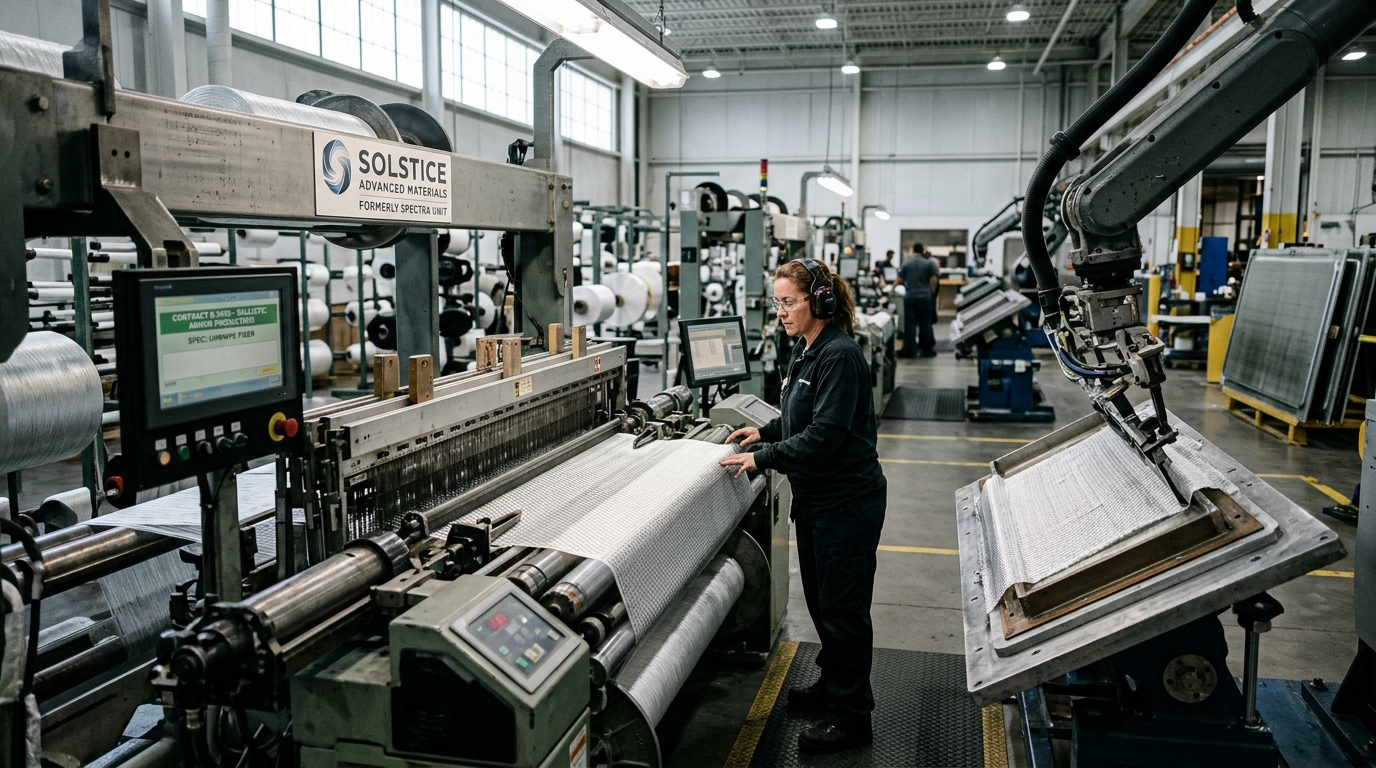
Honeywell no longer owns its most decorated material. Spectra fiber, the ultra-high molecular weight polyethylene used in bullet-resistant vests, combat helmets, and armored vehicles worldwide, now sits inside Solstice Advanced Materials (SOLS), which completed its spin-off from HON on October 30, 2025. Honeywell shareholders received one SOLS share for every four HON shares held. The transaction was intended to be generally tax-free for U.S. federal income tax purposes (except for any cash received in lieu of fractional shares). Most traders filed it away and moved on.
That may be a mistake.
What Spectra Actually Is
The fiber is not a niche product. Spectra Shield is pound-for-pound up to 15 times stronger than steel, yet light enough to float. The U.S. Army has used it for helmets, vest plates, and vehicle armor. Defense manufacturers including DFNDR Armor have promoted a research and development partnership with Honeywell’s advanced fibers and composites team. Graphene integration is often cited as a future composite direction in the broader materials world, but Solstice has not publicly tied Spectra Shield product plans to graphene, so treat that as speculation unless the company says otherwise.
The Demand Signal Is Real
Global defense budgets have not slowed. In March 2026, Honeywell Aerospace separately announced a supplier framework agreement with the U.S. Department of War that includes a $500 million multi-year investment to upgrade production capacity for critical defense technologies. Meanwhile, Solstice has told investors that demand for its protective fibers business is tied closely to global defense spending and expects those budgets to keep increasing. The spin-off was completed on October 30, 2025; in the year ended December 31, 2025, Solstice reported net sales of about $3.9 billion and an adjusted standalone EBITDA margin of 24.6%.
Rising defense budgets flow downstream to the prime contractors who specify and procure the materials inside their platforms. Lockheed Martin’s record $230 billion backlog reflects the same sustained government demand that underpins Solstice’s protective fibers order book.
The Trading Angle
Spin-off mechanics often suppress early institutional positioning, but the underlying contract pipeline is what resets valuations. Multi-year Pentagon framework agreements with guaranteed minimum procurement quantities show how defense revenue gets locked in before Wall Street pays attention.
- SOLS: Pure-play exposure to Spectra fiber and ballistic composites, now separate from the refrigerant and semiconductor materials noise. Watch volume and institutional positioning, which can stay light in the early quarters after a spin-off.
- HON: Cleaner automation and aerospace story post-Solstice. The Aerospace Technologies separation was previously targeted for the second half of 2026.
- Risk: SOLS carries standalone cost burdens that did not exist under Honeywell’s balance sheet. That mid-20% adjusted standalone EBITDA margin is the floor to watch on each earnings report.
The armor demand story has not changed. The company holding the fiber just has a new ticker, and most traders haven’t reset their view of it yet.