October 24, 2026
Bonus Content: Oracle’s $125 Billion Debt Isn’t the Crisis. The Next 5 Years Are.
Heads up:
If you still haven’t downloaded your copy of The Retirement Trade, you’d better grab it now.
I’m eventually planning to move this book behind a paywall.
So the smart thing to do right now is download the book and save it to your phone or computer. This way you’ll have your copy of the guide saved no matter what it costs in the future.
Grab it here:
Expiring Download Link: The Retirement Trade (Free pdf)
To your success,
Dave Aquino
Basecamp Trading
P.S. Be sure to pay close attention to page 6, where I show an example of making $1,160 in less than an hour from a retirement trade on a popular tech company. Ticker & full strategy revealed on page 6 here.
Oracle’s $125 Billion Debt Isn’t the Crisis. The Next 5 Years Are.
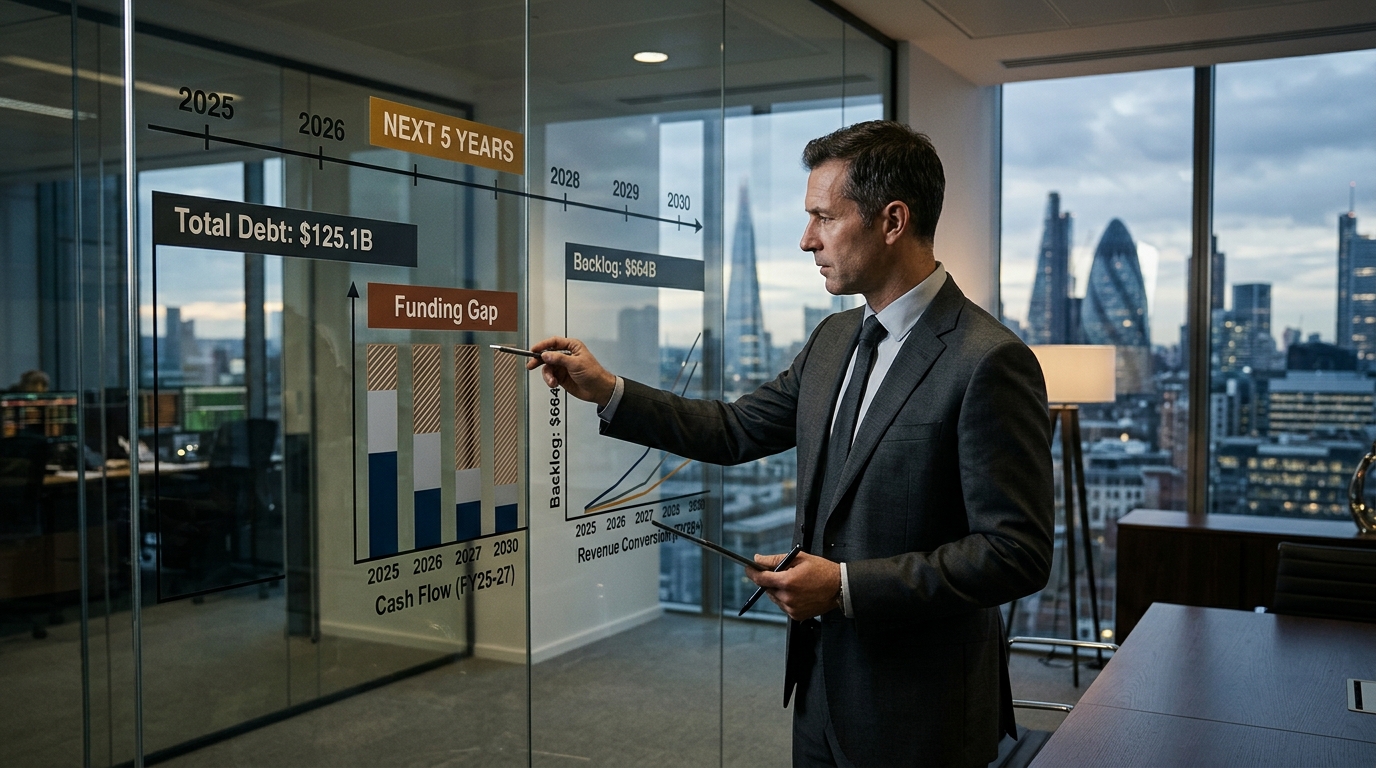
Oracle is not insolvent. That much is clear from the numbers. What is less clear is whether the company can keep borrowing at survivable rates long enough for its $664 billion backlog to generate the cash to repay what it owes.
That distinction matters right now, because the market is conflating two very different problems.
What the Balance Sheet Actually Says
Debt declined from roughly $129.5 billion to $125.3 billion in Oracle’s most recent quarter, while cash increased from $31.3 billion to $36.4 billion. That is movement in the right direction. Positive free cash flow did not drive the debt reduction. Oracle raised $19.9 billion by issuing new shares and used part of the proceeds to repay debt. Equity dilution, in other words, is doing the work the business cannot yet do on its own.
Oracle generated $32.0 billion in operating cash flow in FY2026, up 54%, but free cash flow was negative $23.7 billion as the company accelerated infrastructure investment. Operating cash flow is healthy. The capex hole is what turns it negative.
The Credit Market’s Verdict
Ratings agencies and bond traders are not waiting for a recovery story. Reuters reported in August 2026 that S&P Global Ratings cut Oracle to BBB- in July 2026, the last rung of investment grade. BBB- is the last rung of investment grade. The five-year credit default swap on Oracle has been trading around the 200-basis-point level at times in 2026, but it has also moved materially above that level during October 2026. The bond market is treating Oracle as junk-adjacent, even if the ratings have not crossed that line.
The contagion risk became visible earlier this month. CoreWeave’s bond market flashed a warning that spread far beyond one AI startup, and Oracle shareholders absorbed a nearly 9% loss in a single session on October 14, 2026. Oracle’s interest expense rose 55% to $1.428 billion in the most recent quarter, and total liabilities reached $236.1 billion.
The CDS move and the bond-market repricing are not isolated to Oracle. Investment-grade credit spreads have been quietly reshaping the risk environment beneath every hyperscaler equity.
The $664 Billion Question
The bull case rests on one number. Remaining performance obligations reached $664 billion, up from $455 billion a year earlier. The share converting within a year is about 13%. That shrinkage is the real problem hiding inside an impressive headline. Oracle is funding data centers today to deliver revenue years from now, using debt that costs more each quarter.
Venture capitalist Paul Kedrosky called out Oracle as financially exposed to an AI downturn in early October 2026. He highlighted Oracle’s shrinking legacy database operations alongside heavier borrowing to fund its push into AI-focused cloud infrastructure. Legacy software revenue was already down 3% in Q1 FY2027, the subsidy that once cushioned the transition is fading.
Where the Risk Actually Lives
This is not a 2026 liquidity crisis. Oracle has said it does not expect to issue additional debt in calendar year 2026. The near-term funding plan is in place.
The risk is a slower, structural one: borrowing costs that stay elevated for three to five years, against a backlog that converts at about 13% annually. Oracle is racing to open data centers alongside Amazon, Microsoft and Google. If AI demand softens before the backlog converts, the interest bill stays while the revenue slides right.
Oracle is not the only infrastructure name carrying a massive backlog funded by debt while waiting for AI demand to convert. Dell’s $95 billion AI server backlog raises the same question about whether contracted revenue arrives before the cost of capital compounds.
Traders should watch the CDS spread and the Q2 FY2027 earnings for any acceleration in the 12-month RPO conversion rate. That figure, more than the debt headline, is what tells you whether Oracle’s bet is on schedule.