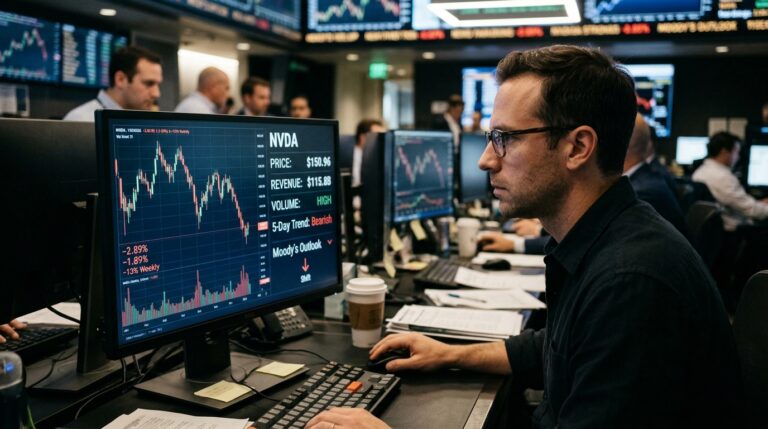
The debate inside investment committees this week is not about Nvidia’s quarter. Kress reported $115.8 billion in Q3 revenue, with $107.6 billion coming from data center alone. The numbers were fine. The question that matters is simpler and harder: who actually runs this company, and when will anyone know?
The Board Closed the Door. Trump Knocked Again.
“The Nvidia board does not intend to reinstate Jensen as CEO,” board chair Harvey Jones said during Tuesday’s earnings call. That was November 17, 2026. Three days later, President Trump held a White House press conference and said the opposite. “I’d like to see Jensen make a big apology and go back,” Trump said, adding, “I think the company, if they were smart, they’d take that brilliant man, accept an apology and let him go back to work.” It was the second time that week Trump backed Huang publicly, and it came three days after Nvidia’s board said it would not reinstate him.
The board’s position is unambiguous. Jones has communicated the decision not to reinstate Huang and confirmed that it hired Heidrick & Struggles to lead the search for a permanent CEO. Trump’s intervention changes none of that legally, but it creates a political overhang that is harder to dismiss. Trump has signaled openness to Huang’s return, while the company’s board has rejected it, and that gap could complicate the relationship between Nvidia and Washington at a sensitive time for chip policy.
What Institutional Holders Are Actually Dealing With
Sophisticated holders are not debating whether Trump’s preference carries board authority. They are asking a different question: how long does this vacuum persist, and what does it cost?
Kress will continue to serve as Executive Vice President and Chief Financial Officer while serving as Interim Chief Executive Officer until a permanent successor has been named. Running two of the most demanding jobs at the most scrutinized company in AI simultaneously is not a governance plan. It is a holding action. Kress’s prospects of becoming Nvidia’s permanent CEO remain uncertain, with questions about her potential exposure to the company’s legal and regulatory challenges complicating her candidacy.
Some large institutional investors want to take an active role in existing class litigation because they are very concerned about “governance failures” at Nvidia. “Investors are going to want to know whether the board adequately oversaw the CEO, or whether the board had become too passive,” said John Rizio-Hamilton of Bernstein Litowitz Berger & Grossmann.
Then there is the SEC. Reuters reported that Nvidia is facing an SEC accounting probe. The probe has focused, in part, on changes in how the company reports geographic revenue and on Nvidia’s AI industry financing deals. Shares were down about 13% on Friday after Reuters reported details of the probe. NVDA, which traded above $210 in late October, closed at about $126 on Friday, November 20, 2026. The drop added to a roughly 40% decline since late October, with leadership turmoil and regulatory scrutiny compounding a broader risk-off turn in AI.
The Founder Discount Is Real
Academic research on post-founder successions is not encouraging for anyone hoping Heidrick & Struggles delivers a quick answer. The spotlight on Huang shows the vulnerabilities of a large company dependent on one executive. “The biggest issue is no human goes on forever, and this is exactly why you want a good succession plan in place if something like this were to happen,” says Charles Elson, a corporate governance expert.
Huang owned about 3.6% of the company as of Nvidia’s most recent proxy statement, and Nvidia does not have supervoting shares, so that is his voting stake too. He cannot force his way back. But the candidates emerging for the permanent role carry their own complications. Prediction markets have placed Arm CEO Rene Haas as the early favorite, with internal candidates also in the mix, and Huang still drawing non-trivial odds despite the board chair’s public position against bringing him back.
What Investors Are Missing
The noise around Trump’s intervention is obscuring a more consequential issue: the SEC probe lands directly in Kress’s lap as CFO, not just as interim CEO. Reuters reported that the investigation has included scrutiny of Nvidia’s geographic revenue reporting changes and its AI financing activity. Any revision to how that $107.6 billion data center quarter is explained would carry significant weight for anyone modeling the AI spending cycle. The person responsible for those disclosures, and responsible for leading the company while a search firm hunts for her replacement or successor, is the same person.
Stocks to Watch
NVDA: The governance overhang, the SEC inquiry, and the absence of a named permanent CEO are three separate discount factors sitting on top of a business that is still operationally strong. The stock does not re-rate until at least one resolves.
ARM: The Financial Times reported that Nvidia’s board has approached Arm CEO Rene Haas in its search for Huang’s successor. If Haas is seriously in play, Arm faces its own succession question, and the market has not priced that risk.
Broadcom and Marvell Technology: Every week the Nvidia CEO search drags on is a week hyperscalers quietly explore custom silicon alternatives. Neither company needs Nvidia’s crisis to benefit, but both benefit if enterprise AI procurement decisions slow while institutional buyers wait for clarity on who is running the world’s most important chip company.