
October 29, 2026
Bonus Content: Apple’s Chip Gap Is the Acquisition It Can’t Ignore
Dear Reader,
Some prominent financial analysts are now predicting a “perfect storm” for the stock market that will be worse than 2008.
In a new must-see briefing, Marc shows how there have been four separate shocks since the AI bull market began in 2022…
Each time, they’ve sent prices skyrocketing higher… creating historic boom times for the companies – and industries – involved.
- Like, Broadcom up 904%…
- Palantir up 3,035%…
- And Powell Industries, up as much as 3,427% in just 15 months…
Marc calls them “AI Demand Shocks” and says that understanding what a demand shock is… and where AI will create one next… is the way to spot the next wave of mega-winners in 2027.
This isn’t Marc’s first bold AI prediction.
He recommended Nvidia all the way back in 2015, before it went on to surge over 21,000%.
And years before AI became a household term, he developed a 20-factor computerized stock-rating system to identify tomorrow’s winners on Wall Street… TODAY.
That system even identified some of the biggest winners in each of the four demand shocks that we’ve seen from AI so far…
- Like Sandisk, before it rose 300% in just a few months.
- Seagate, before it rocketed 393% in months.
- And Micron Technology, before an 827% gain in just a year.
That’s why he just released a new investing briefing. In it, he explains exactly what’s happening to the all-important AI trade… what to expect in the U.S. stock market in the next 90 days as a result…
And the concrete steps to take right now with your money, to place your portfolio in the best possible position.
Good investing,
Vic Lederman
Publisher, Chaikin Analytics
Apple’s Chip Gap Is the Acquisition It Can’t Ignore
Apple has done multiple acquisitions in 2026. Sonera grabbed brain-magnetic sensors for future Apple Watch health features. MotionVFX lifted Final Cut’s plugin library. Q.ai, reportedly valued at about $1.6 billion (with some outlets describing it as nearly $2 billion), brought Israeli audio-AI talent to sharpen Siri’s ability to parse speech in noisy environments. Every deal follows the same template: targeted, small, designed to fill a specific engineering gap.
What none of them address is the gap that actually threatens Apple’s AI ambitions.
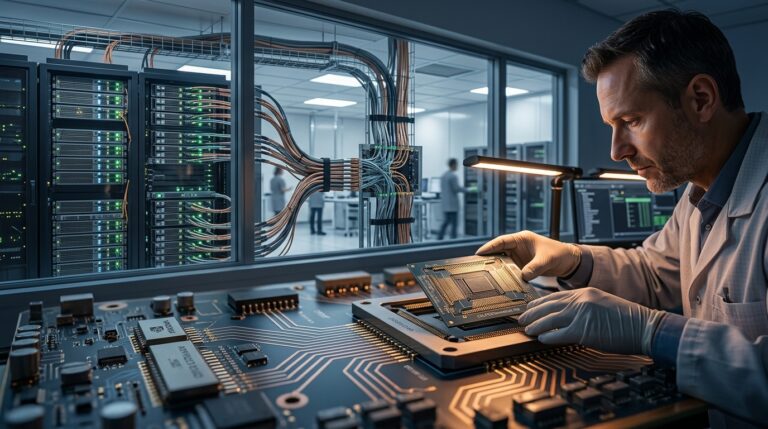
The server silicon problem is urgent. Apple’s Private Cloud Compute infrastructure runs on M2 Ultra chips. Those chips cannot handle the larger AI models Apple needs, including the Gemini-based Siri overhaul that required Apple to work with Google and Nvidia to run some workloads on Nvidia GPUs in Google Cloud. The internal fix, a dedicated AI server chip internally codenamed Baltra and co-developed with Broadcom, was supposed to be ready for mass production in 2026. It has slipped. No confirmed new date exists. Meanwhile, Apple announced in July an expanded, multiyear Broadcom commitment that it expects to exceed $30 billion, and Broadcom has said the partnership extends through 2031, a clear signal that Cupertino is buying time it does not have with in-house silicon alone.
This is why, in July, The Information reported Apple was approaching AI chip startups and consulting investment bankers about acquisitions, a striking shift for a company that has historically built its silicon rather than bought it. The logic is straightforward. Buying specialized inference-chip IP accelerates what Baltra cannot deliver fast enough.
The search-startup angle has cooled. Perplexity talks from mid-2025 never progressed to a formal bid, and internal debate between Eddy Cue’s pro-acquisition camp and Craig Federighi’s build-in-house faction appears to have stalled that track. Perplexity has since moved toward its own ambitions, including an August 12, 2025 reported $34.5 billion offer for Google Chrome that The Wall Street Journal first reported and Axios confirmed. That door looks closed.
Apple is not the only company scanning for inference-chip targets. Nvidia’s own pursuit of Korean chip designer Rebellions shows how quickly the inference acquisition window can close once a larger buyer moves first.
The institutional signal is also worth reading. In October 2026, Apple replaced longtime M&A head Adrian Perica, who ran deals for 17 years reporting directly to Tim Cook. His successor, Steve Smith, reports to CFO Kevan Parekh. That structural change matters: placing M&A inside finance typically tightens the return-on-capital filter. It suggests Apple’s next big deal will need a harder business case than acquihiring a model compression team.
An inference-chip acquisition clears that bar. Apple carries $62.4 billion in near-term liquidity, against $39.5 billion in cash alone as of June 27, 2026. Buying a chip startup at, say, $3 to $5 billion would be the largest hardware acquisition since the Intel modem carve-out, and it would give Apple something no partnership or rental arrangement provides: owned silicon for its own data centers, controlled roadmap, and zero dependence on a competitor’s cloud for the AI product at the center of its Services growth.
The pattern of Apple’s 2026 acquisitions suggests incremental moves, not transformational ones. The Baltra delay changes that calculus. When your proprietary chip slips and you are leaning on Nvidia capacity through a rival’s infrastructure, the clock on a bolt-on chip deal is running faster than most traders are pricing in.