Friday told two completely different market stories at the same time, and the index headline obscured both of them.
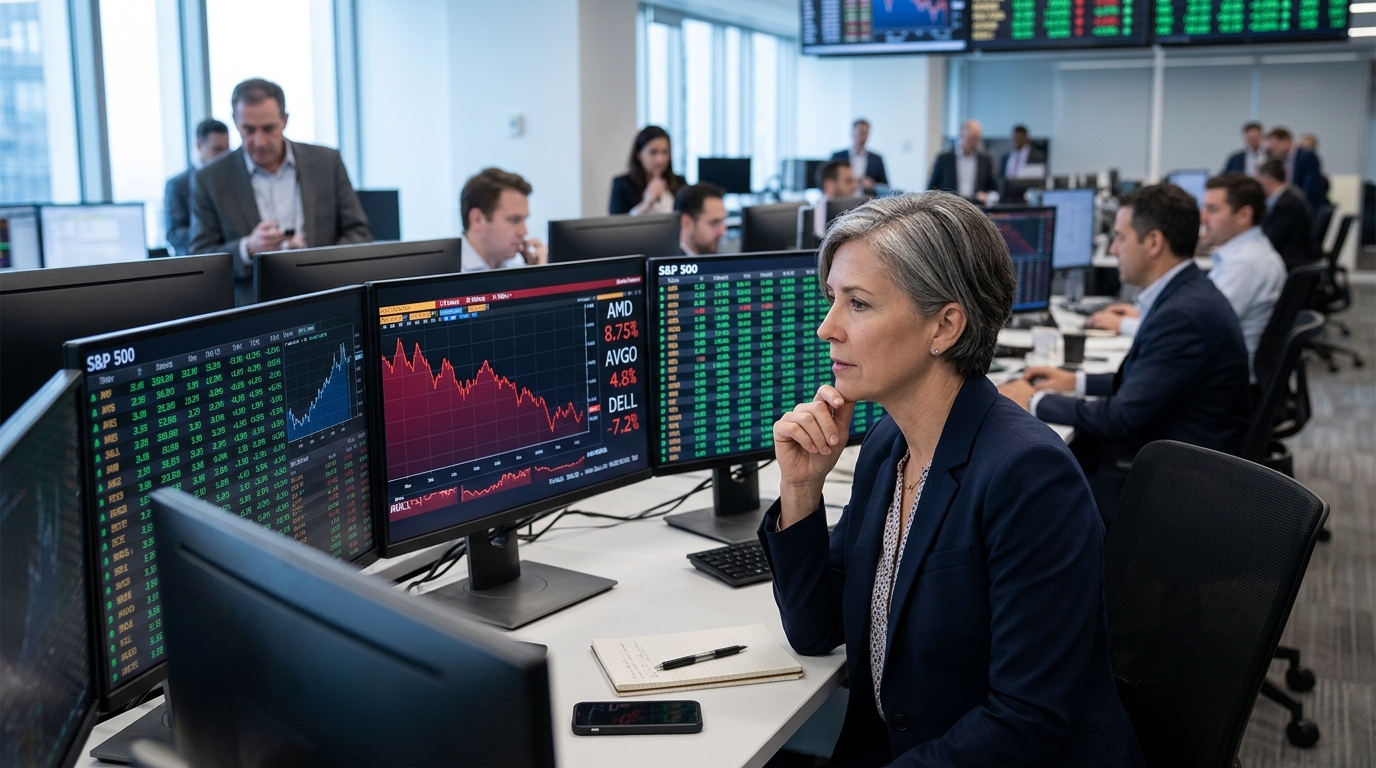
The S&P 500 fell 0.40% to 7,561.67, which looked like an ordinary down day. It was not. The index dropped while most stocks were up, meaning a handful of megacaps were doing the damage and the average holding was quietly fine. Roughly 315 S&P 500 members rose while 185 fell. The equal-weight version of the index, RSP, rose 0.20%, outperforming the cap-weighted index.
The damage was concentrated and specific. AMD closed down 8.75%, Broadcom down 4.76%, and Nvidia down 2.01%. Dell dropped 7.18% on concern about its reliance on Nvidia-based AI servers. Nebius fell 9.92%, Fabrinet 7.31%, Cisco 6.24%, and CoreWeave 6.13%. These were not random victims of a broad selloff. They were the precise beneficiaries of the rotation trade that had built all week on the view that Jensen Huang’s resignation would redistribute AI revenue to anyone but Nvidia.
That thesis had real momentum behind it. AMD had gained about 30% through Thursday, including a 5.86% jump on Thursday, as money rotated toward rival AI processor designers. Broadcom had been lifted sharply through Thursday as well. The math implied the market had concluded that every dollar Nvidia lost would flow to its rivals.
Friday tested that conclusion and found it fragile. Friday was the first real crack: with chip stocks broadly lower, AMD and Broadcom fell much harder than Nvidia. The rotation thesis was not just pausing; it was arithmetically reversing.
Cisco made the picture stranger. Cisco fell 6.24% to $95.64, the day after reporting record quarterly revenue of about $18.5 billion and raising its fiscal 2027 outlook. The stock dropped on its best numbers in over a decade, in a session when healthcare and financials were rising. Healthcare and financial stocks provided steady support through the afternoon, with Eli Lilly, Visa, and Mastercard each advancing about 1.3%.
Cisco was dragged by sector association, not by its own fundamentals.
The same logic applied to Dell and Fabrinet. Dell fell on concern about its reliance on Nvidia-based AI servers, a risk that existed before Huang resigned and that Friday’s selloff did nothing to change. CoreWeave extended its declines in the wake of Huang’s departure, as Nvidia had been a major financial backer and strategic partner.
What the breadth numbers reveal is that this was de-grossing, not a verdict on AI demand. Funds that had crowded into the “Nvidia alternatives” basket in a compressed window unwound the same positions in a single session, while the rest of the market carried on. “Nvidia’s pullback serves as a reminder of the concentration risk embedded in a market where a small number of mega-cap technology stocks have driven an outsized share of returns,” said Angelo Kourkafas, senior global strategist at Edward Jones.
The strongest counterpoint: some of the rotation may still have legs. AMD’s fundamentals are accelerating, with data center revenue up 97% to a record $8.5 billion and total Q3 revenue up 45%. A one-session reversal does not settle whether AMD collects more business as Nvidia navigates its leadership transition.
The answer arrives Tuesday. Nvidia will report its third-quarter fiscal 2027 results on November 17. Analysts expect revenue to jump to about $108.7 billion and adjusted earnings per share to $2.47. Given the circumstances, those numbers will take a back seat to how interim CEO Colette Kress handles the call and who else she brings on, which could hint at the company’s next permanent leader. If guidance holds and the product roadmap stays intact, the case for AMD and Broadcom as structural Nvidia replacements weakens considerably. If Kress leaves more questions open, the rotation trade gets a second look.