
July 5, 2026
AbbVie Survived the Biggest Patent Cliff in Drug History
Now it is building something bigger than what it replaced.
First a note from Stansberry Research
Dear Reader,
I’ve just revealed a powerful investing strategy that boils down to “Sell This, Buy That.”
It’s a way to rid yourself of overpriced AI stocks before the tech trade breaks down this summer…
And instead move that money into smaller, lesser-known names that are showing real potential to dethrone the “Mag 7.”
I even give away a Hotlist and Hitlist of buy and sell ideas that you can act on right now.
Like my recommendation I call “an upgrade to Tesla stock.” It’s a little-known company that just inked a groundbreaking partnership with the king of AI, Nvidia. This deal virtually hands this under-the-radar firm the keys to the self-driving industries’ biggest customers, putting them miles ahead of Tesla in the autonomous vehicle race.
That’s why I want to put this stock on your radar before markets open.
You can get the name and ticker symbol here.
Sincerely,
Marc Chaikin
Founder, Chaikin Analytics
FEATURED
AbbVie Survived the Biggest Patent Cliff in Drug History
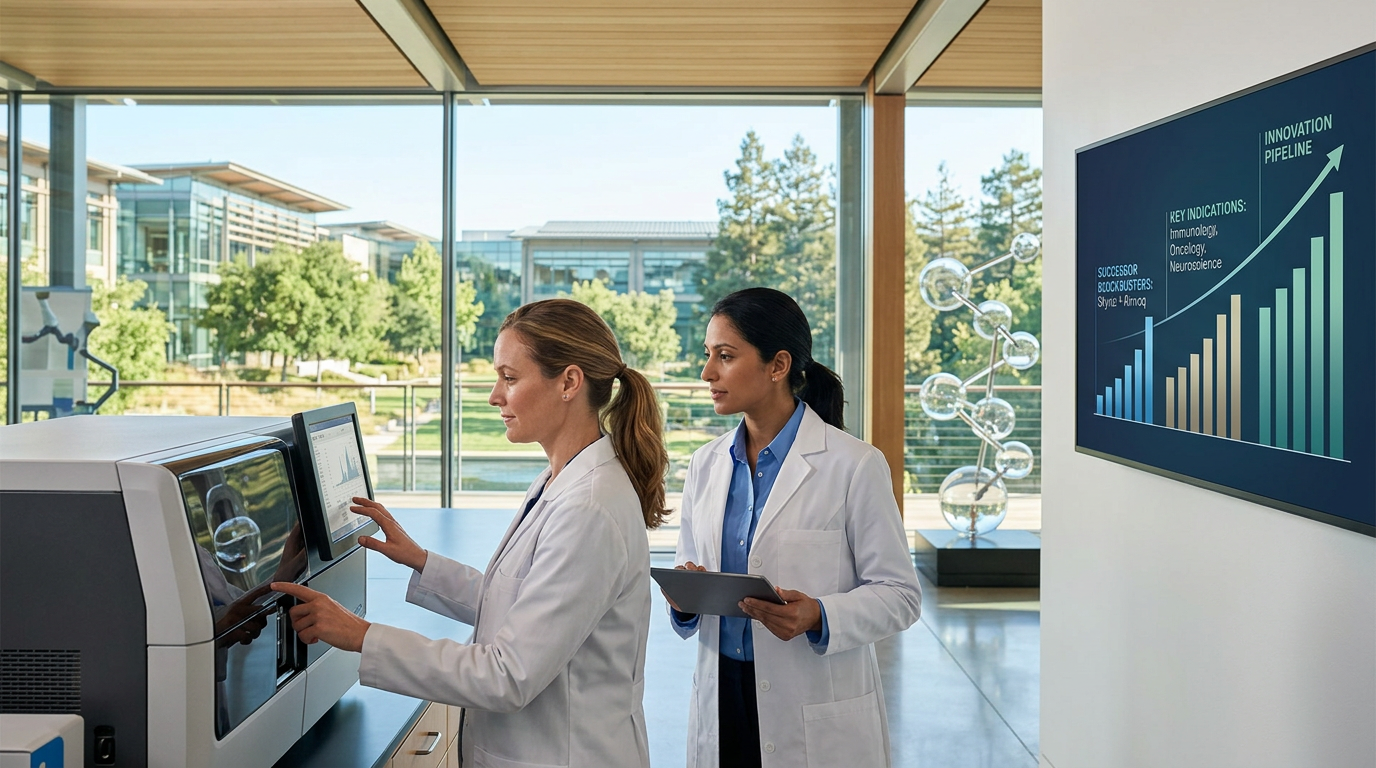
Somewhere between 2023 and now, AbbVie quietly pulled off one of the more impressive corporate turnarounds in modern pharma. The company that was supposedly headed toward a slow revenue collapse after losing Humira’s exclusivity is instead reporting $15 billion quarters, expanding margins, and hunting for its next set of blockbusters.
The market still sometimes treats this like a post-cliff recovery story. It is not. It is a new growth story in a different wrapper.
The Numbers That Reframe Everything
AbbVie raised its full-year adjusted earnings forecast after Q1 2026 results exceeded expectations, driven by strong demand for Skyrizi and Rinvoq as Humira continued its expected decline from biosimilar competition.
- Skyrizi global revenue: $4.48B (+30.9% year-over-year); Rinvoq global revenue: $2.12B (+23.3% year-over-year)
- Combined Skyrizi + Rinvoq Q1 2026: $6.6B
- Humira: $688M (-38.6% year-over-year) as biosimilar competition intensified
- Neuroscience revenues: +26% to $2.88B
- Adjusted diluted EPS: $2.65 (+7.7% year-over-year), beating consensus of $2.59
- Full-year 2026 revenue guidance: raised to ~$67.3B
What is worth sitting with here: Skyrizi and Rinvoq delivered a combined $25.9 billion in full-year 2025 revenue, clearing AbbVie’s original $27 billion 2027 combined guidance target two full years early. Management has since raised the combined 2027 target to more than $31 billion, and 2026 guidance alone now sits at $31.8 billion combined. AbbVie did not just survive the largest patent cliff in pharmaceutical history. It came out the other side with two blockbusters that are growing faster than Humira ever did.
The Acquisition Nobody Should Overlook
On June 22, AbbVie announced a deal to acquire Apogee Therapeutics for $135.11 per share in cash, valuing the company at roughly $10.9 billion. It is the largest acquisition AbbVie has made since its $63 billion purchase of Allergan in 2020. The deal is expected to close in Q3 2026, pending regulatory and shareholder approvals.
The center of the deal is zumilokibart, Apogee’s lead asset. It targets IL-13, a protein that drives inflammatory conditions including atopic dermatitis and asthma. In a Phase 2 trial, roughly two-thirds of patients achieved significant skin clearance at 16 weeks. What makes it interesting competitively: maintenance dosing could be as infrequent as twice a year, versus every two weeks for Dupixent. That is a meaningful convenience gap if late-stage data holds.
Slight tangent, but it matters for context: pharma dealmaking in the first half of 2026 has already been massive. The Apogee deal is one of several buyouts valued above $10 billion this year, part of a broader acquisition surge across the sector. AbbVie is not alone in spending aggressively right now.
One thing to keep in mind on Apogee: AbbVie expects the deal to be accretive to adjusted EPS beginning in 2032. That is a long runway, and the balance sheet will carry added debt in the meantime. Cash generation is substantial, but the leverage is real.
The Second Pillar Most Investors Are Underpricing
Neuroscience is building fast. Full-year 2026 guidance for the segment is $12.6 billion, with multiple drugs growing double digits. For the first time, Global Botox Therapeutic sales crossed $1 billion in a single quarter, coming in at $1.009 billion, a 16.5% increase. Management has said both the migraine and Parkinson’s franchises carry peak sales potential above $5 billion each, well above current Street models.
This is where it gets interesting. AbbVie started the decade as a one-drug company managing the exit of Humira. It is ending 2026 as a company with two large immunology blockbusters, a neuroscience franchise approaching $13 billion in annual sales, an aesthetics business, and an oncology platform. The diversification that was supposed to take years happened faster than most expected.
Cheaper Phones Could Send EarnPhone Soaring
Apple’s push for lower-cost Chinese memory chips says it all: the smartphone race is shifting toward phones more people can afford.
Mode Mobile is built for this shift. Their EarnOS turns everyday smartphone activity into earnings. Like Uber turned cars into taxis, Mode is turning phones into EarnPhones, reaching 490M+ users and helping them earn and save $1B+.
As AI demand grows, Mode’s first-party data economy could become more valuable for model training while users share in the upside. With 32,481% revenue growth and Nasdaq ticker $MODE secured, investors can still invest at $0.52/share.
Click to explore Mode’s pre-IPO offering before the share price changes.
Please read the offering circular at invest.modemobile.com. This is a paid advertisement for Mode Mobile’s Regulation A Offering.
Where the Risk Actually Lives
The bear case is not about current revenue. It is about 2030 and beyond. Skyrizi’s core U.S. composition-of-matter patent expires in 2033. For Rinvoq, AbbVie settled all patent litigation with generic challengers in September 2025, blocking any U.S. generics until April 2037, assuming pediatric exclusivity is granted. That settlement added roughly four to five years of exclusivity beyond what the market had priced in.
Imbruvica is a different story. The IRA Medicare price negotiation is now in effect, with a negotiated price of $9,319 per 30-day supply representing a 38% reduction from prior list prices. That is real revenue pressure, even if Imbruvica is no longer the centerpiece of the company. Debt from the Apogee deal adds to the watch list. AbbVie will fund the $10.9 billion acquisition through debt. Free cash flow in 2026 is projected near $18.5 billion, which gives the company room, but the balance sheet is not pristine.
Three Ways This Plays Out
- Bull: Zumilokibart achieves blockbuster status in atopic dermatitis and asthma. Rinvoq wins new indications in vitiligo and alopecia areata. Neuroscience sustains double-digit growth through the decade. The stock re-rates as a quality compounder rather than a Humira recovery trade.
- Base: Skyrizi and Rinvoq sustain 20%-plus combined growth through 2027. The Apogee pipeline progresses on schedule. Neuroscience delivers mid-teens annual growth. EPS tracks toward the $14.08-$14.28 full-year guide.
- Bear: IRA price pressure spreads to additional AbbVie drugs in future negotiation rounds. Zumilokibart faces Phase 3 setbacks. Aesthetics softens in a weaker consumer environment. Multiple compression follows as debt weighs on sentiment.
Skyrizi and Rinvoq have already surpassed Humira’s peak revenue trajectory on a combined basis. Neuroscience is building a second large pillar. And the $10.9 billion Apogee deal adds a pipeline candidate with genuine blockbuster potential at a convenient dosing interval that could take real share from Dupixent.
Q2 2026 earnings are scheduled for July 31. What management says about the combined revenue exit rate and first commentary on Apogee integration will determine whether the market finally prices this company for what it has actually become.