
July 4, 2026
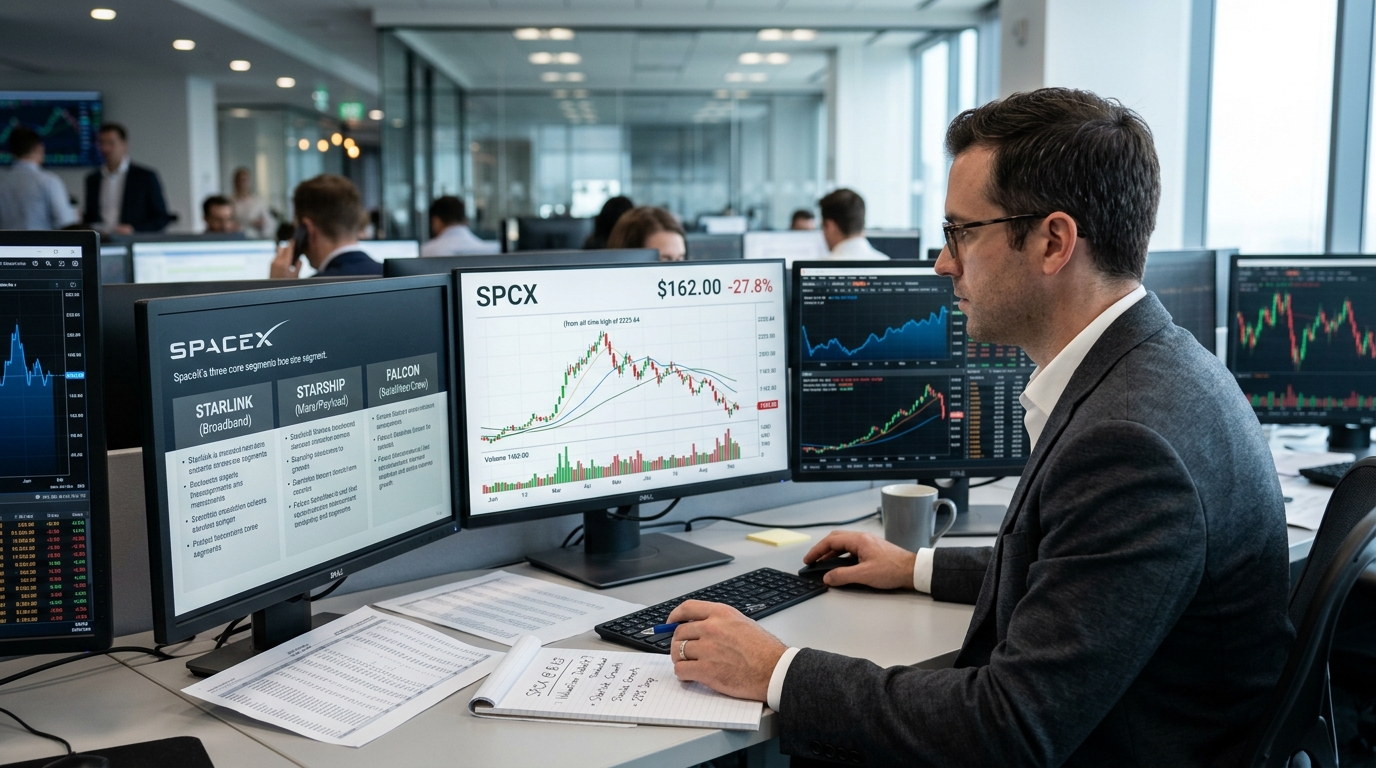
SPCX Is at $162. The Real Debate Starts Now.
First a note from T3 Trading
Most retail traders are chasing the same handful of names.
NVDA. AAPL. TSLA. The magnificent seven.
Adam Mesh is trading something else entirely.
Here’s what’s in his book right now:
- SNDA – opened Feb 26. +$203. Still open.
- OWL – opened March 5. +$735. Still open.
- BB – opened April 21. +$474. Still open.
- ASPI – opened April 23. +$800. Still open.
- NOK – opened April 30. +$480. Still open.
- BULL – opened May 14. +$156. Still open.
Six open options trades. All in the green. Three months running.
Not a magnificent seven name on the list.
…Not because he hates them – because his strategy doesn’t need them.
His four–strategy playbook works on any liquid optionable name. Big cap. Small cap. Boring legacy companies. Forgotten tickers. Doesn’t matter. The structure of the trade is what does the work, not the ticker.
Which is the whole point. Most retail traders blow up chasing the shiny names everyone else is chasing.
Adam’s been doing the opposite for 30 years and recently hitting a 70 to 80 percent win rate doing it.
He just put together a free video that walks through the four strategies.
Click here to watch the free video on how he makes these trades →
You’ll see how the trade structure works. Why he doesn’t need the headline names. And how to spot setups Wall Street is ignoring.
Adam’s a full–time options trader, 30 years. Sold his trading company twice. He’s been on NBC’s Average Joe, the Tonight Show, and every business network you can name.
Click here to access the free options video →
– Adam Mesh
FEATURED
SPCX Is at $162. The Real Debate Starts Now.
The confetti has settled. The Nasdaq crowd has gone home. And SpaceX, which completed the largest initial public offering in history on June 12, is now trading around $162 — down roughly 28% from its intraday all-time high of $225.64 reached just four days after listing.
Most people are reading this wrong.
The story right now is not that SPCX had a massive IPO. SpaceX priced 555.6 million shares at $135 on June 11, raising approximately $75 billion (rising to $85.7 billion after underwriters exercised the greenshoe option) at a valuation of $1.77 trillion — surpassing Saudi Aramco’s 2019 record by a wide margin, making it the largest equity offering in history. That part everyone already knows. What the market hasn’t fully worked through is what you’re actually buying when you buy SPCX at $162.
Don’t dive into options blind – get a “battle-tested” strategy FREE today – ticker included
Ready to dive into options? Don’t go in blind. Dave Aquino’s 11-Hour Options for Beginners guide is so much more than just theory. Inside, he gives you a detailed, plain English walkthrough of his “rinse and repeat” strategy for consistent income in crazy markets, PLUS the exact ticker he’s used nearly 900 times with a 95.3% success rate.
Claim your copy of Dave’s 11-Hour Options for Beginners guide…HERE
Here’s where it gets interesting.
The investment case for SpaceX rests on three pillars: the rapidly expanding Starlink satellite internet constellation, the Starship launch vehicle program, and the company’s AI operations through the xAI merger completed in February 2026. Three businesses. Three different economics. Three different timelines. And right now the market is slapping one multiple on all of them.
Let’s start with the part that actually makes money today. Starlink generated $11.4 billion in revenue in 2025 and $4.4 billion in operating profit, with its subscriber base growing from 4.4 million at end of 2024 to 8.9 million by end of 2025 — then reaching 10.3 million across 164 countries by March 31, 2026. That is a real business. A fast-growing, high-margin telecommunications franchise that already rivals some of the best software companies on the planet by margin profile.
Then there’s xAI. This is the part that makes the valuation math uncomfortable.
In 2025, the AI segment posted a $6.36 billion operating loss on $3.2 billion in revenue. The losses are accelerating: xAI burned another $2.47 billion in just Q1 2026 alone, and AI capital expenditures hit $7.7 billion in that single quarter — 76% of all company capex for the period. So Starlink is funding a cash-burning AI unit that is consuming the majority of the company’s capital. That is not a knock on the long-term vision. It is just context for where the risk actually lives inside SPCX today.
Slight tangent, but it matters: SpaceX just joined the Nasdaq-100 on July 7, creating mechanical, price-agnostic buying pressure from index-tracking funds. J.P. Morgan estimated Nasdaq-100 inclusion alone could trigger roughly $4.3 billion in forced passive demand. Russell index inclusion adds another estimated $3 billion. The float is extraordinarily tight — only about 4.3% of total shares are publicly tradeable — which means these flows land in a very shallow pool. That mechanical bid is real. It is not the same thing as fundamental value. But it is a legitimate reason why the stock may hold better than pure valuation math suggests in the near term.
The bear case has a number. Morningstar values SpaceX’s current business at roughly $780 billion — less than half its IPO valuation — citing xAI as a material threat of value destruction and describing the company’s economic moat as indeterminate. Their analyst Nicolas Owens ran a probability-weighted discounted cash flow model that put fair value at $63 per share.
The bull case also has a number. Analysts carry an average 12-month price target of around $188 to $210 depending on which consensus you use, with the most bullish targets reaching $310. The wide gap between $63 and $310 tells you everything about what kind of stock this actually is. SPCX is not a value stock. It is not even a growth stock in the traditional sense. It is a bet on a very specific version of the future.
“My system said ‘SELL’ right before this stock tanked. Today, I’m shouting ‘BUY NOW’ before it soars.”
In 2023, Marc Chaikin’s system flashed bearish on an automotive company no one had yet heard of. The stock crashed 35%. Today, his system rates this company “Very Bullish” and Marc calls it a screaming buy thanks to a new “groundbreaking partnership” with Nvidia that hands this company the keys to the self-driving kingdom on a silver platter.
SpaceX is expected to release its first publicly audited earnings report in early August — widely cited as August 6, though not officially confirmed as of this writing. That will be the first real data point the market gets to stress-test the whole thing. Watch xAI capex guidance and Starlink subscriber trajectory. Those two numbers will set the tone for the second half of the year.
The better reading here is that buying SPCX at $162 is a bet on the 2030s, not the 2026 income statement. That can still work for long-horizon holders — but it leaves very little cushion for launch failures, Starlink competition from Amazon’s Project Kuiper, or governance surprises tied to a founder who simultaneously runs Tesla, the Boring Company, and several other ventures.
The pullback from $225 to $162 is not a crisis. It is the market finding its footing on a genuinely unprecedented asset. The three-business model is real. The valuation gap between bulls and bears is unusually wide. Early August closes some of that gap.
Until then, the float is thin, the passive bid just arrived, and nobody actually knows what xAI is worth. That combination makes this one of the more interesting situations in the market right now. Not necessarily cheap. But very far from boring.