The question going into today was whether Novo Nordisk’s first full Capital Markets Day under CEO Mike Doustdar would be a turning point or another delay. Investors got concrete numbers. The stock dropped anyway, and that reaction tells you almost everything about the credibility gap Doustdar still has to close.
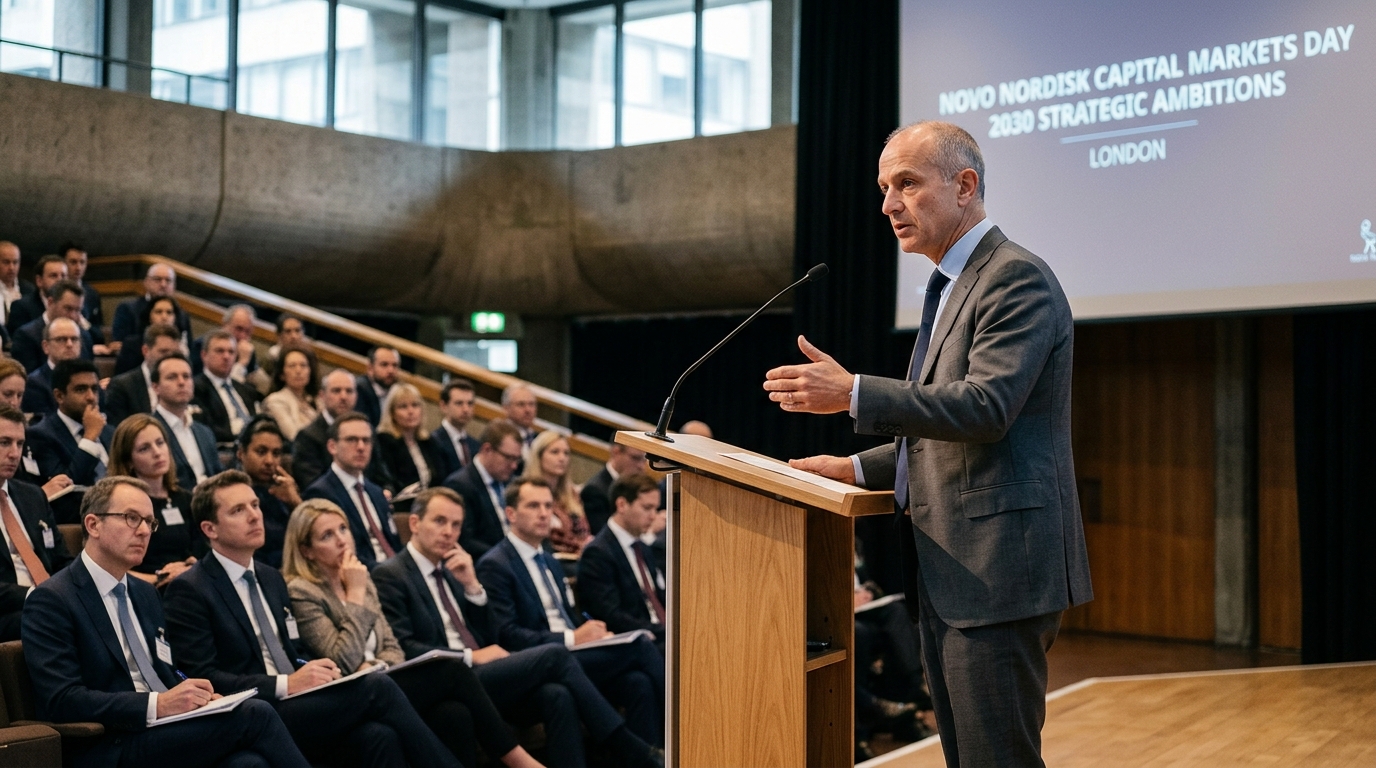
Novo shares fell as much as 7% on Monday after the company laid out new growth ambitions to revive its fortunes in the booming obesity drug market. The session ran from 09:00 to 15:30 BST in London, with Doustdar and his senior team covering corporate strategy, R&D, U.S. commercial operations, manufacturing, and financials across a six-hour presentation.
What Doustdar Actually Said
The company said it aims to launch more than five drugs with multi-blockbuster potential by 2030 and generate more than 150 billion Danish kroner ($23 billion) in risk-adjusted pipeline sales by 2035. It also expects revenue growth between 2026 and 2030 to be in line with a defined group of industry peers. The company aims to deliver a 2026-2030 revenue CAGR in line with that peer group, maintain a broadly stable operating margin based on adjusted metrics, and maintain an attractive dividend per share.
Novo Nordisk plans to scale capacity so it is able to serve 10 times more people with obesity on oral GLP-1 and aims to serve more than 60 million patients globally by 2030. Novo Nordisk targets at least five Phase 3 programmes in obesity and diabetes and at least five Phase 3 programmes in other therapy areas, including new and current programmes.
Doustdar addressed the patent clock directly. He told investors that the elephant in the room was that semaglutide, the active ingredient in Wegovy and Ozempic, will lose key exclusivity in the early 2030s, a long-discussed concern for a franchise where the U.S. is a central profit pool. This loss of exclusivity is what is on most people’s mind, and rightfully so, Doustdar said.
Why the Market Said No
The company itself flagged in its materials that the 2030 ambitions are inherently uncertain and do not constitute Novo’s financial outlook or guidance. That caveat matters. Investors had explicitly asked for binding medium-term financial targets. What they received were ambitions benchmarked against a peer group, without a specific revenue figure or a stated margin floor attached.
Novo’s share price has fallen about 70% from its June 2024 peak, while Lilly’s has surged. Sales of Lilly’s rival Zepbound treatment are expected to outpace Wegovy this year by more than $7 billion, according to LSEG data cited in reports on Monday. That competitive gap, combined with the recent ziltivekimab setbacks, left analysts wanting a harder promise than peer-level CAGR language could provide.
Sydbank analyst Soren Lontoft Hansen had framed the stakes before the event: “It will be a very tough task actually to convince the market that the company is in really good shape because of the competition from Lilly, the price pressure, and also the patent expiry of semaglutide at the beginning of the next decade.”
What to Watch From Here
The bull case still exists. On the company’s Q2 2026 call, EVP of U.S. Operations Jamey Millar called the Wegovy pill the strongest ever GLP-1 launch by volume, and the company has said total prescriptions since launch have exceeded five million, with the pill holding around 90% of the U.S. oral obesity medication market after a competitor launched in early April. An oral GLP-1 with that kind of velocity is a real commercial asset, and Doustdar’s plan to scale capacity tenfold for it is the clearest path to re-engaging institutional buyers.
The bear case centers on timing. As semaglutide protection fades, investors will care less about this year’s prescriptions and more about what cash flows look like in the years after competition intensifies. CagriSema’s U.S. approval decision is expected at the end of 2026, and its outcome will do more to validate or destroy the 2030 pipeline thesis than anything presented in London today.
Doustdar’s first major investor presentation moved the conversation from aspirations to structured ambitions. Whether the market treats that as progress or a rebranded version of the same uncertainty will become clear when Q3 results land on November 4.