
The federal spigot just tightened. The Infrastructure Investment and Jobs Act (IIJA) injected billions into drinking-water and wastewater programs across federal fiscal years 2022 through 2026, including supplemental Drinking Water State Revolving Fund support tied to lead service line replacement and emerging contaminants such as PFAS. But the federal fiscal year ended September 30, and much of the IIJA’s incremental, time-bound surge funding is now rolling off with no clear replacement package in place. The timing matters because the underlying need keeps growing: the American Water Works Association estimates that sustaining safe, reliable drinking water service through 2050 requires approximately $90.2 billion per year, while utilities currently spend about $33.6 billion annually, leaving a $56.6 billion gap.
That gap is doing something concrete right now. It is pushing mid-size municipalities toward a delivery model that was previously reserved for water-scarce island economies and drought-stressed Texas towns: Water-as-a-Service.
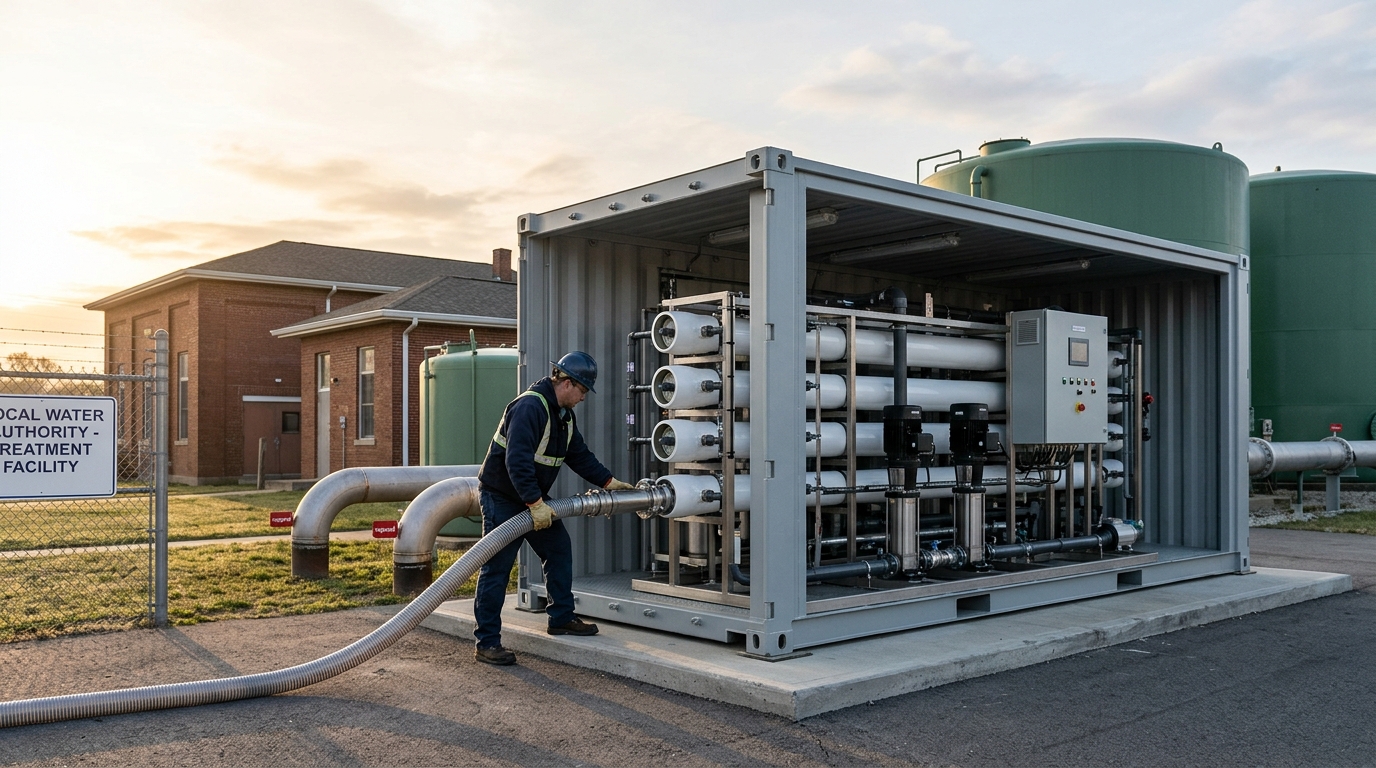
The mechanics are straightforward. Under a WaaS model, financing is provided by the operator, who takes on responsibility for plant construction and assumes operational and maintenance risks through build-own-operate or build-own-operate-transfer agreements. Customers pay for delivered water at contract terms tied to quality and performance, with far less capital procurement and operational complexity required on the municipal side. The modular RO plant arrives, the contract begins, and the city can avoid a bond issuance entirely.
The economics were already competitive in edge cases. Seven Seas Water Group’s project with the City of Alice, Texas illustrates the calculus: Alice had long relied on imported raw-water supply, and Seven Seas advanced a brackish-water reverse osmosis desalination facility under a long-term service agreement designed to minimize upfront municipal capital. Public descriptions of the project cite an initial capacity around 2.7 MGD with expansion options.
The funding rollover sharpens that logic for a much wider set of buyers. EPA’s most recent national assessment of clean water needs puts the price tag at about $630.1 billion to repair and replace clean water and wastewater infrastructure nationwide over the next 20 years, and utilities face a long-run replacement cycle that will increasingly favor modular upgrades, digitized asset management, and performance-linked financing.
The hidden angle here is the credit dynamic, not the technology. Water-as-a-Service is a credit instrument first and a water technology second. When revolving-fund money was abundant and heavily subsidized, cities had little reason to hand their balance sheets to a private operator. As incremental federal support becomes less predictable, the relative appeal of WaaS contracts can rise. Operators who can absorb long-tenor risk and scale modular capacity across a portfolio start to look like a functional substitute for what state revolving funds have historically offered: long-duration, low-friction capital paired with implementation capacity.
The emerging “Adaptive Water Infrastructure as a Service” framing goes further, picturing water infrastructure as modular, service-oriented, and dynamically adaptable, often paired with real-time monitoring and more automated contracting concepts. That framing is still mostly academic, but the underlying shift is not. Municipalities that spent the last four years assuming federal capital would keep flowing now face a different set of choices. Modular RO on a service contract is no longer the fallback option. For a growing number of regional utilities, it is becoming the only realistic path forward.