November 4, 2026
A bottleneck in Renton is why 500 deliveries won’t happen in 2026, and why the next ramp slips into 2027.
Boeing’s Q3 earnings call last Tuesday contained a number traders needed to hear plainly: the company will not deliver roughly 500 737 MAX jets in 2026, and the production rate of 47 aircraft per month that management had promised by summer is now an early 2027 target. Boeing does not expect to significantly ramp up output of its best-selling 737 MAX until the second half of 2027, pushing the next milestone rate of 52 jets per month well past the original schedule.
For Traders Protecting a Nest Egg
If you’re trading with money you spent decades saving, one bad options trade hurts more than it should.
The first few checks on this list are all about protecting your account before you think about anything else.
The Smart Trade Options Checklist.
Normally $29.97. Free today.
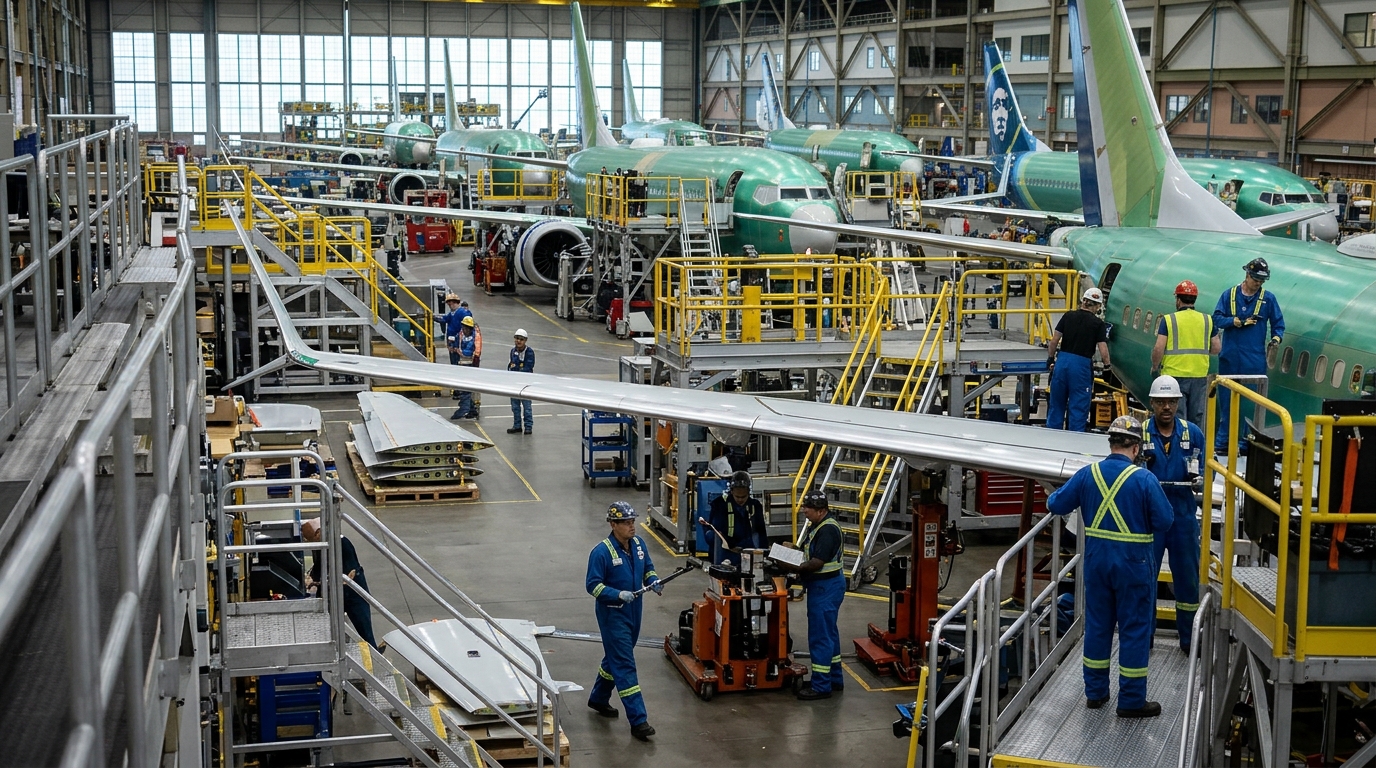
The specific culprit is not labor, not regulatory friction, and not demand. Wing production at the Renton, Washington, factory remains the most significant constraint, and Boeing has confirmed it will fall short of delivering around 500 737 MAX jets this year as a result. Process changes intended to accelerate the wing line did not deliver the expected efficiency gains. Management said some changes meant to speed up the line did not bring the intended savings, so the company is adding capacity where they fell short.
The delivery math is worth pinning down. Deliveries for the first nine months of 2026 rose more than 10% year-on-year, from 330 in 2025 to 367 in 2026. Progress, clearly. But Boeing averaged roughly 41 737 deliveries per month through the first nine months, below the pace needed in Q4 to hit an annual target of around 500. That gap is too wide to close in one quarter, particularly with wing output still below the required pace.
Meanwhile, the new 737 production line in Everett adds another variable. To reach 47 jets per month, Boeing needs the Everett facility, which opened in July, certified and integrated into the production system for rates above 47, and it also needs fuselage output from Wichita to keep up. CEO Kelly Ortberg said Everett needs to be certified and operating as part of the production system before Boeing can move to the higher rate. FAA oversight of a new production line is not a fast process.
Former Congressman Ron Paul’s Biggest Warning Yet
They mocked him for warning about the housing bubble. Then 2008 happened. They called his predictions about the dollar crazy. Now groceries cost double what they did in 2020. Today, at 91 years old, Dr. Ron Paul is stepping forward with what may be the most important warning of his life: a crisis he believes could wipe out the savings of millions of Americans.
FAA certification timelines are only one layer of the production constraint. Supply-chain bottlenecks in aerospace castings have forced engine makers to acquire their own suppliers rather than wait for the market to resolve the problem.
Commercial Airplanes, Boeing’s largest segment, is still losing money, with management putting the unit’s operating margin at negative 6.5% in Q3 2026. Every delayed delivery is a delayed cash receipt, which is why CEO Ortberg’s path to $10 billion in free cash flow by 2029 depends almost entirely on the 737 system stabilizing and the wing line problem getting solved, not on defense contracts or services revenue.
Boeing stock fell 10.7% the day results dropped, while the S&P 500 rose 0.6%. It recovered about 2.2% on November 2, but the structural question has not changed. A buyer at this price is betting that Boeing fixes a real problem, not that the market has overlooked a sound business.
Strange “Loophole” Allows Anyone to Collect “SpaceX Royalty” Payouts
Thanks to a little-known loophole…
Mainstreet investors can collect a fair share of a $3.6 billion payout from what Marc Lichtenfeld calls “SpaceX Royalty Shares…”
It’s all thanks to a “loophole” in the U.S. tax code…
The delivery shortfall lands directly on airline capacity planning. American, United and Southwest were already trimming schedules before this delay news, leaving carriers with fewer options to offset rising operating costs.
What to watch: Wing output per week at Renton is the leading indicator. Boeing’s commercial backlog stands at $612 billion, covering more than 6,300 planes. The demand is not the issue. The question is whether the Renton line can accelerate fast enough to make the 47-per-month rate stick in early 2027 before management needs to revise guidance again.