
The question that every Nvidia portfolio manager is sitting with this morning is not whether the scandal ends. It is whether the market has priced it correctly. The answer, right now, is that it probably has not.
Why Institutions Cannot Look Away
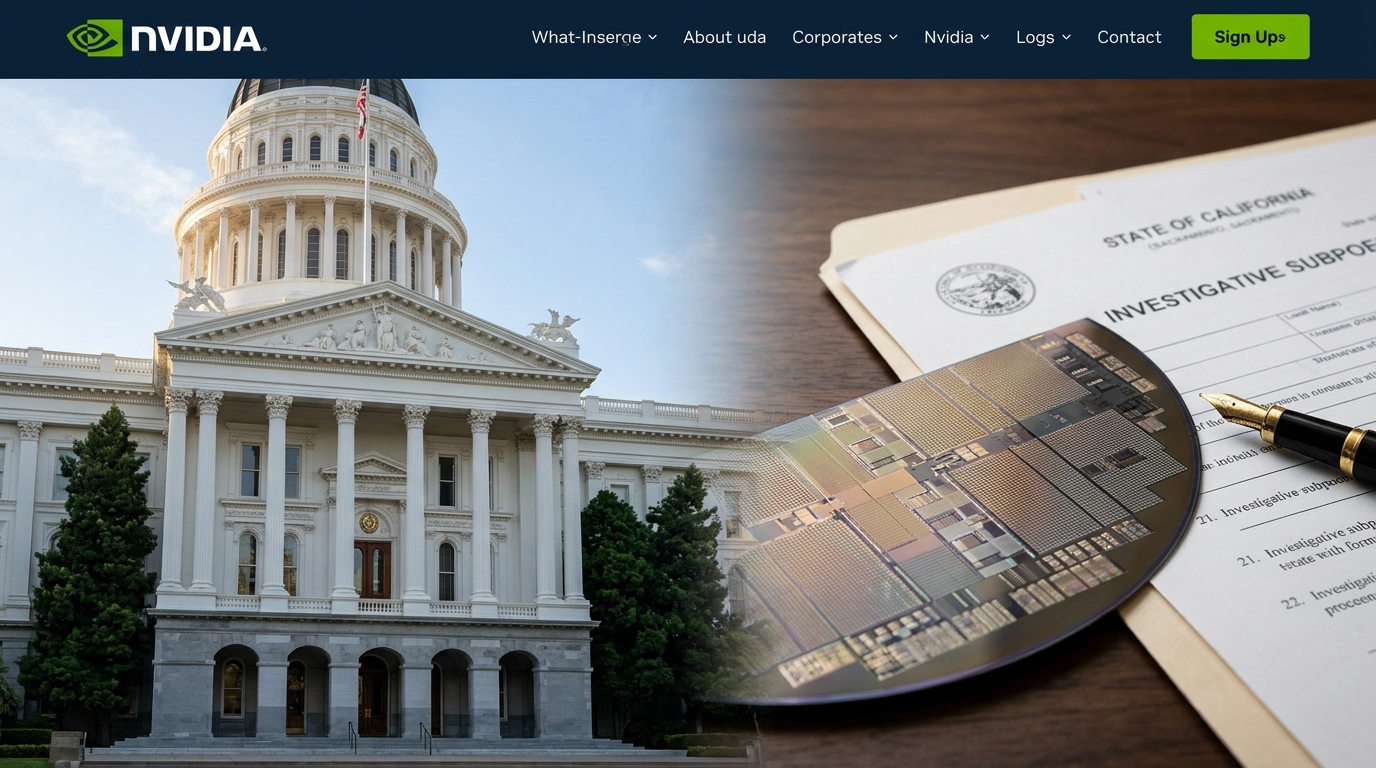
Last Thursday, California Attorney General Rob Bonta served Nvidia with an investigative subpoena. That alone was manageable. What changed on Friday was the scope. Bonta said there are a variety of California laws that could have been broken if Nvidia or former CEO Jensen Huang gave false information to the public about chip sales to China, widening a probe that already covers potential criminal violations of state law. This is no longer a federal enforcement story. Because Nvidia is headquartered in Santa Clara, the state has jurisdiction to pursue possible breaches of its own laws.
Whether criminal charges will be filed depends on the facts uncovered during the investigation, including when individuals became aware of the issues and their intent. That is the most important sentence Bonta has said. It shifts the conversation from “will there be a fine” to “who knew what and when.”
The Evidence Is Getting Specific
The Financial Times, reporting this weekend, traced the smuggling architecture in detail. The FT analyzed corporate registry filings and described how multiple layers of companies were used to buy chips, route them through ostensibly legitimate customers, and then move them into China while shifting money offshore. Singapore-based Megaspeed has been identified in multiple reports as a key node in that alleged structure. Its Malaysian subsidiary was reported to have imported roughly $4.6 billion of Nvidia chips in the year to December 2025, with some of those chips suspected of flowing into China and being resold at large markups.
Reports describing the alleged diversion say smugglers used tactics like relabeling hardware and moving shipments overland across parts of China’s land border with Southeast Asia. Separately, the Institute for Progress estimates that by the end of 2026, Chinese entities could access about 1.05 million H100-equivalent chips of offshore computing power. That is not a rounding error. That is a years-long industrial operation.
The Testimony Problem
Former Nvidia CEO Jensen Huang has agreed to testify before the U.S. Senate in a public hearing, Reuters reported on November 20, as lawmakers probe allegations about Huang’s ties to a woman accused of being a Chinese spy. If the hearing proceeds as planned, it would be Huang’s first public testimony since he stepped down as Nvidia’s chief executive on November 12.
Public congressional testimony creates its own legal hazard. His testimony could expose inconsistencies between congressional statements, corporate disclosures, and evidence gathered by investigators. Every word Huang says on the record is now material to both the California criminal probe and a reported SEC inquiry. The compliance answers Bessent demanded in his November 15 Fox appearance are due around November 25. Bessent said whether Huang could return depended on “where the buck stops” in the ongoing compliance investigation into chip shipments to China.
What the Market Is Missing
Nvidia closed at $125.53 on Friday, November 20, a sharp 14% drop from the prior close. From its pre-scandal level above $200, that is a 37% decline. Wall Street’s consensus target sits near $247. The gap between where the stock trades and where analysts modeled it is real, but it was built on a business that assumed no criminal exposure, no CEO vacancy extending into 2027, and no supply chain under law enforcement scrutiny in four countries simultaneously.
The bull case leans on fundamentals: Nvidia generated about $215.9 billion in revenue in fiscal 2026, and demand for AI compute is not going away regardless of who runs the company. That is the strongest available argument for holding. The bear case is simpler. A state criminal probe that explicitly covers statements by Huang himself makes any quick reinstatement much harder for the board to justify, whatever the investor pressure. An extended leadership vacuum, combined with subpoenas touching revenue reporting practices and geographic disclosure methodology, is not a one-quarter reset.
Stocks to Watch
- NVDA: The central name. The valuation debate is real, but criminal exposure at the state level is a different category of risk than a typical governance scandal. Watch November 25 compliance disclosures as the first real signal.
- AMD: The clearest beneficiary if Nvidia’s compliance posture forces customers to diversify GPU sourcing. Enterprise procurement teams do not wait for verdicts.
- Broadcom: Custom silicon momentum accelerates every week Nvidia’s supply chain remains under law enforcement review. Hyperscalers with internal chip programs gain optionality.
- Palantir: Government AI contracts tied to export-controlled hardware become stickier if the Nvidia channel faces new scrutiny. The compliance angle quietly helps Palantir’s pitch to defense customers.