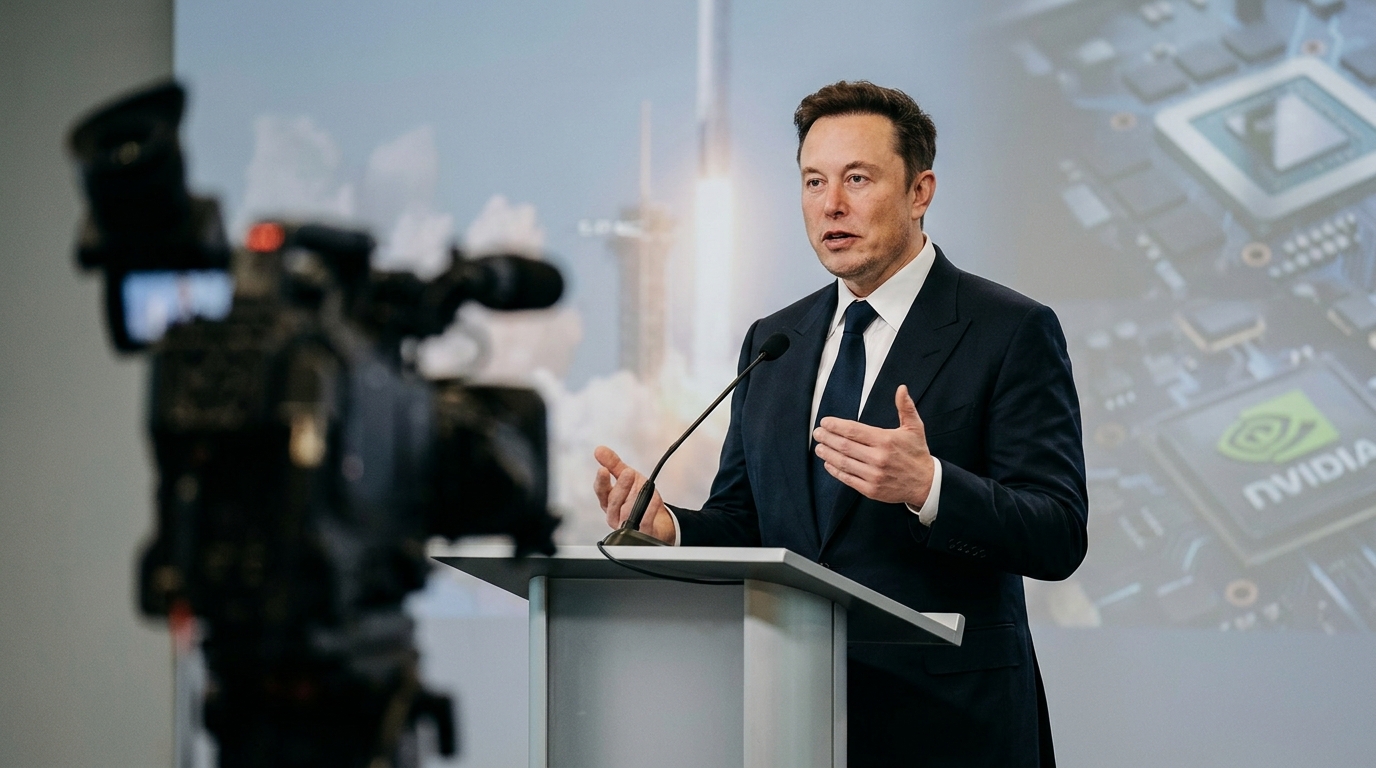
The AI compute buildout now has a visible dividing line, and Elon Musk drew it himself on Sunday, October 25, 2026. SpaceX is pursuing a roughly $40 billion debt financing tied to Nvidia GPU purchases, and Musk argued the deal is supported by SpaceX’s investment-grade ratings and recurring cash flows from Starlink and its launch business. Then he turned to everyone else. Musk suggested that debt markets had all but shut off for neoclouds depending solely on revenue from AI data centers, predicting that more than 200 of them would see “guppy-level death and consolidation.”
The structure matters as much as the size. The financing under discussion is designed to fund GPU purchases expected to arrive in the first and second quarters of 2027, and Musk has described the debt as callable. Earlier reporting described the package as roughly $10 billion in bank loans and $30 billion in investment-grade debt, though pricing and final terms were still being negotiated as of the weekend. A special purpose vehicle would keep the borrowing off SpaceX’s balance sheet, helping protect its investment-grade ratings, with Goldman Sachs leading talks alongside investors including Apollo Global Management. Note that Bloomberg reported pricing discussions were still ongoing as of Sunday, so the precise terms remain fluid.
The credit case for SpaceX rests on something no pure compute firm can replicate. SpaceX received investment-grade credit ratings on June 18, 2026, after its IPO: S&P Global Ratings at BBB with a stable outlook and Moody’s at Baa1 with a stable outlook, with Fitch also assigning an investment-grade rating. Moody’s highlighted Starlink as a key driver of cash flow and a factor reducing dependence on launch revenue alone. In SpaceX’s quarterly filings, the company reported that its Connectivity segment generated about $5.25 billion in Q3 2026 revenue, with a roughly 45% GAAP operating margin, and it reported 13.6 million Starlink consumer subscribers as of September 30, 2026. That is recurring, contracted cash that credit committees can model. GPU rental revenue tied to a handful of AI customers is not the same asset.
The CoreWeave Mirror Image
CoreWeave is what the other side of Musk’s divide looks like in practice. As of late June 2026, the company reported about $35 billion of debt, plus roughly $16 billion of debt-like lease liabilities, totaling roughly $51 billion of debt and lease obligations tied to its buildout. Recent reporting has highlighted how quickly investor sentiment can shift when leverage, customer concentration, and refinancing needs collide, and CoreWeave’s unsecured bond market has been effectively closed for months. The cost of insuring CoreWeave’s debt against default rose sharply, and reporting in October put unsecured yields in the mid-teens, with some unsecured bonds trading at discounts.
The credit market’s verdict on overleveraged infrastructure borrowers did not begin with CoreWeave. Oracle’s own credit rating was downgraded as bond investors concluded its negative free cash flow made it an infrastructure borrower, not a software company.
The structural vulnerability is not hard to find. Part of CoreWeave’s capital stack is unsecured at the parent, including convertible notes, and that unsecured layer is where markets tend to crack first when confidence fades. The short version is simple: lenders are not afraid of GPU-backed debt per se. They are afraid of unsecured GPU-company debt with customer concentration and no revenue diversification.
Who Survives
The bifurcation Musk described is already sorting the field. Oracle illustrates a second path to durability, but not for the reason in the original framing. Oracle already reported its fiscal Q1 2027 results on September 10, 2026. Oracle posted record Q1 total revenues of $19.3 billion, up 30%, with cloud revenues rising 62% to $11.6 billion, including 121% growth in cloud infrastructure. Oracle has also discussed deal structures that reduce the amount of Oracle-funded hardware it must carry on its own balance sheet, including customer prepayments and customer-provided hardware in some large AI arrangements. Customer-funded capex is a different credit profile entirely from debt-funded GPU speculation.
Nvidia sits at the center regardless of who wins. Every dollar of SpaceX’s roughly $40 billion eventually reaches Nvidia’s order book, as does CoreWeave’s spending. The chip maker’s revenue does not depend on its customers’ solvency in the short run. The longer-run question is whether a wave of neocloud consolidation depresses future GPU procurement cycles once distressed balance sheets are restructured at lower capacity targets.
The investment committee takeaway: the AI infrastructure trade is bifurcating into creditworthy operators with diversified revenue, and overleveraged pure-compute lenders whose refinancing windows are closing. Musk warned that more than 200 neocloud companies could face widespread failures and consolidation as debt financing tightens. That is not a reason to exit the theme. It is a reason to own the companies that lenders are still calling back.