
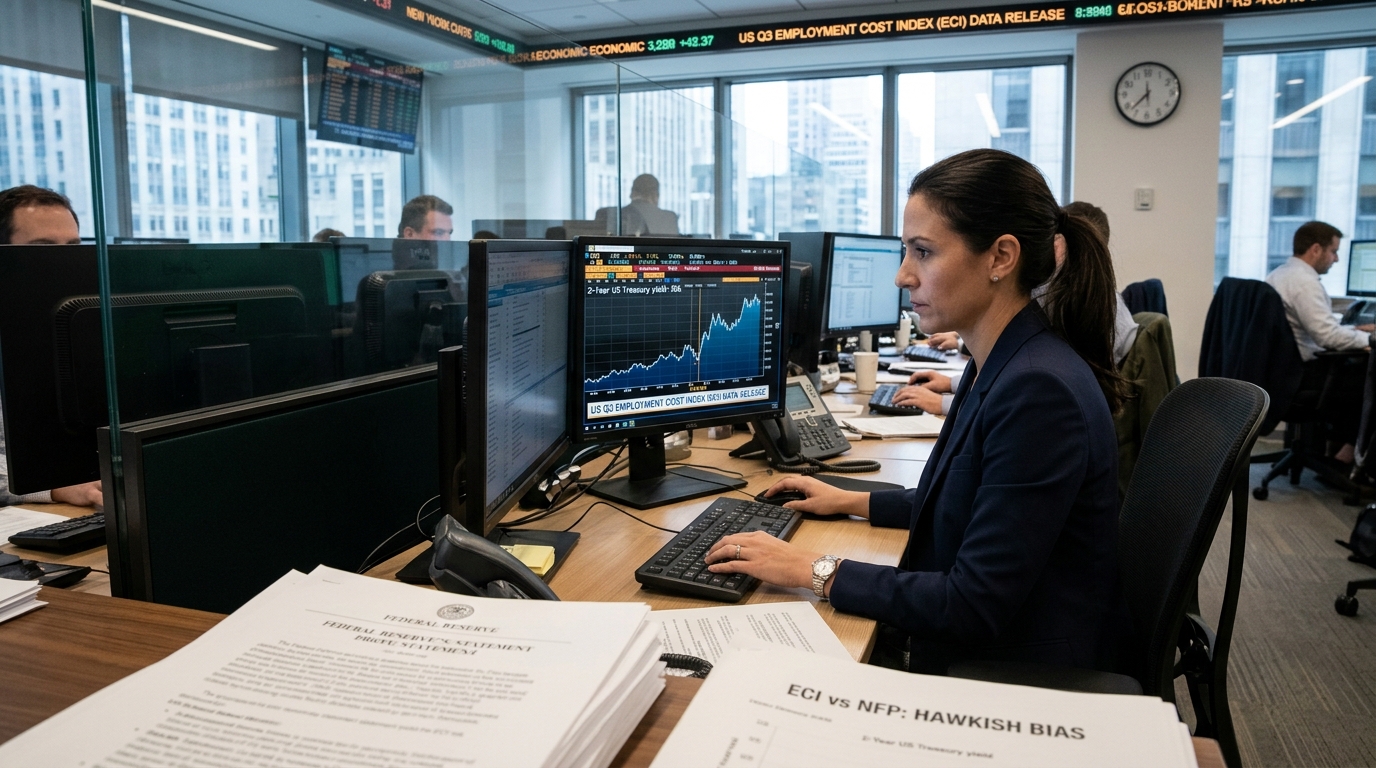
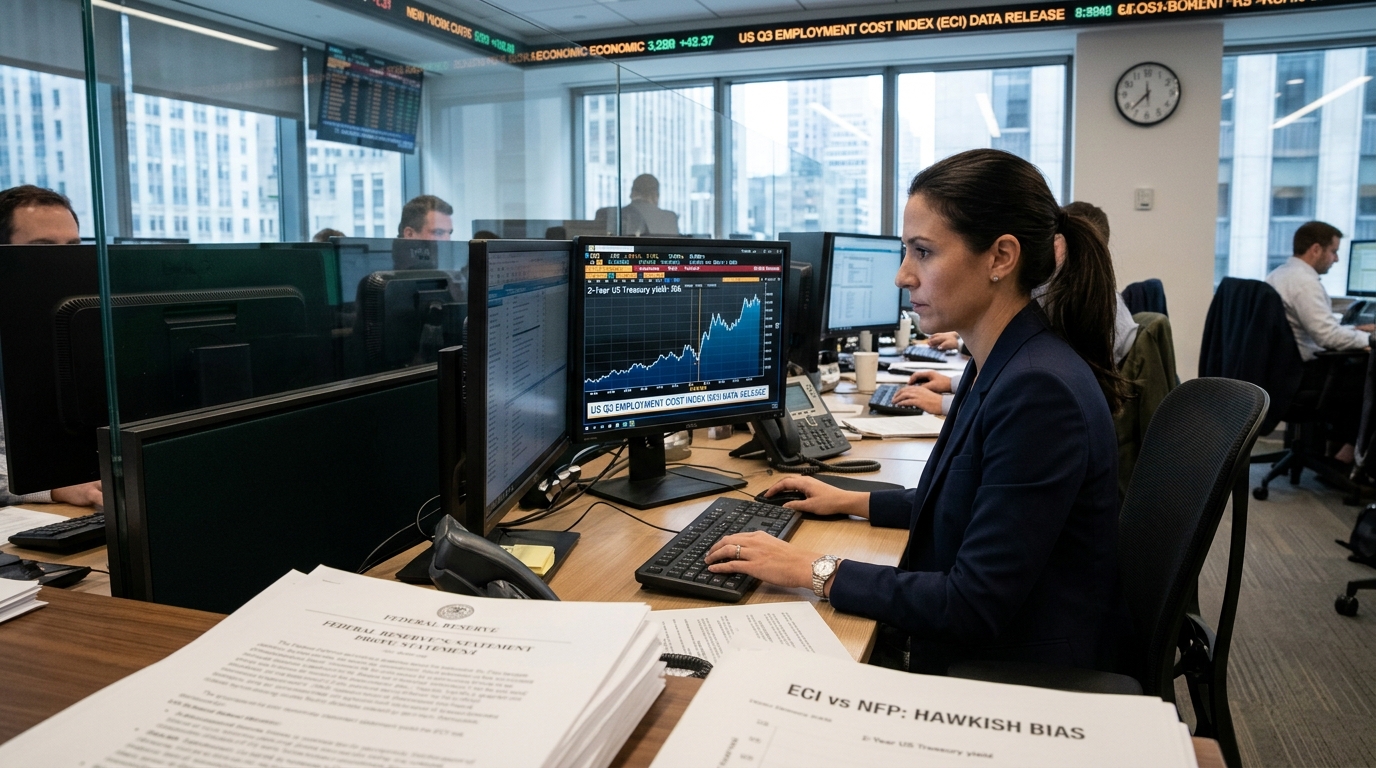
Every Friday morning has a headline number. Today’s is different. The Bureau of Labor Statistics releases the Q3 2026 Employment Cost Index at 8:30 a.m. ET, and this one arrives with more policy weight than any wage report in years. The context is what makes it matter: on October 28, the Federal Reserve kept rates unchanged at 3.75% to 4.00%, with two officials voting for a 25-basis-point increase. Governor Lisa Cook and Cleveland Fed President Beth Hammack preferred a 25 basis point hike, according to the FOMC statement.
After the decision, futures markets shifted to price a higher likelihood of a December 9 hike. The backdrop from Thursday only added fuel: real GDP rose 3.4% annualized in Q3 2026, up from 2.2% in Q2, while core PCE was 3.1% in September. The hawks have everything they need to make the case. What they are waiting on is the wages.
Why This Number and Not Average Hourly Earnings
Traders who watch the monthly payrolls release and assume they have read the Fed’s wage signal are reading an incomplete version of the story. The Fed has long treated the Employment Cost Index as a key gauge of labor-cost pressures, and it often carries more signal value than average hourly earnings. The reason is methodological, and it is not a small distinction.
Unlike average hourly earnings, which can be distorted by compositional shifts in who is employed across the business cycle, the ECI uses a fixed-weight methodology that holds the occupational and industrial mix constant across quarters, making it a far purer read on underlying wage inflation dynamics. The ECI is designed to limit the mix-shift effects that can whipsaw average hourly earnings when employment changes disproportionately hit low- or high-wage workers. When Cook or Hammack quote a wage number at the December 9 meeting, it will be this one.
The Two-Year Treasury Is the Instrument to Watch
Before the number drops, the two-year yield is trading near 4.59%. That drift lower reflects some relief after Thursday’s split signal: strong GDP paired with a core PCE reading that, at 3.1%, stayed uncomfortably above target but did not accelerate.
The two-year yield’s sensitivity to incoming data has been building for weeks. The September CPI showed how a single inflation print can reprice the entire December rate path when the bond market is already stretched.
The ECI changes that equilibrium. Consensus sits at 0.8% quarter-on-quarter. If the ECI comes in hot, it will reinforce the argument that wage disinflation has stalled. With inflation resurgence already a live risk, any further upside surprise will solidify the Fed’s hike bias and could push the 2-year yield toward, and potentially above, 5.00%. A soft 0.7% or lower, conversely, gives pause advocates their first real piece of cover since September.
The hawkish base inside the Fed is wider than the two dissenting votes suggest. Discount-rate minutes exposed a broader coalition of regional bank directors pushing for higher rates than the official tally showed.
Watch the 2-year Treasury yield. It reacts to Fed expectations faster than most assets and often leads the dollar. The DXY reaction will follow the two-year, not the other way around.
The Trader’s Lesson
Not all data releases carry equal weight with policymakers, and confusing frequency with importance costs traders real money. Average hourly earnings prints every month. The ECI does not. The practical takeaway: when the quarterly ECI and the monthly jobs wages diverge, the ECI wins the argument inside the Fed building. Know which number the committee will cite in six weeks, and you know which number to trade today.