Editor’s Note: Over the past 20 years, Matt McCall has written up 50 stocks before they soared tenfold or more. Today he’s giving away a favorite new pick, free… at the center of what Dr. Mark Skousen calls “the most dangerous boom in history.” Click here to get the full details or read more below.
Dear Reader,
I recently sat down with Dr. Mark Skousen…
And he told me something that contradicts just about EVERYTHING we’ve been hearing about the stock market.
In short…
He says an astounding amount of money could flood into the markets in the years ahead.
We’re talking $60 trillion in new wealth up for grabs between now and 2029.
In my career, I’ve found 50 stocks before they soared tenfold or more.
(Most investors are lucky to see one ten-bagger in their lifetime.)
And I can tell you flat out…
I’ve never been more excited for what’s coming than I am right now.
See why here!
And as a special thank you for watching, you’ll get one of my favorite picks.
Regards,
Matt McCall
Editor, McCall’s Innovation Report
Musk Backs a Tesla-SpaceX Merger. The Math Fights It.
Elon Musk called a Tesla-SpaceX merger a good idea, then spent the next few sentences explaining why it might never happen. That gap is what traders need to sit with going into today’s session.
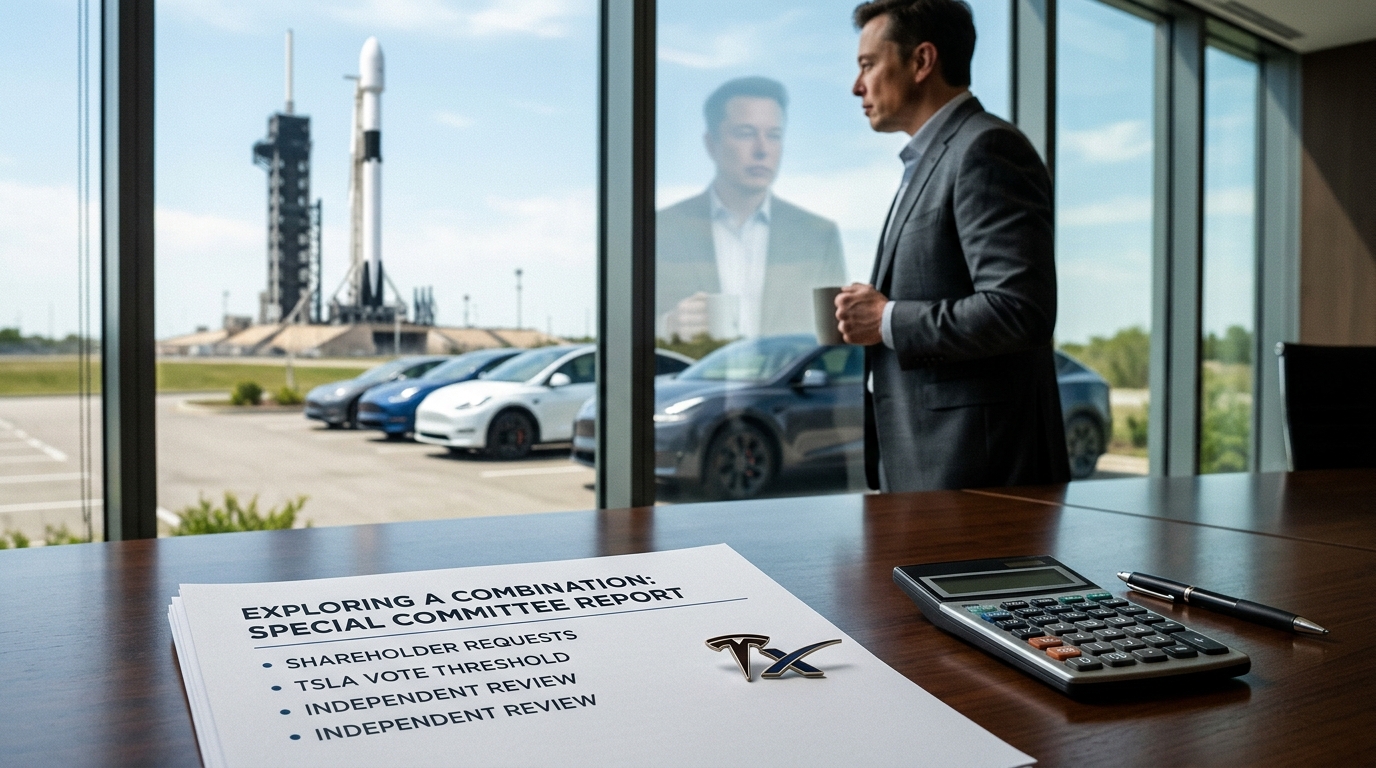
On SpaceX’s October 20 earnings call, Musk confirmed that both companies formed independent special committees of directors to explore a combination, disclosing that the move came at shareholder request. Because he runs both Tesla (TSLA) and SpaceX (SPCX), he is a conflicted party under securities regulations and cannot participate in either committee’s talks. He called the resulting dynamic “an odd kabuki dance where two groups of people are talking, and I can’t be in the conversation.”
Then came October 29. Musk publicly endorsed the idea. Asked whether a merger was worth doing, he said yes. Then came the hedge that matters most to anyone long TSLA: the approval threshold.
The 50% Wall
Tesla would need “a 50% vote of all shares, not just those who vote, but of all shareholders.” Musk called that “quite a high hurdle to try to achieve.”
Tesla reported 3,952,757,946 shares outstanding as of October 15, meaning a majority requires roughly 1.98 billion yes votes. Under that standard, every share whose owner ignores the proxy ballot counts the same as a no.
For context: if a merger vote drew the same turnout as a typical Tesla proxy, a deal would need a much higher percentage of votes cast to reach a majority of all outstanding shares. Under an “all shares” standard, low turnout is itself a headwind.
The vote math compounds a separate structural problem for bulls. Tesla’s automotive gross margin and capital spending trajectory were already the central debate heading into Q3 earnings, before merger speculation reset the conversation.
The gap between economic ownership and votes means SpaceX shareholders have little practical say, so the real check on the transaction sits on the Tesla side. Musk holds more than 82% of SpaceX’s voting power. Tesla is a different story: Musk beneficially owns 19.8% of Tesla’s shares according to the company’s latest proxy filing.
What the Filing Actually Says
The Tesla Q3 10-Q language is worth reading carefully. The committee was formed “to explore deepening Tesla’s relationship with SpaceX,” and a business combination is only one possible path listed “including without limitation.” That mandate is broader than a merger. Licensing deals, joint ventures and supply agreements all fit inside it.
As of October 31, neither company has disclosed a signed merger agreement in SEC filings. No exchange ratio, price, or timeline appears in Tesla’s filings.
What the Market Has Priced In
TSLA has already moved hard on the speculation. Tesla reclaimed $400, rising 4.04% to $407.46 on SpaceX merger hopes, recovering a level it had not held since July. Barclays upgraded Tesla to Overweight on expectations of a merger with SpaceX, and Bank of America has a Buy rating with a $460 target on Tesla.
On the shareholder pressure side, a shareholder letter urging the board to pursue a SpaceX merger was reported to have gathered 6,493 signers holding over 17.5 million shares within 48 hours. Even at 17.5 million shares, that would cover a small slice of Tesla’s nearly 4 billion shares outstanding, and Tesla’s December 3 annual meeting has no merger vote on the ballot.
SpaceX’s capital ambitions extend well beyond any Tesla tie-up. SpaceX’s $40 billion Nvidia GPU financing deal signals how aggressively the company is deploying cash independent of any merger outcome, which shapes the strategic calculus for both boards.
What to Watch
The stock has moved as if a deal is coming. The filings say committees are talking and nothing is agreed. Some market commentary has tied a recent drop in Tesla sell ratings to merger discussion, but the clean tell for traders is simpler.
Watch for any SEC filing that introduces exchange ratio language, a special meeting date, or a committee recommendation. Until one appears, the 1.98 billion vote problem Musk flagged himself is the only number that actually governs whether this happens.